


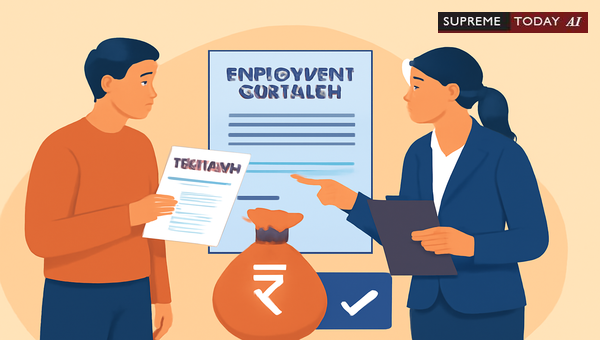
Can Companies Recover Advance Salary After Employee Resignation?
In today's fast-paced job market, employees frequently switch roles, often leaving employers in tricky financial situations. Imagine this: an analyst receives an advance on their salary to cover personal expenses, then resigns abruptly. Can the company claw back that advance? This question—Can a Company Recover Advance Salary from its Employee who was an Analyst after his Resignation?—arises often in HR departments and legal consultations.
While the answer isn't a simple yes or no, Indian employment law generally leans against automatic recovery post-resignation unless specific conditions are met. This post dives into the legal nuances, drawing from case laws and regulations, to help employers and employees navigate this issue. Note: This is general information based on analyzed cases and not specific legal advice. Consult a qualified lawyer for your situation.
The Effectiveness of Resignation: When Does Employment End?
Resignation marks the end of the employment relationship, but its timing is crucial. Courts have ruled that a , without always needing formal employer acceptance. In one key case, the court held that the resignation of an employee becomes effective upon submission, and the employer's obligation to accept or communicate acceptance is not always necessary 2022 0 Supreme(P&H) 683.
Once effective, the employee's departure severs ties, limiting the employer's leverage for recoveries. For instance, an employee's attempt to withdraw resignation after the notice period expires is invalid, as the relationship has terminated 2022 0 Supreme(P&H) 683. This principle applies even to roles like system analysts, where specialized skills don't alter basic resignation rules 2024 Supreme(Online)(Tel) 43657.
General Rule: Limited Recovery of Advance Salary Post-Resignation
Broadly, companies from a resigned employee, particularly if they've left the organization. Legal documents emphasize that without explicit contractual or statutory backing, such recoveries are not supported. The legal case emphasizes that an employee who has resigned and left the organization cannot be compelled to repay salary unless there are clear allowing such recovery 2022 0 Supreme(P&H) 683.
Regulations like Regulation 20 of the Officers' Service Regulations 1979 focus on notice periods and procedures but don't address advance salary recovery directly. General jurisprudence treats salary advances as part of final settlement upon resignation, not automatically reclaimable afterward.
Why Recovery is Challenging
- Termination of Obligations: Post-resignation, the employer-employee bond ends, ceasing mutual obligations unless specified otherwise.
- No Explicit Statutory Support: Absent laws mandating repayment, courts prioritize contractual clarity.
- Final Settlement Norms: Advances often adjust against dues during exit formalities.
Exceptions: When Can Companies Recover Advances?
Recovery isn't impossible—specific scenarios allow it. Courts uphold employer claims if:
- Contractual Clauses Exist: Employment agreements often require repaying advances upon resignation. For example, one policy states: Any employee who wants to resign shall tender his written resignation at least one month in advance... failing which he shall surrender one month’s salary 2012 0 Supreme(Mad) 2138.
- Notice Period Defaults: Employees paying salary in lieu or taking advances without serving notice may face deductions. Cases show demands for & 1) Three month last drawn salary: Rs. 1,70,675/- 2) Travelling Advance: Rs. 35,000 2025 Supreme(Online)(Gau) 8010 2025 Supreme(Online)(GAU) 1867.
- Breach or Misconduct: Fraudulent resignation or defaults justify recovery. In disputes, courts directed repayment for unserved notice or unrepaid advances 2024 Supreme(Online)(TEL) 361.
- Post-Acceptance Scenarios: Once accepted, unilateral withdrawal fails: It is not the case of the plaintiff that there is any rule or resignation which enables the employee to withdraw the resignation. In these circumstances, the is not binding on the appellant-company 2024 0 Supreme(P&H) 788.
In analyst cases, like a system analyst resigning after 18 years, courts examined service continuity but allowed recovery pursuits if defaults occurred 2024 Supreme(Online)(Tel) 43657.
Insights from Key Case Laws
Several judgments provide clarity:
- Resignation Irrevocability: Employers aren't bound by post-acceptance withdrawals, enabling recovery actions for dues 2025 Supreme(Online)(Gau) 8010.
- Mandates: In some, courts ordered full benefits till superannuation, adjusting prior payments: The respondent-Company is directed to treat the appellant in upto the age of superannuation... and give him all benefits including arrears of salary. The Company may adjust any amount paid 2024 0 Supreme(Bom) 716. However, this doesn't bar advance recovery if contracted.
- and Resignation: Resignation doesn't forfeit claims, but advance clauses stand separate 2025 Supreme(Online)(Ker) 15453.
- Withdrawal Rights: Employees can withdraw before acceptance if jural ties persist: Honble Supreme Court held that employee was entitled to withdraw his resignation even after his acceptance when a ... continued 2006 0 Supreme(Jhk) 821.
These cases underscore: recovery hinges on contract terms, acceptance timing, and defaults.
Practical Implications for Employers and Employees
For Employers (Especially in Tech/Analyst Roles)
- Draft Strong Contracts: Include clauses for advance recovery, notice pay, and post-resignation settlements.
- Document Everything: Track advances, obtain acknowledgments, and communicate dues pre-exit.
- Legal Recourse: Pursue civil suits for breaches, as courts enforce valid claims.
For Employees
- Review Contracts: Understand repayment obligations before resigning.
- Serve Notice: Avoid defaults triggering recoveries.
- Negotiate Settlements: Clear dues during exit to prevent disputes.
Recommendations mirror legal advice: Review the employment contract... If no such clause exists, the employer's claim... is weak 2022 0 Supreme(P&H) 683. Formalize policies to preempt issues.
Key Takeaways
- Generally No Automatic Recovery: Post-effective resignation, advances aren't reclaimable without backing.
- Contract is King: Explicit clauses enable recovery for notice defaults or advances.
- Case-Specific: Analyst or otherwise, outcomes depend on facts like acceptance and defaults.
- Proactive Steps: Employers, embed recovery terms; employees, comply to avoid litigation.
In summary, while companies face hurdles recovering advance salary after an analyst's resignation, strategic contracting and documentation tip the scales. Stay informed, as employment law evolves. For tailored guidance, reach out to legal experts.
References:- 2022 0 Supreme(P&H) 683 (Primary on resignation effectiveness)- 2025 Supreme(Online)(Gau) 8010, 2025 Supreme(Online)(GAU) 1867 (Advance and notice recovery)- 2024 Supreme(Online)(Tel) 43657, 2024 Supreme(Online)(TEL) 361 (Analyst cases)- 2024 0 Supreme(Bom) 716, 2024 0 Supreme(P&H) 788, 2012 0 Supreme(Mad) 2138, 2006 0 Supreme(Jhk) 821, 2025 Supreme(Online)(Ker) 15453
This analysis draws solely from cited documents. External laws may apply.
#EmploymentLaw, #SalaryRecovery, #ResignationRights















