


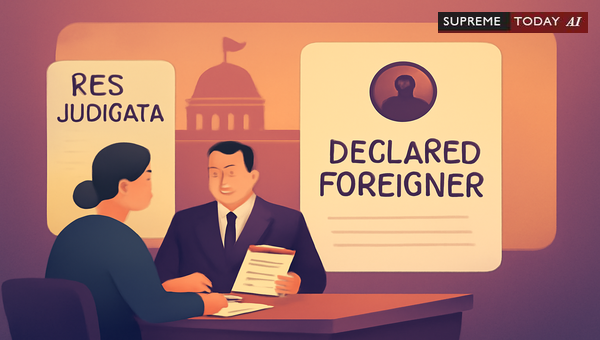
Declared Foreigner After Winning Tribunal Case? Understanding Your Legal Rights
This article provides general information on legal principles related to Foreigners Tribunals and citizenship determinations in India. It is not intended as specific legal advice. Consult a qualified lawyer for personalized guidance.
Imagine this scenario: You've fought a hard battle in a and emerged victorious, with the tribunal declaring you an Indian citizen. Relief washes over you—until, unexpectedly, in a subsequent proceeding, you're labeled a foreigner. Is this legally possible? The question at the heart of many such disputes is: A Person won the Case in Foreign Tribunal. Thereafter he was Declared Foreigner.
The short answer, based on established legal principles, is generally no. A prior favorable decision from a typically binds future proceedings under the doctrine of , unless that earlier ruling is properly challenged and set aside. This protects individuals from inconsistent and arbitrary declarations that could upend their lives. In this comprehensive guide, we'll dive deep into the legal reasoning, key court findings, and practical implications, drawing from authoritative sources.
The Principle of in Decisions
Foreigners Tribunals, established under the , and linked to the , play a critical role in determining citizenship status, particularly in regions like Assam amid processes. These tribunals issue , meaning they function like courts and their reasoned, final orders carry significant weight.
, a Latin term meaning a matter judged, is a cornerstone of judicial efficiency and fairness. It prevents the same issue from being relitigated between the same parties. Courts have repeatedly affirmed that this principle applies to tribunal decisions under the Foreigners Act. As noted in a key ruling: The principle of applies to , requiring reasoned orders for binding effect in subsequent proceedings. 2024 0 Supreme(Gau) 1199
In essence, once a tribunal has thoroughly examined evidence and declared an individual an Indian citizen, that finding becomes binding. A later tribunal cannot simply ignore it and issue a contradictory ruling without valid grounds.
Why Prior Tribunal Wins Matter
Tribunal proceedings are not casual administrative reviews; they involve evidence, hearings, and reasoned judgments. A final decision enjoys presumptive validity. Key points include:
- The decision of a , once final and reasoned, is binding under the principle of . 2024 0 Supreme(Gau) 1199
- A person declared an Indian citizen in a prior tribunal decision cannot be declared a foreigner in a subsequent proceeding without the earlier decision being effectively challenged and set aside. 2024 0 Supreme(Gau) 1199
- Failure by the tribunal to consider the earlier ruling or provide a reasoned order undermines the legitimacy of subsequent declarations of foreigner status. 2024 0 Supreme(Gau) 1199
This ensures consistency and prevents harassment through repeated challenges to citizenship.
A Real-World Case: Victory Followed by Reversal
Consider the facts from a pivotal case that illustrates this issue. The petitioner had previously won a case before a , where they were recognized as an Indian citizen. Yet, in a later proceeding—possibly initiated by new references or referrals—the same individual was declared a foreigner. 2024 0 Supreme(Gau) 1199
The court scrutinized this sequence and found the second decision flawed. The tribunal had failed to adequately address or give effect to the earlier ruling, which should have been binding unless successfully challenged. The court emphasized: tribunals must provide reasoned orders that engage with prior decisions. Without this, the subsequent order lacks legitimacy.
As a result, the court set aside the second order declaring the petitioner a foreigner and remanded the matter for fresh consideration. This outcome underscores that courts will intervene when tribunals disregard established precedents. 2024 0 Supreme(Gau) 1199
Broader Context in Indian Citizenship Law
Citizenship disputes have surged in recent years, especially in Assam, where over 1.9 million people received exclusion notices under the NRC, leading to thousands of tribunal references. The and High Courts have stressed procedural fairness. Ignoring a prior favorable tribunal decision not only violates but also risks violating (equality before law) and (right to life and liberty) of the , as arbitrary declarations can lead to detention or deportation.
Hypothetically, if new evidence emerges—such as forged documents from the original case—that might justify revisiting the matter. But mere disagreement or fresh suspicion isn't enough; the prior decision must be systematically challenged, perhaps via appeal to the under .
Exceptions and Limitations to the Binding Nature
No legal principle is absolute. There are narrow exceptions where a subsequent declaration might stand:
- Successful Challenge: If the earlier decision is appealed and overturned by a higher authority, like the or , it loses binding force.
- Distinguishable Facts: If the new proceeding involves entirely different grounds or documents not considered before, may not apply fully—but the tribunal must explicitly reason this distinction.
- Fraud or Collusion: Proven fraud in obtaining the prior decision could void it, though this requires strong evidence and judicial review.
Importantly, simply ignoring the prior ruling doesn't work. As courts have held, tribunals must confront and distinguish earlier decisions in their orders. Failure to do so invites judicial invalidation. 2024 0 Supreme(Gau) 1199
Practical Implications for Individuals Facing Tribunal Proceedings
If you've won a prior case, here's what this means practically:
- Preserve Records: Keep certified copies of your favorable tribunal order. Reference it in any new proceedings.
- Raise Objections Early: Immediately bring the prior decision to the tribunal's notice and demand it be considered under .
- Seek Judicial Review: If ignored, approach the via under . Courts typically grant relief if the tribunal's order is unreasoned.
For tribunals and authorities:
- Issue detailed, reasoned orders that address prior rulings.
- Avoid parallel proceedings without resolving earlier decisions.
This principle promotes finality, reducing endless litigation that burdens both individuals and the system.
Recommendations for Navigating Citizenship Disputes
To safeguard your rights:
- Document Everything: Maintain a timeline of all proceedings, decisions, and communications.
- Engage Legal Experts: Lawyers specializing in citizenship law can invoke effectively.
- Monitor Deadlines: Appeals have strict timelines—act swiftly.
- Stay Informed: Follow updates from the or on NRC/tribunal matters.
Tribunals should prioritize reasoned judgments, while courts must continue scrutinizing for compliance with .
Key Takeaways
- A win in a generally shields you from being declared a foreigner later, thanks to . 2024 0 Supreme(Gau) 1199
- Tribunals must consider and reason about prior decisions; failure leads to orders being set aside.
- Challenge prior rulings properly if contesting them—ignoring them isn't an option.
- This protects against arbitrary citizenship denials, upholding fairness in sensitive matters.
In conclusion, while citizenship verification is crucial for national security, it must respect legal safeguards like . If facing such a situation, remember: a reasoned tribunal victory is a powerful shield. Always seek professional advice tailored to your case.
References
- 2024 0 Supreme(Gau) 1199: This case highlights the binding nature of previous tribunal decisions under , the need for reasoned orders, and the flaw in subsequent foreigner declarations that ignore prior rulings. It involved setting aside a second order for failing to consider an earlier citizenship recognition.












