Searching Case Laws & Precedent on Legal Query.....!
Scanned Judgements…!



Searching Case Laws & Precedent on Legal Query.....!
Scanned Judgements…!
Narayan S/o Late Shri Madhulal VS Heera Lal S/o Nathu Lohar - Current Civil Cases
"] ["2023 0 Supreme(Raj) 678"]Narayan S/o Late Shri Madhulal VS Heera Lal S/o Nathu Lohar - Current Civil Cases
"] ["2023 0 Supreme(Raj) 678"]Revenue courts handle khatedari/mutation fiscally but defer heirship disputes to civil courts to avoid overreach; parties must resolve heirship first via civil suit. ["2023 0 Supreme(Bom) 1797"] ["
Narayan S/o Late Shri Madhulal VS Heera Lal S/o Nathu Lohar - Current Civil Cases
"] ["2023 0 Supreme(Raj) 678"] ["2022 Supreme(Online)(Mad) 60718"]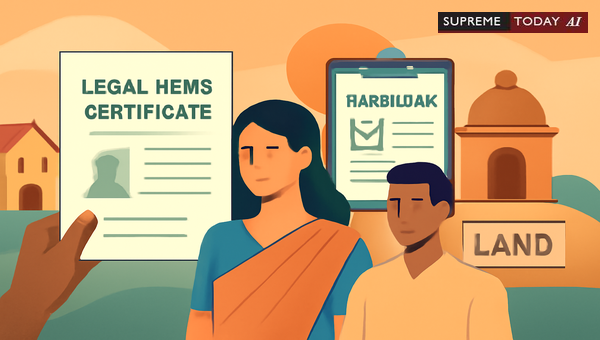
In the complex world of property inheritance in India, a common question arises: Does the have power to decide and successors of a deceased person? Many families facing disputes over land, compensation, or assets turn to local revenue officers like Tahsildars for quick resolutions. However, this often leads to confusion and legal setbacks. Generally, revenue courts lack the authority to such matters, especially when title or are involved. This post explores the , backed by judicial precedents, to help you navigate heirship claims effectively.
Note: This is general information based on case laws and should not be taken as specific legal advice. Consult a qualified lawyer for your situation.
Revenue courts or officers, such as Tahsildars, lack the power to disputes regarding and successors of a deceased person, particularly in matters involving title to property or like land acquisition compensation. Such determinations must typically be made by competent . Revenue authorities are limited to issuing for minor movable assets or payments up to Rs. 1,00,000/-. or complex heirship claims require civil court adjudication, as executive revenue authorities have no statutory jurisdiction to decide competing claims. 2020 0 Supreme(Telangana) 756 2020 0 Supreme(Telangana) 755
This principle is reinforced across multiple judgments. For instance, revenue courts' orders are only conclusive for limited proceedings and not for . 2015 0 Supreme(AP) 47
Other cases echo this: The is right in holding that has no authority to decide the issue between the parties. 2019 0 Supreme(Chh) 710 Similarly, Revenue Officer has no power, jurisdiction and authority to decide title of the property. 2009 0 Supreme(Jhk) 1613
Revenue courts are explicitly barred from deciding , which include heirship claims. Under the and Rules 1987, the Tahsildar is not empowered to upon a 'title dispute'. A combined reading of and directs parties to , with revenue records updated only post-decree. 2020 0 Supreme(Telangana) 756 2020 0 Supreme(Telangana) 755
A clarified: absent any specific power conferred on any executive authority or agency to disputes... we are unable to countenance any power, authority or jurisdiction in the or other . 2020 0 Supreme(Telangana) 756 2020 0 Supreme(Telangana) 755 This extends to states like Telangana and beyond, emphasizing civil exclusivity.
In another ruling: Revenue Courts have no power or jurisdiction to decide the title conclusively... are only for the . 2015 0 Supreme(AP) 47
Tahsildars may issue administratively, but strictly for limited purposes: are intended specifically for movable assets; the value of which is less than Rs. 5,000/- (later enhanced to Rs. 1,00,000/-). They cover pensions or similar up to Rs. 1 lakh after enquiry. 2024 0 Supreme(Ker) 340
However, they cannot determine heirs for land acquisition compensation: the Legal Heirship Certificate cannot be used for disbursement of land acquisition compensation... the Collector must deposit funds in court for the to . Under . 2024 0 Supreme(Ker) 340
Revenue authorities lack power to decide successors: There is no provision which had conferred power on the Revenue Authorities such as Tahsildar... to decide as to who is the legal heir or who is the successor of a deceased individual. 2008 0 Supreme(Mad) 347
confers broad jurisdiction: Section 9 of the confers wide jurisdiction on courts to all disputes of a civil nature except those specifically excluded. Revenue decisions are non-binding on rights. 2020 0 Supreme(Telangana) 756 2020 0 Supreme(Telangana) 755
affirm: Revenue courts cannot resolve title via documents like gift deeds; handle full trials. 2006 0 Supreme(Kar) 328
While revenue officers have narrow roles:
In suits for injunction or mutation, revenue orders do not decide title and cannot override civil proceedings. 2009 0 Supreme(Jhk) 1613
Exhaust revenue appeals before revisions, as unexplained delays (e.g., 12 years) bar claims. 2015 0 Supreme(AP) 47
Understanding these boundaries prevents wasted time and ensures enforceable outcomes. Always verify with local laws and precedents, as jurisdictions may vary slightly by state.
References:1. 2020 0 Supreme(Telangana) 756: Tahsildars' lack of power; civil recourse.2. 2020 0 Supreme(Telangana) 755: Revenue limits vs. .3. 2024 0 Supreme(Ker) 340: Certificate scope; excludes compensation.4. Additional supports from 2019 0 Supreme(Chh) 710, 2015 0 Supreme(AP) 47, 2009 0 Supreme(Jhk) 1613, 2008 0 Supreme(Mad) 347, 2006 0 Supreme(Kar) 328.
#LegalHeirs, #RevenueCourt, #CivilCourtJurisdiction


The Apex Court judgment in Phoolchand (supra) throws light on the course of action which can be adopted where there is contest between two legal heirs of a deceased decree holder. ... That it is not open for such an aggrieved person to challenge Tehsildar's decision before higher revenue official, such as Additional Collector, Additional Divisional Commissioner or Minister. ... upon to decide in this Petition. ... The dispute was brought to the Civil Court, which proc....

to decide the question of legal heirs of deceased Shri Madhulal before approaching the revenue authorities for mutation in the revenue records. ... 2.2 Thereafter, the learned SDO vide the impugned judgment and decree dated 19.10.2011 dismissed the suit, and while deciding issue no.5 on the application of respondent no.1, held that the power to decide the matter pertaining to legal heirs vests with the civil courts and not ... This Court#H....

to decide the question of legal heirs of deceased Shri Madhulal before approaching the revenue authorities for mutation in the revenue records. ... 2.2 Thereafter, the learned SDO vide the impugned judgment and decree dated 19.10.2011 dismissed the suit, and while deciding issue no.5 on the application of respondent no.1, held that the power to decide the matter pertaining to legal heirs vests with the civil courts and not ... This Court#H....

The above proceedings would make it clear that the Tahsildars have got no power and jurisdiction to issue the Legal Heir Certificates, when the deceased had two wives during his life time and the parties have to be directed to approach the competent civil Court. ... The petitioner can apply electronically from any of the CSCs or online to the Tahsildar in whose jurisdiction, the deceased person ordinarily resided before his death. ... It is thus seen that the Division Bench of this #HL....

M. , Hardwar praying that samples of hairs of accused Neeraj Sharma and Rajeev alias Raju may be taken for getting the same compared with the hairs which were found in the hands of the deceased at the time of the inquest. ... from the grip of the deceased and ran away from the spot. ... During investigation it was revealed that at the time of incident a scuffle had ensued between the deceased and the assailant and in the course of said scuffle the deceased had caught the assailant by h....
Part of the evidence against the accused was that hairs were found at the scene were morphologically to the sample hairs taken from the person of the accused. The accused was convicted and appealed. ... PW22 concluded from his mere visual examination that the hairs recovered at the scene were 75% physically similar to those taken from the person of the accused. ... As a person who was acquainted with the deceased, and who had knowledge that she habitually wore certain....
Part of the evidence against the accused was that hairs were found at the scene were morphologically to the sample hairs taken from the person of the accused. The accused was convicted and appealed. ... PW22 concluded from his mere visual examination that the hairs recovered at the scene were 75% physically similar to those taken from the person of the accused. ... As a person who was acquainted with the deceased, and who had knowledge that she habitually wore certain....

We cannot but observe that the Sessions Court has no such power. On a difference of opinion expressed in a batch of references, a Full Bench of this Court has in State of Kerala v. ... (2) The hairs in items 7(d) contain human body hairs which were similar to the sample body hairs in item No.3(a). ... (3) The hairs in item No.7(b) and 8 contain human scalp hairs which were similar to the sample scalp hairs in item No.15. ... The d....
We cannot but observe that the Sessions Court has no such power. On a difference of opinion expressed in a batch of references, a Full Bench of this Court has in State of Kerala v. ... (2) The hairs in items 7(d) contain human body hairs which were similar to the sample body hairs in item No.3(a). (3) The hairs in item No.7(b) and 8 contain human scalp hairs which were similar to the sample scalp hairs in item No.15. ... But all th....

Mathur(Since deceased), through his legal hairs 6/1. Smt. ... Shri Bhagwan Prasad Mathur (Since Deceased), no legal hairs. ... Shri Mahendra Prasad mathur (Since Deceased), through his legal hairs. ... Jhamori Mathur (Since deceased), through her legal hairs 7/1 Smt. Shakuntala Mathur W/o Late Shri P.N. ... Shri Bhawani Lal Mathur (Since deceased), th....

Affidavits (Ex,D/1 and D/2) were filed by Balwir Singh and Tetri Devi and both have not entered into witness box before the trial Court, therefore, Ex. D/1 and D/2 for which respondent No.1 was not provided opportunity to cross-examine, cannot be taken as evidence. The trial Court is right in holding that revenue court has no authority to decide the issue between the parties. Finding of the trial court is based on proper marshalling of the evidence and after re-assessing the evidence, this court has no reason to substitute contrary finding.

11. In K.G. Krishna Murthy’s Case (Supra 1), the learned Single Judge of this Court held that the orders of the Courts of limited jurisdiction like Revenue Courts, are only conclusive as far as the proceedings are concerned. The Revenue Courts have no power or jurisdiction to decide the title conclusively. Subject to the conditions mentioned under the statute, they have got limited jurisdiction conferred thereunder. This Court observed that mutation proceedings are only for the fiscal purposes and they are made only to enable the collection of land revenue to the Government....

Revenue Officer has no power, jurisdiction and authority to decide title of the property, in question. Thus, the Circle Officer, Baghmara, District-Dhanbad, who has granted permission of construction upon the suit property is nothing, but, an interference with the justice delivery system.

But at any rate this Court need not go into the validity of the certificate issued by the Tahsildar or for that matter the order passed by the 1st respondent herein. There is no provision which had conferred power on the Revenue Authorities such as Tahsildar, Revenue Divisional Officer, District Revenue Officer to decide as to who is the legal heir or who is the successor f a deceased individual. In case of dispute as to succession or inheritance the parties have to before the competent civil court. The Competent civil court is bound to decide the dispute as to who is the l....

Of course the petitioner herein claims the property on the basis of the so-called 'gift deed' said to have been executed by Yellawwa to Muniyappa in the year 1955, so also on the basis of inheritance. But Revenue Court has no jurisdiction to decide the right of the parties on the basis of such documents. Of course so-called gift deed through which the petitioner claims the property was an unregistered one. In a writ jurisdiction the High Court is not a fact finding body, it is for the Civil Court to decide all these matters in a full-dressed trial, under Article 226 of the ....


An indispensable Tool for Legal Professionals, Endorsed by Various High Court and Judicial Officers
Please visit our Training & Support
Center or Contact Us for assistance

Scan Me!
India’s Legal research and Law Firm App, Download now!


For Daily Legal Updates, Join us on :



 Back to top


