


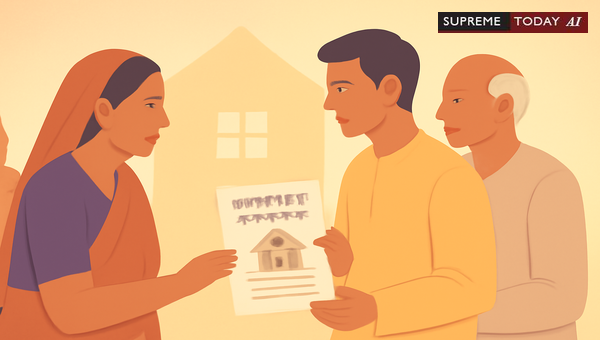
Can a Scheduled Caste Mother Transfer Her Immovable Property to Her General Caste Son?
In family matters involving property, questions about caste differences often arise, especially under Hindu law. A common query is: Can a Schedule Cast Mother Transfer her Immovable Property to her General Cast Son? This issue touches on inheritance rights, guardian authority, and the validity of transfers like gifts or relinquishments. While Hindu law generally allows property transfers, nuances around caste, guardianship, and legal formalities play a crucial role.
This post breaks down the legal principles, drawing from key case law and doctrines. Note: This is general information, not specific legal advice. Consult a qualified lawyer for your situation.
Understanding Inheritance and Transfer Rights Under Hindu Law
Under the and related principles, a mother holds significant rights over her property, including immovable assets like land or houses. She can typically gift, sell, or relinquish her property, but restrictions apply if it's or involves minors.
The core question revolves around whether caste differences—Scheduled Caste (SC) mother and general caste son—affect this. Hindu law does not explicitly bar transfers based on caste for . However, for inherited or , family consent and guardian authority matter. A , like a mother, can manage and relinquish a minor child's share in inheritance, provided it's valid and in the child's best interest 2022 1 Supreme 755.
Key point: A , such as a mother, can relinquish her child's share of inheritance, especially when acting within her authority as the child's guardian 2022 1 Supreme 755.
Mother's Authority as to Relinquish or Transfer
As a under Hindu law (), a mother can handle her minor child's estate. This includes relinquishing the child's inheritance share during or .
For instance, in family , a mother may execute on behalf of minors if properly documented. The validity hinges on substance over form: The validity of relinquishment depends on the facts, substance, and context of the transaction, not merely its nomenclature 2022 1 Supreme 755.
Regarding caste: Sources indicate no blanket prohibition. Property inherited by a child from the mother devolves to her heirs, but transfers remain feasible. Under Kandyan Law influences in some jurisdictions, The mother inherits the property of her children at their death by filial right of inheritance
, yet a living mother can manage her own assets freely.
If the property is the mother's self-acquired immovable asset, she can transfer it via (requiring registration for immovable property over Rs. 100 value) without caste barriers, as Hindu law prioritizes individual rights post- reforms.
Validity of Relinquishment and Potential Challenges
Relinquishments or gifts must be . A guardian cannot dispose of a minor's share arbitrarily, but are permissible. Relinquishment made by a guardian in favor of the child or on behalf of a minor is generally recognized as valid if executed properly 2022 1 Supreme 755.
Caste angles appear in inheritance contexts for illegitimate children or specific customs: Illegitimate children inherit the property of their intestate mother, but not that of their father or that of the relatives of their mother
. However, for direct mother-to-son transfers, no such caste-based denial exists in standard Hindu law.
Challenges arise if:- The transfer lacks consent from coparceners for undivided shares.- It's deemed voidable due to .- Executed beyond guardian authority.
One source notes a mother-in-law demanding relinquishment: the mother-in-law/Respondent No.5, has raised a demand against the Writ Petitioner that the Writ Petitioner should give up 75% of the death benefits in favour of the mother-in-law and that she has to relinquish her right of inheritance entirely 2023 Supreme(Online)(AP) 352. Courts scrutinize such pressures, upholding statutory rights.
Insights from Related Case Law and Customs
Traditional laws like Tesawalamai and Kandyan Law provide context:- Tesawalamai-Property inherited by child from mother-Death of child- Inheritance rights of father-Rights of the heirs of the mother
. Upon a child's death, property reverts to maternal heirs, but living transfers by mother are distinct.- Exceptions for binna marriages or gifts: The only exception to this rule which has been recognized by our Courts is where the property is acquired by a child by gift from a binna married mother
.
Modern application emphasizes substance: Gifts of undivided coparcenary interest need coparcener consent, but relinquishments in are valid 2022 1 Supreme 755.
For SC/general caste dynamics, while affirmative action exists (e.g., SC/ST protections), property transfers between mother-son aren't restricted by caste alone. However, ensure no violation of anti-discrimination laws or property rules.
Limitations, Exceptions, and Best Practices
- or Coercion: Courts invalidate forced relinquishments. Courts generally uphold the statutory inheritance rights of mothers and do not permit undue coercion (derived from 2022 Supreme(Online)(MAD) 42800).
- Illegitimate Children: Limited rights to paternal side, but maternal transfers hold
.
- Documentation: Register deeds, obtain consents, and follow formalities.
Recommendations:- Document intent clearly in deeds.- Seek family consent for .- Consult counsel to verify authority and avoid challenges.
Conclusion and Key Takeaways
Generally, a Scheduled Caste mother can transfer her immovable property to her general caste son via gift, sale, or relinquishment, especially if self-acquired and properly executed. As , she may relinquish child's shares in settlements, subject to validity checks 2022 1 Supreme 755. Caste does not bar this under core Hindu law, though customs and facts matter.
Key Takeaways:- Focus on transaction substance, not label 2022 1 Supreme 755.- Ensure good faith and legal formalities.- Inheritance flows maternally strong, with mother holding management powers
.- Always prioritize professional advice to navigate specifics.
This analysis draws from doctrines like Hindu Minority and Guardianship Act, Succession Act, and cited precedents. Stay informed on evolving laws.
#HinduLaw #PropertyTransfer #InheritanceRights












