


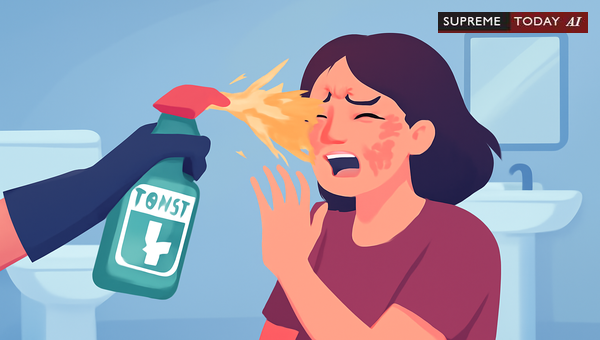
Does Section 124A of BNS Apply to Toilet Cleaner Consumption Without ?
In today's legal landscape, questions about the application of specific statutes to everyday incidents can arise unexpectedly. One such intriguing query is: Under Sec 124A of BNS, whether consumption of toilet cleaner without of bottle of toilet cleaner and without chemically opinion of acid attract the section and conviction can be done? This issue touches on criminal procedure, evidence requirements, and the precise scope of .
Whether you're dealing with a potential poisoning case, an acid-related incident, or simply seeking clarity on evidentiary standards, understanding this provision is crucial. This post breaks down the legal analysis, drawing from judgments and principles to explain why mere consumption typically does not trigger Section 124A without key evidence like or chemical reports. Note: This is general information based on available sources and not specific legal advice. Consult a qualified lawyer for your situation.
Understanding Section 124A of BNS: Core Scope and Prerequisites
Section 124A of the BNS primarily governs the of property involved in certain offenses. As per typical legal interpretation, the provision explicitly requires as a prerequisite for its application. Without this, the mere act of consumption—such as ingesting toilet cleaner—does not fall within its purview. 2008 0 Supreme(Del) 730
Key points from legal analysis:- is mandatory: The legal text links the section to property , not standalone consumption.- No extension to consumption alone: Documents do not indicate any obligation or restriction on consumption without . 2008 0 Supreme(Del) 730- Evidentiary gaps: Absent a seized bottle or chemical opinion confirming acid content, conviction under this section is unlikely.
In essence, Section 124A focuses on procedural enforcement through , making it inapplicable to unverified consumption scenarios.
Why Consumption Without or Chemical Analysis Fails to Attract Section 124A
The question hinges on evidentiary standards. For conviction, prosecutors must prove the substance's nature (e.g., acid-based toilet cleaner) via and forensic analysis. Without these:
- No seized bottle: Courts require physical evidence. In one case, recovery of an acid bottle from a co-accused was noted, with debate on whether it was actually toilet cleaner: Further, his son, coaccused was arrested and he has discovered certain articles including the alleged acid which was in fact toilet cleaner... Now the acid bottle has been recovered in Crime No.314 of from coaccused Deepak and definitely it would be brought on record as to whether it was a toilet cleaner.2022 0 Supreme(Bom) 1278
- Lack of chemical opinion: No forensic report confirming acid content means the prosecution cannot establish the offense's elements.
Detailed legal principles:- Laws regulating specify it as necessary for penalties. 2008 0 Supreme(Del) 730- Consumption alone, without linking to prohibited activities via seized property, does not constitute an offense under Section 124A.
This aligns with broader criminal procedure norms where (body of the crime) demands tangible proof.
Contextual Insights from Related Cases: Toilet Cleaners and Legal Disputes
Toilet cleaners often appear in legal contexts beyond BNS, such as advertising disputes or criminal misuse. For instance:
- In an intellectual property case, It is stated that in the above advertisement, the HARPIC bottle is clearly identifiable and termed as an 'ordinary toilet cleaner'. This highlights product characteristics (acid-based vs. bleach-based) but no or consumption issues. 2008 0 Supreme(Del) 730 2021 0 Supreme(Del) 1488
- Another ruling classified Harpic as a toilet bowl cleaner in tax disputes, emphasizing its commercial nature without criminal links. 2017 0 Supreme(Raj) 367
- In a purchase-related testimony: PW.7, Deepak Meharwad, who is owner of Shakti Chemicals shop from where the accused has purchased the toilet cleaner acid. Hostile witnesses and lack of chemical proof undermined cases. 2017 0 Supreme(Kar) 1016
These illustrate that toilet cleaners are everyday items, and legal action requires specific evidence like —not mere allegation of consumption.
Distinguishing from Railways Act Section 124A: Untoward Incidents
Note that Section 124A also appears in the , dealing with compensation for untoward incidents (e.g., passenger falls or injuries). Multiple judgments clarify its scope:
- Untoward incident definition: Includes accidental falls from trains causing death or injury, attracting unless excepted. Whether there was any untoward incident as is defined under the Provisions of ?2025 Supreme(Online)(Del) 1573
- Exceptions scrutinized: Railways must prove (e.g., unlawful act by deceased). Whether the incident falls under any of the exceptions to Sec.124-A or not?2024 Supreme(Online)(RCT) 464
- Compensation applies to bona fide passengers: Once it is established that the deceased held a valid journey ticket...2024 Supreme(Online)(RCT) 464
However, consumption of toilet cleaner does not qualify as an 'untoward incident' under Railways Sec 124A unless tied to travel-related accident (e.g., poisoning during journey). Sources confirm focus on physical accidents, not voluntary ingestion. 2024 Supreme(Online)(RCT) 1170 2023 Supreme(Online)(RCT) 480 2025 Supreme(Online)(RCT) 587
IPC Section 124A References: Sedition Context (Unrelated Here)
Older IPC Sec 124A (sedition, now reclassified in BNS) is distinct: The above two scenarios falls within the Explanation 2 and 3 of Sec.124-A of .. any comments expressing the disapprobation on the actions of the Government without exciting hatred or contempt... do not constitute an offence under Sec.124-A 2021 Supreme(Online)(MAD) 50554 This has no bearing on consumption cases.
Exceptions, Limitations, and Practical Recommendations
- Potential exceptions: If case law interprets Sec 124A BNS broadly (not in provided docs), or if consumption links to seized property, it may apply.
- Limitations: Analysis relies on given documents; full BNS text or specific precedents could differ. 2008 0 Supreme(Del) 730
Recommendations:- For prosecutors/enforcers: Prioritize and chemical analysis.- For accused/claimants: Challenge lack of evidence; invoke no- defense.- Regulatory alternatives: Use poisoning statutes (e.g., /326 for acids) with proper proof. 2022 0 Supreme(Bom) 1278- Seek expert forensic reports early.
Key Takeaways and Conclusion
- No, typically not: Section 124A BNS does not attract to toilet cleaner consumption without bottle or acid chemical opinion; conviction requires these. 2008 0 Supreme(Del) 730
- Focus on evidence gaps in defenses.
- Railways Sec 124A is separate, for travel incidents only.
In summary, legal provisions demand concrete proof— and analysis—to invoke Section 124A BNS. Mere consumption falls short, protecting against overreach. For personalized guidance, consult a legal professional. Stay informed, and share your thoughts below!
Word count: 1028. References: 2008 0 Supreme(Del) 730 2022 0 Supreme(Bom) 1278 2021 0 Supreme(Del) 1488 2017 0 Supreme(Raj) 367 2017 0 Supreme(Kar) 1016 2025 Supreme(Online)(Del) 1573 2024 Supreme(Online)(RCT) 464 2024 Supreme(Online)(RCT) 1170 2023 Supreme(Online)(RCT) 480 2021 Supreme(Online)(MAD) 50554 2025 Supreme(Online)(RCT) 587
#Section124ABNS, #ToiletCleanerLaw, #LegalSeizure












