


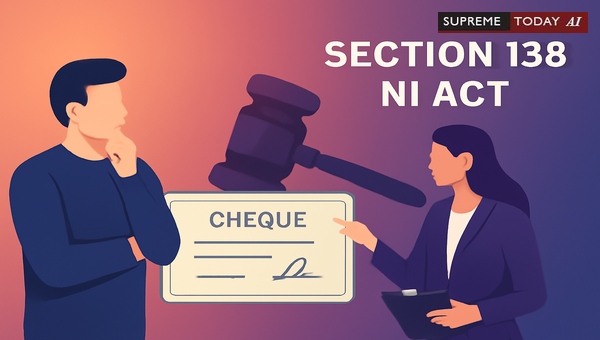
Burden of Proof in Section 138 NI Act Cases: When Does It Shift Back to the Complainant?
In the high-stakes world of disputes under Section 138 of the Negotiable Instruments Act (NI Act), 1881, one burning question often arises: Shifting of Burden of Proof Towards Complainant in a 138 Case of NI Act when the Complainant Fails to Substantiate the Evidence while Proving. Complainants and accused alike grapple with this, especially when defenses seem shaky. But does a weak case from the accused automatically hand victory to them by shifting the burden back? This post dives deep into the legal nuances, presumptions, and judicial insights to clarify.
Drawing from key precedents, we'll unpack how the law typically favors the complainant once basic facts are established, while highlighting exceptions where failures doom the case. Whether you're a business owner facing dishonored cheques or an accused mounting a defense, understanding this can be crucial.
Main Legal Finding
A weakness in the accused's case under Section 138 of the NI Act will generally not succeed in absolving the complainant of liability. The law presumes the issuance and consideration of the cheque under , shifting the burden to the accused to rebut this presumption. Failure of the accused to establish a valid defense or disprove the presumption does not automatically invalidate the complainant’s case2019 0 Supreme(SC) 1167.
This principle ensures efficiency in these , protecting payees who rely on cheques as enforceable instruments.
Key Points on Presumption and Burden
- under shifts the burden to the accused to rebut it 2019 0 Supreme(SC) 1167.
- Accused's failure to produce evidence supports the complainant’s case2019 0 Supreme(SC) 1167.
- Weaknesses or contradictions in the accused's case do not defeat the complainant unless the presumption is rebutted2019 0 Supreme(SC) 1167.
These points underscore that mere denial isn't enough—the accused must prove, on a , no debt existed.
Detailed Analysis: Presumption Under
How the Presumption Works
Once a cheque is proven issued and dishonored for insufficient funds, creates a presumption that the cheque was issued for the discharge of a . As clarified in key rulings, the presumption under must follow once the cheque is issued2019 0 Supreme(SC) 1167. The onus then shifts squarely to the accused.
Courts evaluate the accused's rebuttal on a balance of probabilities, not . Simple claims like it was for security require backing evidence.
Impact of Weaknesses in Accused's Defense
Judicial consistency is clear: mere denial or creation of doubt by the accused does not automatically defeat the case. In one precedent, mere discrepancies in the statement or defence of the accused, such as claiming the cheque was issued as security or for other reasons, do not automatically negate the 2019 0 Supreme(SC) 1157. Unless rebutted with credible proof, the complainant's case stands firm 2019 0 Supreme(SC) 1157.
Similarly, the has held that the accused must prove that the cheque was not issued for any debt or liability, and mere denial or creating doubt is not sufficient
Padmanabhan, S. VS Vasudevan Namboodiri M. G. - Dishonour Of Cheque (2010)
. Failure to produce evidence leads to conviction, even amid accused claims of contradictions 2025 2 Supreme 109.Judicial Precedents: Strength of Complainant's Position
Courts repeatedly affirm that weaknesses in the accused’s case alone are insufficient for acquittal. Denials of issuance, security claims, or insufficient funds pleas falter without proof. The accused's failure to produce evidence or to rebut the presumption results in the conviction2025 2 Supreme 109.
This position holds unless the accused delivers concrete rebuttal, preserving the presumption's integrity.
Exceptions and Limitations: When Complainant Bears the Brunt
While the presumption strongly favors complainants, exceptions exist where their own failures shift or maintain the burden:
Improper legal notice: Failure to state the correct amount in the notice under Section 138(c) can be fatal. In one case, demanding Rs.25,000/- instead of Rs.1,00,000/- led to dismissal, as the failure to issue a proper legal notice under , stating the correct amount, is fatal to the complainant's case2025 0 Supreme(Mad) 3064. The presumption was rebutted due to this defect 2025 0 Supreme(Mad) 3064.
No enforceable debt proven: If the complainant admits prior payments or fails to establish debt, proceedings may be quashed. For instance, complainant admitted receiving Rs.31,59,683.50 via RTGS, rendering the cheque unenforceable and constituting 2023 0 Supreme(Raj) 1799.
Lack of debt evidence: Where the Complainant has not established the main ingredient i.e. whole or in part, any debt or liability, acquittal follows, especially if cheques were for security 2020 0 Supreme(Guj) 956. Accused successfully shifted burden back by proving no liability 2020 0 Supreme(Guj) 956.
Service of notice issues: Endorsements like addressee left India without proof of knowledge may undermine presumption of service 2017 0 Supreme(Ker) 1127.
Failure : Even with presumption, if complainant can't prove case amid credible defense (e.g., security cheque), acquittal upheld 2017 0 Supreme(Mad) 101.
These cases illustrate that while accused weaknesses rarely help, complainant lapses—like poor documentation or contradictions—can decisively shift dynamics.
Practical Implications for Parties Involved
For Complainants
Ensure robust basics: cheque copies, bank slips, proper notices, and debt acknowledgments. Courts respect well-documented cases, even against shaky defenses.
For Accused
Don't rely on doubt—gather proof like payment receipts, security agreements, or no-debt ledgers. is key to rebuttal.
Court Scrutiny
Judges critically assess but won't acquit on accused weaknesses alone 2019 0 Supreme(SC) 1167.
Recommendations for NI Act Litigants
- Complainants: Document issuance and consideration meticulously—cheque copies, notices (Ex.P.3 style), receipts 2025 0 Supreme(Mad) 3064. Rectify notice errors promptly.
- Accused: Produce credible rebuttal evidence, e.g., RTGS proofs or account statements 2023 0 Supreme(Raj) 1799. Avoid mere denials.
- General: Consider settlements, as Section 138 emphasizes compensation over punishment 2023 0 Supreme(Raj) 1799. Seek probation or sentence reduction for petty amounts 2015 0 Supreme(Raj) 693.
Conclusion and Key Takeaways
In Section 138 NI Act cases, the presumption under robustly protects complainants—accused weaknesses rarely shift the burden back unless rebutted effectively 2019 0 Supreme(SC) 1167. However, complainant pitfalls like flawed notices or unproven debts can lead to failure 2025 0 Supreme(Mad) 3064 2020 0 Supreme(Guj) 956.
Key Takeaways:- Presumption shifts burden to accused; their failures bolster complainant 2019 0 Supreme(SC) 1167.- Concrete evidence trumps doubt for rebuttal
Padmanabhan, S. VS Vasudevan Namboodiri M. G. - Dishonour Of Cheque (2010)
.- Exceptions hinge on complainant lapses or strong accused proofs.This is general information based on precedents and not specific legal advice. Consult a qualified lawyer for your case.
References
- 2019 0 Supreme(SC) 1167: Presumption shifts burden; weaknesses insufficient.
- 2019 0 Supreme(SC) 1157: Discrepancies don't negate presumption.
Padmanabhan, S. VS Vasudevan Namboodiri M. G. - Dishonour Of Cheque (2010)
: Proof required beyond denial.- 2025 2 Supreme 109: Failure leads to conviction.
- Additional cases: 2025 0 Supreme(Mad) 3064, 2023 0 Supreme(Raj) 1799, 2020 0 Supreme(Guj) 956, 2017 0 Supreme(Ker) 1127, 2017 0 Supreme(Mad) 101.
















