


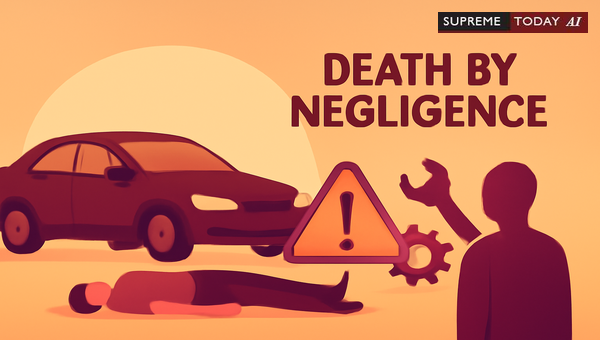
Is an Offence Against Society?
In an era where road accidents, medical mishaps, and workplace incidents claim countless lives, understanding the legal ramifications is crucial. deals with causing —a provision invoked in cases of rash or negligent acts leading to fatalities. But a pressing question arises: Can Section 304A be considered an offence against society? This blog delves into the definition, judicial interpretations, and broader implications, drawing from legal precedents to provide clarity.
Note: This article offers general information and is not a substitute for professional legal advice. Consult a qualified lawyer for specific cases.
Understanding : Definition and Scope
states: Whoever causes the death of any person by doing any not amounting to , shall be punished with imprisonment of either description for a term which may extend to two years, or with fine, or with both. Document 10 10
This provision targets acts that are careless or reckless but fall short of intentional harm under . Common scenarios include:- Reckless driving leading to fatal accidents.- Medical negligence resulting in patient death.- Unsafe handling of machinery or hazardous materials.
Key Elements of the Offence
To establish liability under Section 304A, three core elements must be proven:1. : Direct link between the accused's act and the victim's death.2. : The conduct must deviate from the a reasonable person would exercise. Rashness implies heedless speed or impulsiveness, while negligence is a failure to exercise due care. Document 10 103. Not : The act lacks intention to cause death or knowledge of its likelihood. Document 10 10
These elements ensure the offence punishes avoidable tragedies without equating them to murder.
Nature of Section 304A: Individual Wrong or Societal Harm?
At first glance, Section 304A appears to address personal culpability—an individual harming another through carelessness. However, its implications ripple far beyond the victim and accused, touching public safety and communal well-being.
Courts have consistently viewed such negligent acts as threats to society, especially in contexts like traffic violations or professional lapses that endanger the public. For instance, negligent driving not only affects one victim but risks multiple lives on shared roads. Document 10 10
Judicial Interpretation: Societal Interest in Deterrence
Indian judiciary emphasizes deterrence, underscoring Section 304A's societal dimension. Sentences aim to prevent future negligence, reflecting a collective interest in safety. Document 10 10 Document 10 10
A pivotal ruling highlights this: It is to be noted that the offence under Section 304A of IPC presents a situation where a victim has lost his life due to the rash and negligent act of the accused. Hence, the offence of such nature cannot be on the ground that the legal representatives of the deceased have entered into a settlement or compromise or that they have given no objection for quashing. The offence under Section 304A of Indian Penal Code is not an offence which is private in nature, but is an off.... 2017 0 Supreme(Bom) 2625
This stance—that Section 304A cannot be easily or via private settlements—reinforces its status as a societal offence. Unlike purely private disputes, it involves to uphold public order. Courts invoke sparingly, prioritizing justice over compromise in negligence deaths. 2017 0 Supreme(Bom) 2625
Key Case Studies Illustrating Societal Impact
Real-world judgments provide deeper insight:
Firearm Negligence Case: In a shooting during a scuffle at a dance event, the court acquitted under but upheld Section 304A conviction, reducing sentence to time served. The confessional statement showed no intent, but negligence in handling the pistol was key: Thus from perusal of the aforesaid confessional statement, it appears that there was no intention of the appellant to resort firing upon the deceased to do away with his life rather pistol went off negligently during the scuffling... 2017 0 Supreme(Pat) 1299
Road Accident Quashing Denied: Despite claims of no rash driving, proceedings continued where evidence suggested negligence. The court stressed: powers under prevent abuse but uphold societal offences like 304A. 2017 0 Supreme(Bom) 2625
Institutional Negligence: In a case involving children's deaths near a riverbed due to poor oversight, under was , but investigation into Section 304A proceeded: Allegations in the at best amount to negligent, lethargic or perhaps irresponsible behaviour on part of the accused... Investigation can be permitted for offence under Section 304A of the IPC. 2011 0 Supreme(Guj) 7
Compounding Exception: Rarely, courts permit compounding in minor cases like a bullock cart dash without alcohol influence, quashing under . However, this is exceptional, affirming the general rule against treating 304A as private. 2015 0 Supreme(Bom) 147
These cases demonstrate that while individual factors matter, the offence's public safety focus prevails.
Broader Societal Implications and Public Safety
Section 304A serves as a deterrent against behaviors eroding societal trust—over-speeding, ignoring safety protocols, or professional shortcuts. Judicial calls for stricter enforcement in repeat offences signal growing recognition of its communal harm. Document 10 10
Statistics underscore urgency: Thousands die annually from negligent road mishaps in India, prompting calls for harsher penalties. By punishing negligence, the law fosters a culture of responsibility, protecting the vulnerable.
Legal practitioners often highlight societal angles in arguments, pushing for accountability that deters widespread recklessness.
Conclusion and Key Takeaways
, though rooted in individual negligence, is inherently an offence against society. Its focus on public safety, resistance to private compromises, and emphasis on deterrence confirm this. Courts view rash acts causing death as communal threats warranting state intervention. 2017 0 Supreme(Bom) 2625Document 10 10
Key Takeaways:- Prosecution Persists: Settlements rarely quash 304A cases due to societal stakes.- Deterrence Matters: Sentences aim to prevent future tragedies.- Duty of Care: Professionals and drivers must prioritize caution.- Seek Advice: If facing charges, emphasize context while respecting public interest.
Stay vigilant—negligence today could cost lives tomorrow. For tailored guidance, consult a legal expert.
References:Document 10 10 Document 10 10 Document 10 10 Document 10 10 2017 0 Supreme(Pat) 1299 2017 0 Supreme(Bom) 2625 2011 0 Supreme(Guj) 7 2015 0 Supreme(Bom) 147
#Section304A #IPCLaw #NegligenceOffence












