


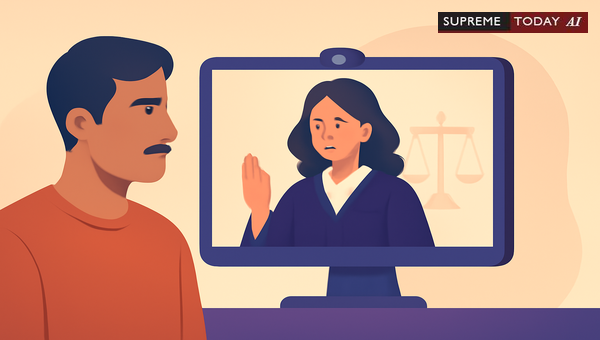
: No Mandatory Physical Appearance for Husband Residing in Another State
In today's fast-paced world, often span across states or even countries, making physical court appearances a logistical nightmare. Imagine a husband living and working in a different state, summoned repeatedly to a for proceedings under (HMA)—a provision for . Must he appear in person on every single date? The answer, backed by judicial wisdom and technological advancements, is generally no. Courts have increasingly recognized alternatives like to ensure fairness without undue hardship. This blog dives deep into the legal nuances, precedents, and practical recommendations.
Understanding Section 9 of the Hindu Marriage Act
allows either spouse to seek court intervention when the other withdraws from the society of the other without reasonable excuse. The petitioner typically files in a , aiming to restore cohabitation. But what if the respondent-husband resides in another state? Traditional rules might demand his physical presence to verify genuine participation, but modern courts prioritize justice over rigidity. 2020 0 Supreme(Del) 1103
The core question arises: In a Proceeding under Section 9 Hindu Marriage Act if Husband is Residing in Another State then Court should Not Insist on his Physical Appearance on Every Date? Judicial rulings affirm that physical presence isn't strictly mandatory on every hearing, especially with reliable alternatives. 2020 0 Supreme(Del) 1103
Main Legal Finding: as a Viable Alternative
Courts have established that the husband's physical appearance is not required at every stage if he resides elsewhere, provided his presence is secured through . This holds true amid technological progress and exceptional circumstances like distance or pandemics. The purpose—ensuring authentic involvement—can be met virtually, avoiding prejudice or hardship. 2020 0 Supreme(Del) 1103
Key points include:- via is recognized, particularly during extraordinary times. 2020 0 Supreme(Del) 1103- No mandate for physical presence on every date if tech secures participation. 2020 0 Supreme(Del) 1103- Balances procedural integrity with practical realities. 2020 0 Supreme(Del) 1103
Judicial Recognition of
Landmark Observations
In , the court observed: > The requirement of can be ensured through as well... If the purpose of the Rule which insists of the parties to the marriage could be ensured by , there shall not be any impediment for the court in interpreting the provisions in such a way as permitting insistence of through . 2020 0 Supreme(Del) 1103
This highlights as a practical substitute, especially for those abroad or in distant states. 2020 0 Supreme(Del) 1103
Supporting Precedents from High Courts and
Multiple courts endorse this:- in accepted for . 2020 0 Supreme(Del) 1103- in noted tech developments fulfill appearance requirements. 2020 0 Supreme(Del) 1103- in ruled satisfies 'personal presence' in proceedings, applicable by analogy to matrimonial cases. 2020 0 Supreme(Del) 1103
These precedents emphasize flexibility in exceptional situations like residence in another state. 2020 0 Supreme(Del) 1103
Insights from Additional Judicial Sources
Family courts across India are adapting similarly. For instance, the learned Judge, , Vijayawada, was directed: > shall not insist physical presence of the petitioner for each and every adjournment in both petitions, if she engages a Counsel, and he can insist her presence, as and when required or at the time of recording her evidence before the Court. 2024 0 Supreme(AP) 822
By analogy, this applies to husbands too—courts may waive physical presence if counsel is engaged, reserving it for key stages like evidence recording. 2024 0 Supreme(AP) 822
In proceedings under : > with the advent of technology, facilities have been put in place in most of the Courts in this State, appearance through virtual conferencing mode is encouraged.
- 2025 2951
Other cases reinforce: Courts exercise discretion, allowing counsel or virtual modes when the husband is in another state, balancing fair trial with distance. Sources like 2022 0 Supreme(P&H) 1913, 2023 0 Supreme(P&H) 714, 2023 Supreme(Online)(AP) 23626, 2023 Supreme(Online)(AP) 8519, 2023 0 Supreme(P&H) 951 highlight and non-insistence on routine appearances to prevent harassment.
Court's Discretion and Practical Considerations
Courts typically:- Permit appearances through counsel for adjournments. 2024 0 Supreme(AP) 822- Encourage virtual modes in family courts like and . 2023 Supreme(Online)(AP) 23626 2023 Supreme(Online)(AP) 8519 2023 0 Supreme(P&H) 951- Accept undertakings for specific dates or . 2024 0 Supreme(AP) 822 2023 0 Supreme(P&H) 951
This aligns with principles serving '' without strict enforcement. 2024 0 Supreme(AP) 822 2023 0 Supreme(P&H) 3135 2023 Supreme(Online)(AP) 23626
However, limitations exist:- If authenticity concerns arise, physical presence may be insisted upon. 2020 0 Supreme(Del) 1103- Court verifies identity and security in virtual modes. 2020 0 Supreme(Del) 1103- Jurisdiction-specific rules apply, subject to interpretation. 2020 0 Supreme(Del) 1103
Recommendations for Parties and Courts
To streamline proceedings:- Request citing precedents and feasibility. 2020 0 Supreme(Del) 1103- Engage counsel to represent on routine dates. 2024 0 Supreme(AP) 822- Courts should protocolize virtual verifications for integrity. 2020 0 Supreme(Del) 1103- Parties in distant states can seek transfers if needed, avoiding harassment. 2022 0 Supreme(P&H) 1913 2023 0 Supreme(P&H) 714
Conclusion and Key Takeaways
Generally, in proceedings, courts should not insist on the husband's physical appearance on every date if he resides in another state. or counsel suffices, ensuring participation without hardship. This reflects judicial trends favoring technology and flexibility. 2020 0 Supreme(Del) 1103 2024 0 Supreme(AP) 822
Key Takeaways:- fulfills ''. 2020 0 Supreme(Del) 1103- Not mandatory every date; discretion for key stages. 2024 0 Supreme(AP) 822- Cite precedents for remote options. 2020 0 Supreme(Del) 1103
Disclaimer: This is general information based on judicial trends, not specific legal advice. Consult a qualified lawyer for your case.
#Section9HMA, #VideoConferencingCourt, #HinduMarriageAct















