


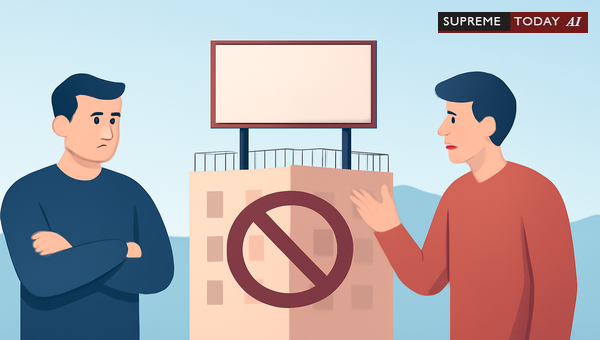
Can a Single Owner Sue to Block Billboards on Building Terrace?
In multi-owner buildings, disputes over common areas like terraces often arise, especially when one party wants to install billboards or signboards for advertising. Imagine owning a 'corner' unit in a shared building and noticing neighbors planning large billboards on the terrace—could you legally stop them? This is a common question: Whether a single corner can file a suit against other corners restricting them from making any or putting any billboard signboard in a common building in the terrace area?
This post breaks down the legal landscape, drawing from court judgments and principles to help you understand your rights. Note: This is general information, not legal advice. Consult a qualified attorney for your specific situation.
Main Legal Finding: Yes, If You Have Established Rights
Generally, a party—whether a single corner owner or a group—can file a suit to restrict other owners or tenants from installing billboard signs or advertisements on the terrace or common areas, provided they demonstrate a legal right, interest, or ownership stake in the property. Courts recognize that unauthorized installations infringing on these rights can be challenged through injunctions. 1967 0 Supreme(SC) 266
Key points include:- Ownership or contractual rights over common areas like terraces allow enforcement of restrictions.- A single owner can sue if the billboard violates agreements, building regulations, or their exclusive interests.- Courts protect legitimate interests, preventing encroachments on shared spaces.
Detailed Legal Basis: Ownership and Common Areas
Rights Over Terraces and Shared Spaces
Terraces in multi-unit buildings are often classified as common areas, but their use can be governed by ownership deeds, leases, or society bylaws. A single owner with proven rights—such as exclusive access or proportional share—may seek to prevent alterations like billboards.
For instance, in 1967 0 Supreme(SC) 266, the court scrutinized billboard income on terraces in relation to ownership agreements, noting that owners could restrict signage based on their interests: the assessment of billboard advertisements on the terrace was scrutinized in relation to ownership and agreements. Similarly,
affirmed that individuals with terrace rights can block unauthorized installations: a person who has rights over a terrace or common area... can seek to prevent others from installing billboard signs if such activity infringes on their rights.
Single Owner's Standing to Sue
Even a lone 'corner' owner isn't powerless. If you can show infringement—e.g., the billboard blocks access, violates aesthetics, or breaches co-ownership terms—you have standing. Courts emphasize proof of legal interest, as seen in 1967 0 Supreme(SC) 266, where unauthorized signage was challengeable despite potential revenue.
Additional cases reinforce this. In 2022 Supreme(Online)(NCDRC) 473, a terrace was deemed a prohibited zone, where a caution board was also put at the entry point, restricting the students and staffs from going in terrace area. This highlights how restrictions on terrace use, including signage, can be enforced via signage or legal means when backed by authority.
M.M. KARIAPPA & ANR. vs HEMALATHA JASWANTH & 2 ORS. -
echoes this, underscoring maturity in understanding restrictions.Integrating Broader Case Law: Common vs. Exclusive Areas
Terraces aren't always purely 'common.' Sources like 2022 Supreme(Online)(KER) 37719 question whether divisions include terraces: whether the division of the First Floor would include the terrace portion also. Rights to stairs or terraces may be relinquished or retained via agreements, impacting signage rights.
In
, failure to restrict terrace misuse was flagged: not restricting the flat owners from improper use of the terrace and common areas amounts to deficiency. This suggests owners can (and should) enforce limits on uses like parties—or billboards.
Further, 2022 0 Supreme(Bom) 1538 discusses terrace encroachments affecting common utilities: Sheets which covered the common inlet pipeline... making it accessible only through the kitchen window. Such interferences justify suits to restore access and prevent further alterations.
Enforcing Injunctions Against Others
Courts grant permanent injunctions in property disputes. 2022 0 Supreme(Mad) 1880 awarded relief: a decree for restraining the defendants... from putting up any construction or building over the suit schedule property. Applied to billboards, this supports single owners restraining co-owners. 2018 0 Supreme(P&H) 3576 sought to bar encroachments: restraining them from making any unlawful encroachment or disturbance.
2009 0 Supreme(Mad) 1665 restrained interference: the defendants are restrained from interfering with the plaintiffs peaceful possession... or by interfering with the common areas. These precedents show single parties succeeding against groups when rights are clear.
Exceptions and Limitations: When Suits May Fail
Not every claim succeeds. Key limitations:- No clear rights? Standing challenged if lacking ownership/lease proof. 2012 0 Supreme(MP) 269- Local regulations: Bylaws or municipal laws may permit signage.- Unilateral restrictions: Can't impose without legal backing; courts favor documented agreements.
Other sources note terraces as common unless specified exclusive (e.g., 2022 0 Supreme(Bom) 1218, 2022 Supreme(Online)(Bom) 3158, 2022 Supreme(Online)(Kar) 57189). Arbitrary bans on billboards in truly shared spaces may fail without bylaws.
Practical Recommendations for Property Owners
To strengthen your position:- Document rights: Deeds, leases, society resolutions proving terrace interest.- Review regulations: Check building bylaws, municipal ad rules.- Gather evidence: Photos, prior complaints of infringement.- Seek early injunction: Courts favor preventing harm over damages.
In
and 2024 0 Supreme(Mad) 944, divisions of common areas hinged on agreements, advising clear documentation.
Conclusion and Key Takeaways
A single corner owner may file a suit to restrict billboards on a building's terrace if backed by ownership, contracts, or regulations—courts protect these interests against unauthorized use. However, success depends on proof; without it, claims falter.
Key Takeaways:- Establish legal rights first.- Use injunctions for quick relief.- Common areas require consensus or bylaws for restrictions.- Always consult a lawyer.
References:- 1967 0 Supreme(SC) 266,
- 2022 Supreme(Online)(NCDRC) 473, 2022 Supreme(Online)(KER) 37719, 2022 0 Supreme(Bom) 1538, 2022 0 Supreme(Mad) 1880
Word count: 1028. This analysis synthesizes judgments for educational purposes.
#PropertyLaw #TerraceRights #BuildingDisputes















