


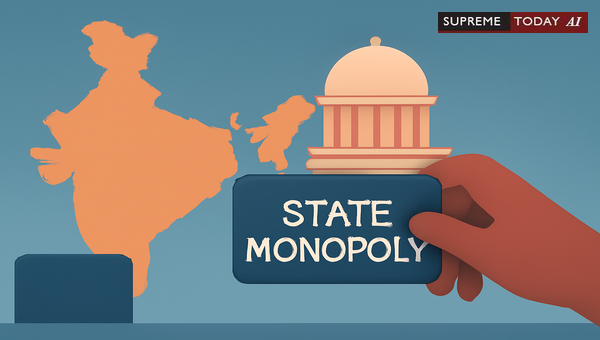
Can the State Create a Monopoly in India? A Constitutional Analysis
In the realm of Indian law, the question Monopoly Cannot be Created by State often arises amid debates on economic regulation, public interest, and fundamental rights. While private monopolies are scrutinized under competition laws, state-created monopolies occupy a unique space. This blog post delves into whether and how the State can lawfully establish monopolies, drawing from constitutional provisions, landmark judgments, and practical examples. Understanding this balance is crucial for businesses, policymakers, and citizens navigating trade restrictions.
Note: This article provides general information based on legal precedents and is not specific legal advice. Consult a qualified lawyer for personalized guidance.
Legal Validity of State-Created Monopolies
The Indian Constitution explicitly permits the State to create or authorize monopolies under certain conditions. Primarily, and 162 empower the State to impose reasonable restrictions on the right to practice any profession, occupation, trade, or business () in the interest of the general public. The State may carry on monopolistic trade directly, through agencies, or via agents, as long as it is backed by law and does not infringe fundamental rights like equality ().2003 0 Supreme(Kar) 647
Key judicial affirmations include:- State monopolies in trade or business are constitutionally permissible if created or authorized by law. 2003 0 Supreme(Kar) 647- The State can operate monopoly trade through corporations or agents on its behalf, within legal bounds. 2003 0 Supreme(Kar) 647- Monopolies for public interest, such as , are valid if aligned with . 1990 0 Supreme(HP) 107
For instance, the upheld the , as it was passed under constitutional competence and received Presidential assent. 1990 0 Supreme(HP) 107
Constitutional Basis and
and 162: The Foundation
Article 19(6) allows the State to create monopolies by law, excluding complete or partial citizen participation in specified trades for public welfare. and 162 provide constitutional backing for the State to impose restrictions or create monopolies for public interest, provided these do not violate fundamental rights or exceed legal authority. 1999 3 Supreme 266
The State's power extends to regulating intoxicants or essential services under entries and police powers. 1974 0 Supreme(SC) 403
Exemptions for
Activities tied to , like power supply, fall outside the . Monopolies established in the context of (e.g., power supply) are generally outside the scope of the MRTP Act and are not considered as infringing citizens' rights. 2017 0 Supreme(Del) 3956
In power distribution cases, arrangements through authorized agents were deemed valid. 2009 0 Supreme(Kar) 478
Limitations: When Monopolies Cross the Line
Not all state actions qualify as lawful monopolies. Complete exclusion of competitors may violate , though partial restrictions or are often upheld. Monopolies that exclude others entirely... may violate constitutional rights under Articles 19(1)(g) and 19(6), but small or partial restrictions are generally permissible. 1999 3 Supreme 266
Legislation must be reasonable, non-arbitrary, and statutorily supported. Administrative orders lacking statutory backing are unconstitutional. For example, executive prohibitions on trade have been declared .
Any monopoly that results in undue restriction of trade, or is not backed by law, may be challenged as unconstitutional or illegal. 1971 0 Supreme(SC) 77
Insights from Additional Legal Precedents
Courts have clarified scenarios where state actions do not create monopolies:
Tender Processes and Public Agencies: Selecting a single entity via tender does not imply monopoly creation. The courts have consistently held that even if a single manufacturer or private party is selected through tendering, this does not amount to the State creating a monopoly in favor of that party. 2023 0 Supreme(AP) 591
Economic Policies: Allocating licenses for fair price shops or transport is policy discretion, not monopoly. Long-standing operations do not confer exclusive rights. 2024 0 Supreme(Raj) 677 2025 0 Supreme(Raj) 2135
Statutory Corporations: Entities like welfare organizations lack inherent monopoly status. 2023 Supreme(Online)(HP) 14884
Executive Orders: We are of the opinion that a monopoly cannot be created by an executive order. 1988 0 Supreme(Raj) 600
: Monopoly in favor of the State can even be created by rules, not just . Monopoly in favour of State Government can be created even by . 2006 0 Supreme(SC) 1284
Private arrangements, like exclusive dealing, differ from state action. 2022 Supreme(US)(ca1) 240
In cooperative contexts, asset distribution for societal benefit does not disadvantage others unfairly. 2024 0 Supreme(Ker) 359
Agency Arrangements and Practical Implementation
The State may employ agents for monopoly trade, provided they act on its behalf. The clarified that when the State carries on trade or industry, it may do so directly or through its controlled corporations. Importantly, the State can also employ agents... 2003 0 Supreme(Kar) 647
However, arrangements must avoid arbitrariness. In food grains or liquor trades, state reservations are lawful without granting citizens equal participation rights. 2024 0 Supreme(Chh) 696
Key Takeaways and Recommendations
- Ground in Law: Ensure monopolies are statutory, not executive.
- Balance Rights: Restrictions must be reasonable, protecting Articles 14 and 19(1)(g). 1999 3 Supreme 266
- Distinguish Sovereign Acts: These evade competition laws like MRTP. 2017 0 Supreme(Del) 3956
- Policy vs. Monopoly: Licensing or tenders rarely create illegal monopolies unless arbitrary.
In conclusion, while the phrase Monopoly Cannot be Created by State captures a common misconception, Indian law affirmatively allows state monopolies when legally authorized and constitutionally compliant. Businesses facing trade restrictions should evaluate if actions stem from valid law or overreach. For tailored advice, professional legal counsel is essential.
References
- 2003 0 Supreme(Kar) 647: State monopolies via agents.
- 1999 3 Supreme 266: Constitutional limits.
- 2017 0 Supreme(Del) 3956: Sovereign exemptions.
- 1990 0 Supreme(HP) 107: Legislative validity.
: orders.
- Others as cited inline.















