Searching Case Laws & Precedent on Legal Query..!
Scanned Judgements…!



Searching Case Laws & Precedent on Legal Query..!
Scanned Judgements…!
Compensation for deaths due to police firing - Main points and insights:
Police resort to firing primarily when other methods (lathi charge, tear gas) fail to control unruly mobs. Firing is considered a last resort aimed at dispersing the crowd, with the intention never to kill, but rather to restore order ["1998 0 Supreme(Guj) 205"], ["2006 0 Supreme(Gau) 453"], ["2006 0 Supreme(Gau) 567"], ["2025 Supreme(Online)(Gau) 8296"].
Police actions, including firing, are often justified by the need to control violent mobs that attack police personnel, damage property, or threaten public safety. In such cases, firing is ordered by authorities such as Executive Magistrates or police officers under specific circumstances ["2012 0 Supreme(Gau) 641"], ["2011 0 Supreme(Mad) 4857"], ["1991 0 Supreme(Mad) 186"], ["2005 0 Supreme(MP) 866"], ["2005 0 Supreme(MP) 862"].
Courts and inquiry reports acknowledge that deaths resulting from police firing occur when mobs become violent and pose a threat, but emphasize that police must act within legal bounds. In many instances, police claims of firing to disperse mobs are accepted, but the use of excessive or reckless force can lead to legal liability ["2012 0 Supreme(Gau) 641"], ["2012 0 Supreme(Gau) 635"], ["2004 0 Supreme(Kar) 266"], ["2012 0 Supreme(Gau) 641"].
Several cases highlight that victims or their families seek compensation for deaths caused by police firing. Courts often recognize that when firing is justified due to mob violence, victims or their families are entitled to monetary compensation, especially if the police's actions are deemed reckless or excessive ["1959 0 Supreme(Gau) 34"], ["2012 0 Supreme(Gau) 635"], ["2012 Supreme(Online)(Gau) 17"].
Some judgments point out the importance of proper firing protocols, such as firing in the air with blank ammunition or from safe distances, to minimize casualties. Lack of adherence to these protocols or firing in vengeance can be grounds for legal action and compensation ["2016 0 Supreme(J&K) 370"], ["2015 0 Supreme(J&K) 669"], ["2005 0 Supreme(MP) 866"].
Analysis and Conclusion:
The consensus across sources indicates that police firing in mob control situations is justified when the crowd becomes violent and threatens safety, but must be carried out responsibly. Reckless or unnecessary firing, especially resulting in death, can lead to liability and compensation claims ["2012 0 Supreme(Gau) 641"], ["2004 0 Supreme(Kar) 266"].
Courts tend to award compensation when police firing is deemed to have caused injury or death, especially if the force used was excessive or lacked proper protocols. Victims or their families are entitled to redress, and police actions are scrutinized for recklessness ["1959 0 Supreme(Gau) 34"], ["2012 0 Supreme(Gau) 635"].
Overall, while police firing can be justified under certain circumstances, strict adherence to guidelines and protocols is essential to prevent unlawful killings and ensure accountability. Compensation is awarded based on the circumstances, with emphasis on whether the force was proportionate and necessary ["1998 0 Supreme(Guj) 205"], ["2006 0 Supreme(Gau) 453"], ["2006 0 Supreme(Gau) 567"].
References:- ["1998 0 Supreme(Guj) 205"]- ["2006 0 Supreme(Gau) 453"]- ["2006 0 Supreme(Gau) 567"]- ["2025 Supreme(Online)(Gau) 8296"]- ["2016 0 Supreme(J&K) 370"]- ["2015 0 Supreme(J&K) 669"]- ["2012 Supreme(Online)(Gau) 17"]- ["2012 0 Supreme(Gau) 641"]- ["2012 0 Supreme(Gau) 635"]- ["2016 6 Supreme 295"]- ["2015 0 Supreme(Tri) 735"]- ["2005 0 Supreme(MP) 866"]- ["2005 0 Supreme(MP) 862"]
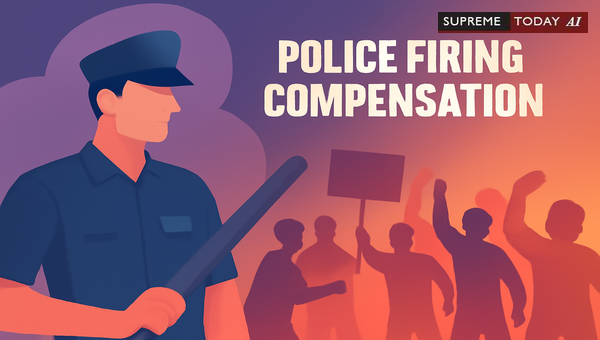
Imagine a chaotic scene: an unruly mob turns violent, stones fly, and police open fire to restore order. Tragically, innocents lose their lives. Can the families of those killed seek compensation from the state? This is a pressing question in India, where police actions during crowd control often spark debates on accountability and human rights.
In this post, we dive into the legal framework surrounding compensation for death due to police firing to control an unruly mob. Drawing from landmark judgments and principles under the Indian Constitution, we'll explore when such claims succeed, key case laws, and practical insights. Note: This is general information based on judicial precedents and not specific legal advice. Consult a qualified lawyer for your situation.
The under of the Indian Constitution is sacrosanct. Courts have repeatedly held that police excesses, including unwarranted firing during mob control, can violate this right, triggering state liability. Compensation is typically sought via under of the Constitution, especially when police action is deemed , unjustified, or disproportionate. The state becomes vicariously liable for its officers' wrongful acts. 2016 0 Supreme(Ori) 177
As established in judicial precedents, the state has a duty to compensate victims of police excesses, especially when the action is or unjustified. 2007 0 Supreme(Ori) 77 This principle stems from , holding the government accountable without needing a separate civil suit.
under are maintainable for compensation claims if facts show negligence or wrongful conduct by police during crowd control. For instance, in cases of police firing resulting in death, courts assess if the force used was proportionate and necessary. 2016 0 Supreme(Ori) 177 The burden lies on claimants to prove recklessness, but once established, the state cannot escape liability.
Indian courts have shaped this area through pivotal rulings. Here's a breakdown:
: The awarded compensation for police excesses, stressing the state's duty to repair the damage caused by its officers. This case underscores compensation as a remedy for violations. 2007 0 Supreme(Ori) 77
Police Firing During Riots Leading to Child Deaths: In a case where police firing killed a child and a young boy, the court held the state liable for right-to-life breaches, awarding compensation for unjustified conduct. 2005 0 Supreme(MP) 866
Electrocution and Analogous Principles: Though involving animal deaths, the ruling affirmed writ maintainability for negligence by authorities, extending to police crowd control scenarios. 2016 0 Supreme(Ori) 177
These cases affirm that police must justify firing—only as a last resort after tear gas or lathi charges fail. firing without lawful orders invokes liability. 2016 0 Supreme(Ori) 177 2005 0 Supreme(MP) 866
Other judgments provide context on mob dynamics and police responses:
In one instance, an angry unruly mob started to throw stones towards the police. After obtaining the permission from the Executive Magistrate (Tahsildar) tear gas were used to disperse the unruly mob. Inspite of it the unruly mob not dispersed. Police then escalated, injuring personnel and highlighting the thin line between justified force and excess.
N.KAMALA KANNAN vs THE STATE REP. BY ITS - 2022 Supreme(Online)(MAD) 15241
A stark example is the death of Nagaraj due to rash and negligent act of firing by the police. The court ruled: The main legal point established in the judgment is that the firing by the police was and without lawful orders, and therefore, the State could not plead immunity as an ''. Compensation was decreed against the state for , totaling Rs. 1,00,000 with interest. 1991 0 Supreme(Kar) 148
During events like Sabarimala tensions, petitioners challenged police creating unruly atmosphere in the name of mob control, alleging violations of rights to movement and worship under guise. 2018 0 Supreme(Ker) 764 Similarly, in riot control, police resorted to mild force against a mob pelting bricks, injuring officers, but escalation led to scrutiny. 2015 0 Supreme(All) 1560
These illustrate that while mobs justify force, recklessness—like firing sans orders—triggers compensation.
Courts demand police firing be:- Justified: Only after exhausting non-lethal options.- Proportionate: Minimal force needed.- Necessary: Backed by magistrate permission where required.
Police firing must be justified, proportionate, and based on necessity. When police resort to firing without proper precautions or in excess of their lawful authority, their conduct is deemed or negligent. 2016 0 Supreme(Ori) 177 2007 0 Supreme(Ori) 77
pins the state, not always individual officers, unless personally culpable. However, officers may claim immunity if acting in good faith within duties. 2005 0 Supreme(MP) 866
Not every firing leads to payout:- Justified Action: Proportionate force against violent mobs protects police. E.g., if mobs injure personnel after tear gas fails, no liability.
N.KAMALA KANNAN vs THE STATE REP. BY ITS - 2022 Supreme(Online)(MAD) 15241
- Burden of Proof: Claimants must show recklessness; state can defend with evidence of necessity.- Defense: Fails if firing lacks lawful orders, as in cases. 1991 0 Supreme(Kar) 148Immunity applies if officers act on reasonable belief during official duties. 2005 0 Supreme(MP) 866
Authorities should document actions meticulously to defend claims.
Indian law generally permits compensation for deaths from police firing in mob control when actions are or violate rights, via writs. Landmark cases like Nilabati Behera reinforce state accountability, deterring excesses. 2007 0 Supreme(Ori) 77 2016 0 Supreme(Ori) 177 2005 0 Supreme(MP) 866
Key Takeaways:- for unjustified police firing.- Prove recklessness to succeed.- Proportionality is crucial—escalate force judiciously.- Victims' families: Act swiftly with legal aid.
This framework balances public order with life protection. For personalized guidance, reach out to legal experts. Stay informed, stay safe.
#PoliceFiringCompensation, #StateLiabilityIndia, #Article226Writs


Junagadh which gives details about the circumstances in which the entire incident had taken place and the circumstances in which the police officers were constrained to open fire at the mob which had become so unruly that lathi-charge and firing of tear-gas shells had failed to control the unruly mob ... It has been submitted by Shri Patel that the police ought not to have resorted to firing as it was possible for the poli....

Since the situation became more serious in order to control the agitated mob the police party first warned the unruly mob and resorted to firing under the order of E.M. Mjr. N. A. ... As the situation become more serious so in order to control agitated mob the police first warned unruly mob and resorted to firing under the order of E.M. Mr. N. A. Ali and as a result Gopal Murmu, ....

Since the situation became more serious in order to control the agitated mob the police party first warned the unruly mob and resorted to firing under the order of E.M. Mr. N.A. ... As the situation become more serious so in order to control agitated mob the police first warned unruly mob and resorted to firing under the order of E.M. Mr. N. A. Ali and as a result Gopal Murmu, To....

injury suffered by the petitioner due to police firing on 20.04.2017. ... The respondent No.5 has filed an affidavit narrating the whole incident, which clearly shows that police had resorted to firing to disperse the unruly protesters due to death of a person on account of the motor accident occurred at Porua Chariali, Tezpur. ... Superintendent of Police, Tezpur, it indicates that there is no dispute to the incident of p....

Where the situation warrants firing over the heads of the crowd and where it is considered likely to be effective in dispersing the violent and unruly mob, such firing should be resorted to only with blank ammunition. ... They will use the most effectual means to explain before hand to the unruly mob that in the event of the police party being forced to open fire, the fire will be effective to injure/immobilize the target. ... Firing should be carrie....

But the angry unruly mob started to throw stones towards the police. After obtaining the permission from the Executive Magistrate (Tahsildar) tear gas were used to disperse the unruly mob. Inspite of it the unruly mob not dispersed. ... Some of the revenue authorities and police personnel were also injured due to pelting of stones by the mob. The lathi charge and the tear gas shell was not enough to bring the situa....
Railway Protection Force ordered the Railway Protection Force personnel to open fire with a view to disperse the unruly mob. ... Petitioners, in view of the admission on the part of respondents that the deceased met his untimely death because of the bullet injury at the hands of Railway Protection Personnel, are entitled to compensation due to them. ... The explanation offered, may exonerate the personnel who opened fire, from any criminal liability or departmental action but is not to disentitle the pe....

Therefore, it is submitted by the police officials that they have been compelled to open fire only due to the above said circumstances and due to the violent act of the unruly mob. ... disperse unruly mob who have indulged in violence. ... It is contended that police resorted to use force only due to the riot and the unruly mob not only set fire to the vehicles including brand new fire engine, but....
account of the death of the said Nagaraj due to the rash and negligent act of reckless firing by the police. ... He reaffirms that he was not at all responsible for the firing that was opened by the police force at the spot to control the unruly mob and to protect the property of the State and of private persons. ... While controlling the unruly mob and dispersing the unruly asse....

account of the death of the said Nagaraj due to the rash and negligent act of reckless firing by the police. ... He reaffirms that he was not at all responsible for the firing that was opened by the police force at the spot to control the unruly mob and to protect the property of the State and of private persons. ... W. 8, it was the second defendant alone who issued orders for firing. According to D. W. 14, anothe....

Direction is sought, to restrain the police from creating an unruly atmosphere in the name of mob control. (viii) In W.P(C) 37766 of 2018, it is contended that no basic amenities have been provided at Sannidhanam. (vii) W.P(C)35753 of 2018 is filed challenging the alleged atrocities of the police and seek for legal action against them. Government/Police interference in the affairs of Sabarimala Temple is sought to be interdicted in WP(C) 37578/18, besides seeking for providing basic amenities, while somewhat similar reliefs are prayed for in WP(C) 36738/18.

The Police authorities had to resort mild force to control the unruly mob but the unruly and agitated mob disrupted the maintenance of law and order by pelting the bricks and stones whereby a number of police officials sustained injuries. The incident was duly flashed in the widely circulated daily news papers. The petitioner was one of the accused in Case Crime No.181 of 14 under sections 302 IPC read with section 7 Criminal Law Amendment Act. The incident in which Satish Maurya lost his life created very tremendous and horrific situation and the agitated melee attacked th....

The police was not in a situation to control the 'unruly mob'. In this case, the respondents No.1 to 6 have clearly admitted that there was total collapse of law and order situation in the place where the petitioner's son was shot dead. The police gave the permission to organise the rally without any assessment as to the nature of agitation, participation and without any prohibitive and protective preparation. As a result, the unruly agitators, by whatever name they may be called, seized the city and there was a serious break-down of law and order situation when it is the p....


An indispensable Tool for Legal Professionals, Endorsed by Various High Court and Judicial Officers
Please visit our Training & Support
Center or Contact Us for assistance

Scan Me!
India’s Legal research and Law Firm App, Download now!


For Daily Legal Updates, Join us on :



 Back to top


