


How to Substitute Original with Copy in Court Evidence India
In legal proceedings, documents are the backbone of evidence. But what happens when the original document is lost, destroyed, or unavailable? Many litigants ask: how to substitute original with copy in evidence? Under Indian law, particularly the , substituting an original with a copy is possible but strictly regulated. This blog explores the principles, conditions, and judicial insights to guide you through this process.
Important Disclaimer: This article provides general information based on legal precedents and is not a substitute for professional legal advice. Consult a qualified lawyer for your specific case.
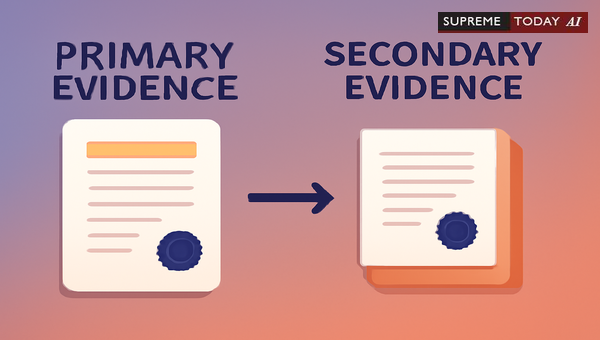
Primary vs. : The Foundation
The Indian Evidence Act prioritizes , defined as the document itself produced for the court's inspection (). As established, The original document must generally be proved by , i.e., the document itself 2003 8 Supreme 193.
However, —such as photocopies, , or —can substitute under specific conditions (). rules are not absolute; copies can even qualify as primary if signed or executed in a manner that makes them equivalent to the original, such as when both parties sign both the original and the copy after comparing them 2003 8 Supreme 193.
includes:- given by legal custodians.- Copies made from the original by mechanical processes ensuring accuracy (e.g., photocopies).- Copies compared with the original or a compared copy 2003 8 Supreme 193.
Illustrations from case law clarify: a photograph of an original even if not compared with original may be a if what was photographed was the original; (b) a copy compared with a copy made by a copying machine from the original is a 2014 0 Supreme(All) 3109. But beware: Such a copy of a copy i.e. after second copy not compared with the original is not evidence because mistakes may have crept up in a second transcription 2018 0 Supreme(Tri) 140.
Conditions for Substituting Original with Copy
Courts allow substitution only when are proven. Key requirements include:
1. Proof of Non-Availability of Original
- The party must justify why the original cannot be produced, e.g., lost, destroyed, or in the adversary's possession despite notice.
- In cases where the original is lost, destroyed, or otherwise unavailable, (such as or photocopies) may be admissible if certain conditions are met, including proof of loss or destruction and proper custody 2023 0 Supreme(SC) 1179 2013 0 Supreme(SC) 673.
- Foundational evidence is crucial: The must be authenticated by foundational evidence that the alleged copy is in fact a true copy of the original 2024 0 Supreme(Guj) 966.
2. Authentication of the Copy
- The copy must be proven as a true reproduction. Mere production or marking as an exhibit does not prove contents: Mere production or marking of a copy as an exhibit does not automatically prove its contents; it must be proved in accordance with law 2003 8 Supreme 193.
- For post-amalgamation or delays: There cannot be any bar to accept the of the documents which were earlier accepted by the Court even in absence of any leave petition 2023 0 Supreme(Gau) 892.
3. Court Discretion and
- Courts may provisionally admit copies during trial, resolving objections at judgment: of should be provisionally recognized at the trial stage, with objections resolved at final judgment to expedite proceedings 2024 0 Supreme(AP) 1504.
- In one case, the court set aside a trial court's refusal, directing provisional exhibition: The court directed that the documents previously rejected should be tentatively exhibited, allowing for further examination of their 2024 0 Supreme(Guj) 966.
Judicial Precedents on Document Substitution
Indian courts have shaped these rules through precedents:
Loss of Originals: When originals are untraceable, like a business transfer agreement, courts evaluate under : the trial court's refusal based on precedent cases - The court evaluates scenarios for admitting when originals are lost 2024 0 Supreme(AP) 1504. The revision was allowed, emphasizing trial efficiency.
as Substitutes: In a money suit post-company amalgamation, of Form 32 were permitted late: the petitioner could obtain the certified copy of document Nos. 3, 4 & 5, which were to be submitted as document Nos. 13, 14 & 15 2023 0 Supreme(Gau) 892.
Strict Proof Requirements: Photocopies fail without comparison: The photocopy of the letter dated cannot be relied upon even as a 2014 0 Supreme(All) 3109. Similarly, in a fatal accident claim, copies needed formal proof 2018 0 Supreme(Tri) 140.
Possession and Agreement Cases: In land disputes, photocopies of sale agreements were inadmissible without proper foundation: the photocopy of the agreement for sale was not admissible as 2012 0 Supreme(All) 580.
These cases underscore: The courts have emphasized that is admissible only when the non-production of the original is justified and properly accounted for, and when the copy is authenticated as true 2023 0 Supreme(SC) 1179 2013 0 Supreme(SC) 673.
Practical Steps and Recommendations
To successfully substitute an original with a copy:1. Attempt to Produce Original First: Always prioritize the original; is exceptional.2. Lay Proper Foundation: File affidavits or lead evidence proving loss/destruction, custody, and copy accuracy. Include newspaper notices of loss if applicable 2024 0 Supreme(Guj) 966.3. Authenticate Thoroughly: Get certifications, witness comparisons, or mechanical process proofs.4. Seek Provisional Marking: Request tentative exhibition to avoid delays 2024 0 Supreme(AP) 1504.5. Object Timely: Opposing parties should raise objections early 2003 8 Supreme 193.6. Avoid Chain-of-Copy Errors: Ensure direct linkage to original; avoid uncompared multi-generation copies 2018 0 Supreme(Tri) 140.
When substituting an original with a copy, ensure that the copy is properly authenticated, signed, or executed in a manner that makes it equivalent to 2023 0 Supreme(SC) 1179.
Key Takeaways
- Substitution is permissible but demands strict compliance with Evidence Act Sections 63-65.
- Prove : loss, authenticity, and accuracy.
- Courts favor efficiency via but scrutinize at final judgment.
- Presumptions (e.g., ) don't apply to copies without foundation 2003 8 Supreme 193 2020 3 Supreme 592.
In summary, while originals reign supreme, copies can substitute when legal hurdles are cleared. Properly handled, they uphold justice without compromising integrity. For tailored guidance, reach out to a legal expert.
References:- 2003 8 Supreme 193, 2013 0 Supreme(SC) 673, 2023 0 Supreme(SC) 1179, 2020 3 Supreme 592, 2024 0 Supreme(AP) 1504, 2023 0 Supreme(Gau) 892, 2024 0 Supreme(Guj) 966, 2018 0 Supreme(Tri) 140, 2014 0 Supreme(All) 3109, 2012 0 Supreme(All) 580.
#IndianEvidenceAct #SecondaryEvidence #CourtEvidence












