




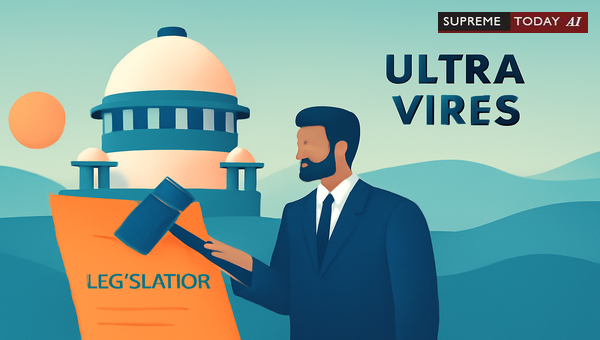
Supreme Court Striking Down Laws: Explained
In the realm of constitutional law, one of the most critical powers vested in the is the ability to strike down legislation deemed . But what does this mean, and under what circumstances does the apex court exercise this authority? The question often arises: Can the Supreme Court strike down legislation on the ground of ? The answer is a resounding yes, provided it exceeds constitutional or statutory limits, violates , or contravenes the parent Act. This doctrine serves as a vital safeguard, ensuring legislative actions stay within prescribed boundaries. 2016 0 Supreme(SC) 1068 2002 0 Supreme(AP) 308 2014 0 Supreme(Guj) 819
This blog post delves into the doctrine of , its application by the Supreme Court, key principles, landmark cases, and practical insights. While this provides general information based on established precedents, it is not legal advice—consult a qualified attorney for specific matters.
Understanding : The Core Doctrine
, Latin for beyond the powers, refers to actions by legislative bodies or authorities that exceed the powers conferred by the Constitution or parent statutes. The Supreme Court has consistently held that such legislation can be invalidated to protect constitutional supremacy. 2016 0 Supreme(SC) 1068
Key aspects include:- : Legislation going beyond the scope of authority.- : Failure to follow prescribed procedures. 2014 0 Supreme(Guj) 819
Courts presume validity (), placing the burden on challengers to prove otherwise. The test examines the source of power, the legislation's meaning, and conformity to delegated authority. 2016 0 Supreme(SC) 1068 2002 0 Supreme(AP) 308
Supreme Court's Power to Invalidate Legislation
Under the Constitution, the Supreme Court can declare laws if they surpass statutory competence, infringe , or are (violating ). 2016 0 Supreme(SC) 1068 2002 0 Supreme(AP) 308
As noted in , must conform to the scope and purpose of the parent Act and cannot be or unreasonable. 2016 0 Supreme(SC) 1068
This power extends to , where courts scrutinize alignment with the parent Act. In , the Court ruled that cannot conflict with the parent statute. 2002 0 Supreme(AP) 308
Principles Governing
Courts apply these principles:- Source of authority: Trace back to the parent Act or Constitution. 2016 0 Supreme(SC) 1068- Generality vs. enumeration: Specific powers listed do not limit general authority. 2016 0 Supreme(SC) 1068- No interference in policy: Courts avoid questioning legislative wisdom unless limits are breached. 2016 0 Supreme(SC) 1068 2002 0 Supreme(AP) 308
Mere apprehension of misuse does not justify striking down laws, as affirmed in cases emphasizing that mere apprehension of misuse of power by itself cannot become a ground for striking down a legislation to be the Constitution of India. 2019 0 Supreme(Chh) 346
Landmark Cases: Supreme Court in Action
The judiciary has shaped this doctrine through precedents:
- : Rules exceeding rule-making power or supplanting statutory provisions are invalid. 2014 0 Supreme(Guj) 819
- : Subordinate rules must align with parent Act purposes. 2016 0 Supreme(SC) 1068
From broader jurisprudence, in challenges to recruitment rules like , courts refused to strike down provisions granting discretion for merit or exams, holding they do not violate Articles 14 or 16. The court noted, court fail to appreciate as to how recruitment either made on the basis of merit or by competitive examination can be said to be violative of and 16. 2019 0 Supreme(Chh) 346
In animal preservation laws, such as the , the Supreme Court upheld a total ban on cow progeny slaughter as in the public interest under , overturning findings of . 2005 8 Supreme 697
Conversely, rules like U.P. Municipal Corporation advertisement tax rules were struck down for procedural lapses, with courts clarifying that repealed rules do not revive automatically post invalidation. 2016 0 Supreme(All) 955
In , arbitrary was declared , reinforcing that it must not violate constitutional mandates. 2016 0 Supreme(All) 905
Challenging Legislation: Judicial Approach
To succeed in an challenge:1. Prove exceedance of parent Act scope. 2016 0 Supreme(SC) 10682. Demonstrate violation of or arbitrariness. 2002 0 Supreme(AP) 3083. Overcome presumption of validity.
Courts refrain from policy evaluation but strike down if . PILs abusing process, like challenges to development rules without genuine public interest, are dismissed. As held, the circumstance that a particular statutory provision is being observed in the breach... is not a ground for striking down such provision as being . 2016 0 Supreme(Bom) 903
to strike down sections of the were rejected for non-joinder of parties and . 1990 0 Supreme(Mad) 159 1990 0 Supreme(Mad) 156
Exceptions and Limitations
Not all legislation faces invalidation:- Reasonable exercises within delegated powers stand.- No strike-down for policy choices absent constitutional breach.- : If core falls within legislative competence, incidental overreach may be overlooked. 2017 0 Supreme(Del) 4841
The principle of guides, but evolving realities allow reconsideration, as in cow slaughter bans where majority upheld changes reflecting economic needs. 2005 8 Supreme 697
Practical Recommendations for Litigants and Legislators
- Challengers: Focus on specific exceedances, bolstered by evidence. 2016 0 Supreme(SC) 1068
- Legislators: Define delegated powers clearly to minimize challenges.
- Practitioners: Analyze source, scope, and rights impact meticulously.
Key Takeaways
The Supreme Court's power upholds constitutional balance, striking down overreaching laws while respecting legislative domain. Grounded in precedents like those cited, it ensures accountability without overreach. 2016 0 Supreme(SC) 1068 2002 0 Supreme(AP) 308 2014 0 Supreme(Guj) 819
Stay informed on evolving jurisprudence, but for tailored advice, seek professional counsel. This analysis draws from established case law for educational purposes.
References:1. 2016 0 Supreme(SC) 1068: Courts' approach to .2. 2002 0 Supreme(AP) 308: Validity testing of .3. 2014 0 Supreme(Guj) 819: Conformity with parent statutes.
#UltraVires #SupremeCourtIndia #ConstitutionalLaw















