Searching Case Laws & Precedent on Legal Query.....!
Analysing the retrieved Case Laws
Scanned Judgements…!



Searching Case Laws & Precedent on Legal Query.....!
Analysing the retrieved Case Laws
Scanned Judgements…!
Articles 315 and 320 establish the constitutional framework for the Public Service Commissions, with Article 315 creating the PSC and Article 320 outlining their functions, including consultation on appointments ["2025 Supreme(Online)(Pat) 1205"].
Analysis and Conclusion:
In Vineet Kumar v. State of Maharashtra, the Court distinguished between final orders and interlocutory orders, emphasizing the scope of the Court's jurisdiction under Article 136 and 128 ["2022 Supreme(Online)(All) 16276"].
Main Judgements:
Manoharlal v. State of Madhya Pradesh: Overruled Pune Municipal Corporation judgment, emphasizing the importance of consistent legal principles ["2025 0 Supreme(All) 3602"].
Analysis and Conclusion:
The Supreme Court has consistently held that:- Authorities must meet specific criteria to be deemed a State under Article 12.- Its review powers under Article 137 are limited to errors or new evidence.- Its appellate jurisdiction under Articles 136 and 128 is broad but exercised within constitutional bounds.- Key judgments like Pradeep Kumar Biswas, Vineet Kumar, and Manoharlal are pivotal in understanding the scope of Article 315 and 320 and the Court’s constitutional powers.
References:- Pradeep Kumar Biswas v. Union of India, (2014)- Vineet Kumar v. State of Maharashtra, (2021)- Manoharlal v. State of Madhya Pradesh- Indus Mobile Distribution Pvt Ltd v. Ved Parkash Mittal, (2017)
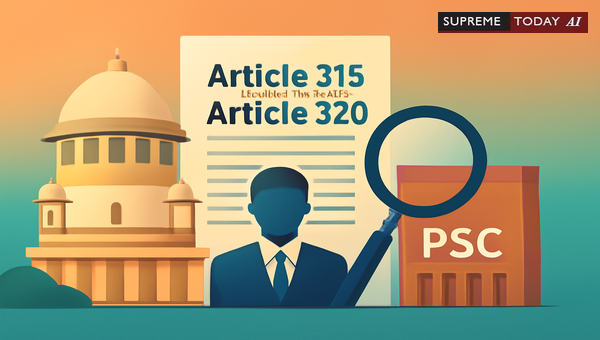
In the realm of Indian constitutional law, questions about recent judgments often arise, including searches for Recent Judgments on 340 Crpc. While deals with offences affecting the administration of justice, today's post focuses on pivotal rulings concerning Articles 315 and 320 of the , which govern (PSCs). These provisions are crucial for ensuring fair recruitment to civil services, and the has provided clarity on their scope, independence, and enforceability. This blog breaks down the main findings, key cases, and practical implications, drawing from authoritative judgments.
Whether you're a civil service aspirant, government official, or legal professional, understanding these rulings can shed light on the constitutional framework for appointments and advisory roles of bodies like and .
The has emphasized that and serve distinct purposes. mandates the establishment of independent for the Union and States to ensure impartiality in civil services recruitment. In contrast, outlines specific functions, such as conducting exams and advising governments. Crucially, the Court has ruled that provisions under (3)(c)—requiring consultation on matters like promotions and disciplinary cases—are . Non-compliance does not automatically invalidate government actions, provided other constitutional procedures under are followed. 2006 8 Supreme 29
As stated in key judgments: The provisions of (3)(c) of the are not mandatory and that non-compliance with those provisions does not afford a to a public servant in a Court of law. 2006 4 Supreme 8
This distinction prevents from overriding enforceable rights under , which protects civil servants from arbitrary dismissal.
establishes PSCs as to promote fair recruitment. The has underscored their independence, noting that the Chairman and members enjoy safeguards against removal, akin to judges. This setup ensures impartiality in processes like exams for IAS, IPS, and state services. In one judgment, the Court reiterated: The does not envisage any employment outside this constitutional scheme and without following the requirements set down therein. 2006 8 Supreme 29
have echoed this in related matters. For instance, in assessing whether entities qualify as State under , courts reference precedents like , testing for government control and public functions—principles aligned with PSC autonomy. IND_Delhi_LPA-315__Delhi_LPA-315_ _DHC_4359-DB_DHC_4359-DB _DHC_4359-DB_DHC_004359>DR JITARANI UDGATA vs UNION OF INDIA & ANR.
(3)(c) requires governments to consult PSCs on penalties, promotions, and transfers. However, the has consistently held this as non-mandatory. The PSC's advice is assistive, not binding, and irregular procedures don't provide grounds for litigation unless statutes specify otherwise. 2006 8 Supreme 29
A landmark observation: PSCs' functions under do not create enforceable individual rights, distinguishing them from protections. 2006 8 Supreme 29 This prevents endless challenges to appointments based on procedural lapses.
Related constitutional discussions in other cases reinforce this. For example, under , evaluation processes like answer script checks must align with constitutional schemes, but outsourcing or digital methods aren't invalidated solely for deviating from advisory norms. 2021 0 Supreme(AP) 530
These principles appear in multiple rulings, promoting efficiency while upholding fairness.
While directory, courts expect good faith consideration of PSC advice when sought. Statutory laws may impose stricter compliance, but constitutionally, lapses aren't fatal. 2006 8 Supreme 29
Other judicial insights integrate seamlessly:- In arbitration disputes involving public entities, tribunals apply akin to PSC consultations, but non-adherence doesn't void awards unless mandatory. 2021 0 Supreme(Guj) 1126 2021 0 Supreme(Guj) 873- RTI and evaluation cases highlight that PSC processes must follow constitutional rigor, but new methods (e.g., digital evaluation) are permissible if impartial. 2021 0 Supreme(AP) 530
Public sector undertakings, as State under Art 12, must balance contracts with these principles, as seen in power project bids where procedural notices precede terminations. 2021 0 Supreme(Guj) 1126
The 's stance on Articles 315 and 320 underscores a balanced constitutional design: independent PSCs advise without overriding government discretion or individual protections. Non-mandatory Art 320(3)(c) fosters efficiency in civil services administration. In summary: Articles 315 and 320 serve different constitutional functions, with (3)(c) being directory rather than mandatory, and non-compliance with it does not, by itself, invalidate government or Commission actions. 2006 8 Supreme 29
Disclaimer: This post provides general information based on judgments and is not legal advice. Consult a qualified lawyer for specific cases.
References:1. 2006 8 Supreme 29: Core clarification on roles and non-mandatory nature.2. 2006 4 Supreme 8: of Art 320(3)(c).3. 2021 0 Supreme(AP) 530: Constitutional provisions overview.
Stay informed on evolving jurisprudence—share your thoughts below!
#SupremeCourtIndia, #Article315320, #PublicServiceCommission


GJEPC does not satisfy any of the requirements or tests laid down by various Judgements of the Supreme Court for establishing whether or not an authority can be deemed to be a “State” under Article 12. ... A 7-Judge Bench of the Supreme Court in Pradeep Kumar Biswas v. ... The Supreme Court, over the years, has examined what constitutes a “Stat....

GJEPC does not satisfy any of the requirements or tests laid down by various Judgements of the Supreme Court for establishing whether or not an authority can be deemed to be a “State” under Article 12. ... A 7-Judge Bench of the Supreme Court in Pradeep Kumar Biswas v. ... The Supreme Court, over the years, has examined what constitutes a “Stat....

The judgement in Pune Municipal Corporation (Supra) was delivered on 24.1.2014. The relevant observations of the Supreme Court are reproduced below :- “15. ... of ambiguity in the legal position due to the judgements of the Supreme Court is liable to be rejected. ... By virtue of Article 144 all civil and judicial authorities in the territory of India ....

To quote the observations read as follows: Pramati Educational and Cultural Trust (Supra) is extracted granted by it, by drawing its implications from the various judgements

By placing reliance on the judgement of the Supreme Court in the case of Indus Mobile Distribution Private Limited Vs. ... In support of the said proposition, the learned counsel relied upon judgement of this Court in the case of Rakesh Malhotra Vs. Rajinder Kumar Malhotra (supra) and judgements of the Supreme Court in the case of Vidya Drolia Vs. .......

In support of the said proposition, the learned counsel relied upon judgement of this Court in the case of Rakesh Malhotra Vs. Rajinder Kumar Malhotra (supra) and judgements of the Supreme Court in the case of Vidya Drolia Vs. ... Reliance was placed on the judgement of the Supreme Court in the case of Best Sellers Retail (India) Private Limited Vs. A....

Power to review its judgments has been conferred on the Supreme Court by Article 137 of the Constitution, and that power is subject to the provisions of any law made by Parliament or the rules made under Article 145. ... Order XL, Rule 1, Supreme Court Rules, 1966. ... Next, the learned Advocate for the petitioner argues that during the passing of the order in WPA 315 o....

Did the Court of Appeal, by its order dated 4th April 2022, misconstrue the provisions pertaining to Contempt of Court jurisdiction by holding that provisions contained in Article 105(2) not relevant, and thereby erred in law? 04. ... Article 128 (2) of the Constitution has also conferred jurisdiction on the Supreme Court to grant Special Leave to App....

So far as to the judgement of the Hon'ble Supreme Court in Vineet Kumar ... Court in the above two cases. ... of Hon'ble Supreme Court in Vineet Kumar and Others Vs. ... State of Maharashtra and Others, (2021) SCC Online SC 315. ... These two judgements are clearly distinguishable on facts inasmuch as the petitioners have prayed for p style="p....
I agree Judge of the Supreme Court Janak de Silva J. I agree Judge of the Supreme Court ... The Appeal before the Supreme Court Upon reading of the judgement of the High Court, it is apparent that there is no examination or analysis of evidence, nor reasoning as to why the findings of the trial court should be disputed or rejected.....

Amber Builders reported in (2020) 2 SCC 540, wherein, the Supreme Court has taken the view that the Gujarat Public Works Contracts Disputes Arbitration Tribunal has the jurisdiction to make an interim order in terms of Section 17 of the Arbitration and Conciliation Act, 1996 (for short, “the Act, 1996”). Section 2(4) makes it absolutely clear that other than Section 40(1), 41 and 43, Part I of the A&C Act shall apply to all arbitrations even if they are carried out under any other enactment as....

Part I of the A&C Act i.e. from Section 2 to Section 43 deals with Arbitration and Section 2(2) clearly states that the said Part would apply to all Arbitrations which take place in India. Amber Builders reported in (2020) 2 SCC 540, wherein, the Supreme Court has taken the view that the Gujarat Public Works Contracts Disputes Arbitration Tribunal has the jurisdiction to make an interim order in terms of Section 17 of the Arbitration and Conciliation Act, 1996 (for short, “the Act, 1996”). #HL....

(Emphasis supplied) 6) CONSTITUTIONAL PROVISIONS AND THE DECISIONS: The constitutional provisions which are relevant are Articles 315 to Article 320 of the Constitution of India. Article 316 (1-A) however has an important bearing on the issues raised. (Emphasis supplied) 6) CONSTITUTIONAL PROVISIONS AND THE DECISIONS: The constitutional provisions which are relevant are Articles 315 to Article 320 of the Constitution of India. Article 316 (1-A) however has a....

The relevant extracts from the judgement of Supreme Court are reproduced below : The Supreme Court in M. Nagabhushana v. State of Karnataka and others, (2011) 3 SCC 408, while explaining the rationale behind the principle of res judicata stated that the principle prevents oppressions which may result under the pretence of law inasmuch as, in the absence of such a principle, there would be no end of litigation and a rich and malicious litigant may scced in compelling the weake....

It is important to quote the relevant paras from this judgement, which read as follows: "7. In support of this contention, learned Counsel for the petitioner has drawn our attention to an endorsement schedule received from the New India Assurance Company wherein it is recorded that earlier policy on the basis of which the complainant had claimed No Claim Bonus was cancelled due to cheque dishonour. Learned Counsel for the petitioner has contended that the impugned order of t....


An indispensable Tool for Legal Professionals, Endorsed by Various High Court and Judicial Officers
Please visit our Training & Support
Center or Contact Us for assistance

Scan Me!
India’s Legal research and Law Firm App, Download now!


For Daily Legal Updates, Join us on :



 Back to top


