Searching Case Laws & Precedent on Legal Query.....!
Analysing the retrieved Case Laws
Scanned Judgements…!



Searching Case Laws & Precedent on Legal Query.....!
Analysing the retrieved Case Laws
Scanned Judgements…!
Person possessing the mortgage property but not being the borrower or guarantor can still exercise rights over the property, including repayment and recovery actions, especially when they are in lawful possession or have obtained possession through legal proceedings ["2025 0 Supreme(MP) 242"] ["2025 0 Supreme(MP) 240"].
Under Section 13(2) of the Securitization Act, notices are issued to the borrower, and if the borrower fails to repay, the secured creditor can initiate proceedings under Section 14 to take possession of the mortgaged property through appropriate authorities like the Tahsildar or District Magistrate ["2025 0 Supreme(MP) 242"] ["2025 0 Supreme(MP) 240"] ["2025 0 Supreme(MP) 404"] ["2025 Supreme(Online)(MP) 3658"].
The law establishes a clear link between the mortgage and the borrower; only the borrower or persons acting on their behalf are primarily liable for repayment, but possession of the mortgaged property can be taken over by a secured creditor or authorized authority if the borrower defaults, regardless of whether the possessor is the borrower or not ["2023 Supreme(SRI)(SC) 20670"].
The possession of the mortgage property can be recovered from a person who is in illegal or unauthorized possession, even if they are not the original borrower or guarantor, provided the possession is established legally (e.g., through orders under the Securitization Act) ["2022 Supreme(Online)(Kar) 151"] ["2025 Supreme(Online)(MP) 3658"] ["2025 Supreme(Online)(MP) 8086"].
Authorities can hand over possession of mortgaged properties to secured creditors after due proceedings, and such possession can be challenged or restored to the borrower if found unlawful or if the borrower re-enters the property unlawfully ["2024 Supreme(Online)(Chh) 2921"] ["2024 Supreme(Online)(Supreme(Chh)) 13143"].
The person who is not the borrower but is in possession of the mortgaged property, especially if acting under lawful orders or possessing the property legally, can repay the loan and recover possession from the borrower or others in illegal possession ["2025 0 Supreme(MP) 242"] ["2025 0 Supreme(MP) 240"].
Analysis and Conclusion:A person who is not the original borrower or guarantor but is in lawful possession of the mortgage property can indeed repay the loan and take legal steps to recover possession from the borrower or illegal occupants. The legal framework under the Securitization Act and related laws permits secured creditors or authorized authorities to take possession of mortgaged properties from lawful possessors, regardless of their status as borrower or guarantor, provided the possession is established through proper legal proceedings ["2025 0 Supreme(MP) 242"] ["2025 0 Supreme(MP) 240"] ["2022 Supreme(Online)(Kar) 151"]. This ensures that possession rights are not solely restricted to the borrower but can be exercised by others lawfully in possession, especially in cases of default or illegal occupation.
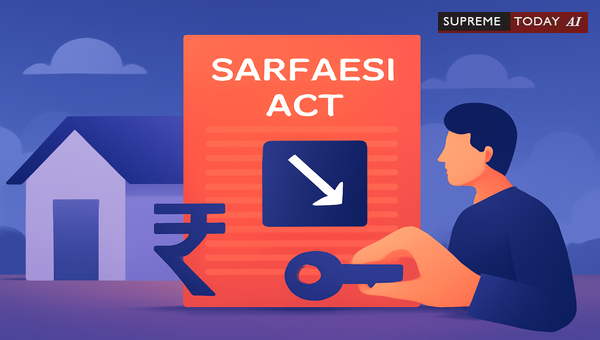
In the complex world of mortgage loans and defaults, questions often arise about the rights of third parties who find themselves in possession of secured properties. Imagine a scenario where someone neither the borrower nor a guarantor holds physical possession of a mortgaged property—perhaps through a lease, purchase, or other arrangement. Can this person repay the outstanding loan to the bank and then seek recovery from the original borrower?
This is a common query in Indian banking and property law, particularly under the . While the law empowers banks to swiftly recover dues from defaulting borrowers, third-party rights are more nuanced. This post breaks down the legal framework, key provisions, and judicial insights to clarify the position—remember, this is general information and not specific legal advice; consult a qualified lawyer for your situation.
The SARFAESI Act provides banks and financial institutions with robust powers to enforce security interests without court intervention in cases of borrower default. Under Section 13(4), the can take possession of the , including , and manage or sell it to recover dues.2006 9 Supreme 425
Under Indian law, particularly the SARFAESI Act and related jurisprudence, the bank or financial institution has statutory authority to take possession of secured assets, including , in case of default by the borrower. 2006 9 Supreme 425 2019 0 Supreme(SC) 998
These rights are exclusive to the bank and do not automatically extend to third parties. The Act overrides other laws via Section 35, ensuring priority for secured creditors. For instance, even if a third party occupies the property derived from the borrower, the bank retains recovery powers. 2024 0 Supreme(Jhk) 289
The bank retains the right to recover debts through even if the borrower sells the property to a third party, as established under the SARFAESI Act, . 2024 0 Supreme(Jhk) 289
Possession alone does not confer the same rights as those of the borrower or guarantor. A third party in possession—say, a purchaser at auction or a lessee—typically acquires rights only through lawful processes like bank-conducted sales under SARFAESI.
In one case, courts emphasized that banks cannot retain title deeds under a if the party is not liable for the debt. A bank cannot exercise a to retain title deeds for debts where the mortgagor is not a borrower and has cleared the outstanding loan. 2024 0 Supreme(AP) 1452
This underscores that third-party involvement must align with statutory procedures.
Recovery rights for a third party are limited and conditional:
A possessor may claim reimbursement for costs incurred in maintaining or improving the property, provided possession is lawful.
A person who is not the borrower or guarantor but is in lawful possession of the mortgage property—such as a purchaser or a lessee—may have a claim to recover costs or expenses incurred in maintaining or improving the property, subject to the terms of transfer or sale. 2013 0 Supreme(SC) 767 2023 1 Supreme 355
If a third party pays off the loan (e.g., to protect their interest) and obtains a transfer of rights from the bank, principles under contract law may allow recovery from the borrower. However, this is not inherent and depends on agreements.
Banks prioritize recovery from borrowers first, then guarantors. The Bank can recover its dues first from the borrower and in case the borrower fails to repay the dues then it can be recovered from the guarantors. 2013 0 Supreme(All) 2357 2013 0 Supreme(All) 2365
Under the SARFAESI Act, a can take possession of a from the borrower or any person who has occupied such asset from the borrower. 2015 0 Supreme(Mad) 3616
No Retroactive Application: Without a valid security interest, SARFAESI actions fail, protecting innocent possessors. 2025 0 Supreme(SC) 2062
: Guarantors or related parties may negotiate OTS, but banks must act in good faith per guidelines. Unauthorized pursuits of property sales post-OTS are invalid. 2013 0 Supreme(All) 2365
In mortgage deeds, third parties can secure others' debts, but stamp duty and validity issues arise. A person other than the borrower can execute a deed of mortgage of his property to secure the debt of others. 2012 0 Supreme(Guj) 559
If you're a third party in possession:1. Verify lawful possession: Ensure it's via bank sale or court order.2. Negotiate with bank: Seek permission to repay partial dues if protecting your interest.3. Document expenses: Keep records for potential claims against the borrower.4. Approach DRT or court: Challenge unlawful bank actions under Article 226 if needed.
Borrowers should note that selling mortgaged property without bank consent doesn't extinguish bank rights. 2024 0 Supreme(Jhk) 289
Understanding these nuances can prevent costly disputes. For tailored advice, reach out to a legal expert specializing in banking law.
This analysis draws from SARFAESI provisions and cited judgments; laws evolve, so verify current status.
#SARFAESIAct, #MortgageRights, #LoanRecovery


Section 13 (2) of the the Securitization Act but borrower did not chose to repay the loan amount. Therefore, petitioner moved an application under Section 14 of the the Securitization Act before the District Magistrate, Guna for taking possession of the property from the borrower. That application was allowed on 06.01.2025 directing the concerned Tahsildar to take possession of the property under mortgage. ... Pe....

Section 13 (2) of the the Securitization Act but borrower did not chose to repay the loan amount. Therefore, petitioner moved an application under Section 14 of the the Securitization Act before the District Magistrate, Vidisha for taking possession of the property from the borrower. That application was allowed on 11.11.2022 directing the concerned Tahsildar to take possession of the property under mortgage. .......

to repay the loan on demand. ... In addition to the amount due on any loan, the Board may recover from the borrower, or any person acting on his behalf – (a) all moneys expended by a bank, in accordance with the covenants contained in the mortgage bond executed by the person to whom the loan was granted, in the ... delivery to be made by putting the purchaser or any person whom he may appoint to receive p....

Thereafter, it appears that the respondent No.2 sold the aforesaid property to the petitioner on 14.08.2003. ... 3. The respondent No.2 did not repay the loan to the Bank. ... From perusal of the S.2(f) of the Act, it is evident that the petitioner is not covered under the definition of the borrower. ... It is pertinent to note that it is not the case of the petitioner that he is a borrower. S.13(2) of the Act envisages a notice only to the #HL_STA....

And held that the borrower having deposited the documents in order to secure a specific transaction, the bank cannot contend that they could hold the documents for a balance due in a different loan account, wherein the person is not a borrower." ... It cannot be disputed that the property in question was not bailed to the appellant Bank by the deceased borrower at any point of time. Further, it is an undisputed fact that the property#HL_EN....
Once the borrower failed to repay the loan amount then the property which is under mortgage should be taken over by the petitioner as petitioner falls under the category of secured creditor. ... Thereafter, since borrower failed to pay the loan amount, therefore, petitioner issued a notice under section 13(2) of the the Securitization Act but borrower did not chose to repay the loan amount. ... Pe....
Once the borrower failed to repay the loan amount then the property which is under mortgage should be taken over by the petitioner as petitioner falls under the category of secured creditor. ... Thereafter, since borrower failed to pay the loan amount, therefore, petitioner issued a notice under Section 13(2) of the the Securitization Act but borrower did not chose to repay the loan amount. ... Pe....
Once the borrower failed to repay the loan amount then the property which is under mortgage should be taken over by the petitioner as petitioner falls under the category of secured creditor. ... Thereafter, since borrower failed to pay the loan amount, therefore, petitioner issued a notice under Section 13(2) of the the Securitization Act but borrower did not chose to repay the loan amount. ... Pe....

The stand was taken by the State in the said affidavit that the aforesaid land having been transferred by the borrower in favour of the 3rd person and hence, the physical possession could not have been provided. 23. ... But, the possession of the said property has not been given. 19. The writ petitioner, thereafter, came to know about the fact that the property in question has been sold out by the borrower. 20. ... The purpose for k....
Having regard to the fact that availing loan from any financial institution or corporation without placing any property on mortgage in favour of such institution or corporation is not possible as per the existing norms, the Council had worked out modalities for Model Village citizens to avail loan facility ... A security agreement may not be contained in a single document. Typically, it is a collection of agreements including loan, hypothecation, guarantee and #HL_STA....
A borrower who has defaulted in paying the loan can be held liable to repay it; The forensic audit traces back the money trail to the borrowing-traders and not to NSEL; (v) Though the transaction by NSEL in its platform seems to be an exchange of commodities on paper, it was an agreement between a lender and borrower.

Under the SARFAESI Act, a secured creditor can take possession of a secured asset from the borrower or any person who has occupied such asset from the borrower. By virtue of Section 35 of the SARFAESI Act, the provisions of SARFAESI Act would override the other laws and the provisions of the Customs Act and the Central Excise Act, which have no provision creating first charge over the dues of the secured creditor.

It is pertinent to mention here that the petitioners are guarantor. The Bank can recover its dues first from the borrower and in case the borrower fails to repay the dues then it can be recovered from the guarantors. The petitioners request that they may be issued a letter of permission from the respondent Bank to sell the property No. 128/131/10, K-Block, Kidwai Nagar, Kanpur within a period of one month. After selling the aforesaid property, the petitioner will deposit Rs. 30,00,000/- with the respondent Bank within a period of three months thereafter.
The Bank can recover its dues first from the borrower and in case the borrower fails to repay the dues then it can be recovered from the guarantors. It is pertinent to mention here that the petitioners are guarantor. After selling the aforesaid property, the petitioner will deposit Rs.30,00,000/- with the respondent Bank within a period of three months thereafter. The petitioners request that they may be issued a letter of permission from the respondent Bank to sell the property No.128/131/10, K-Block, Kidwai Nagar, Kanpur within a period of one month.

Therefore, in accordance with the definition of “mortgage” as provided in the Transfer of Property Act, a security trustee of different lenders can be a party to a mortgage deed of the borrower. Similarly, a person other than the borrower can execute a deed of mortgage of his property to secure the debt of others. It is also not in dispute that a security trustee agreement among the lenders had been separately executed and appropriate amount of stamp-duty as required under the Act is also paid.


An indispensable Tool for Legal Professionals, Endorsed by Various High Court and Judicial Officers
Please visit our Training & Support
Center or Contact Us for assistance

Scan Me!
India’s Legal research and Law Firm App, Download now!


For Daily Legal Updates, Join us on :



 Back to top


