


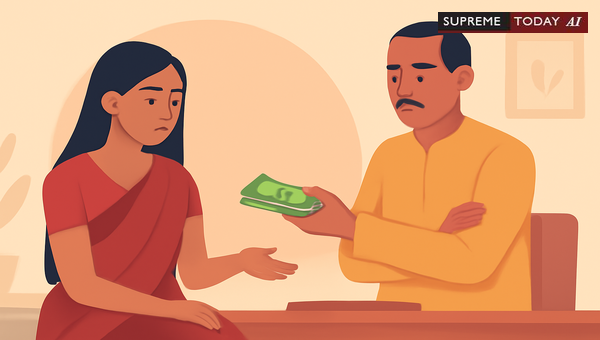
Is an Unmarried Daughter Entitled to from Her Father?
In Indian families, financial support between parents and children is a common concern, especially when daughters remain unmarried and face economic challenges. A frequent legal question arises: Whether an unmarried daughter is entitled to get from the father? This issue is governed primarily by , which aims to prevent and provide relief to dependents unable to support themselves. This blog post explores the legal framework, key conditions, case laws, and related family obligations to offer clarity on this topic.
While this information is based on established laws and judgments, it is for educational purposes only. Consult a qualified lawyer for advice tailored to your specific situation.
Legal Framework: Section 125 CrPC and Rights
Section 125 CrPC is a secular provision applicable to all Indians, regardless of religion, allowing magistrates to order for wives, children, and parents who cannot maintain themselves. For children, explicitly states that a —whether married or not—who is unable to maintain itself, can claim from their father or mother, provided the latter has sufficient means. 2025 Supreme(Online)(MP) 4834
This provision underscores the father's primary obligation towards his children, including unmarried daughters. Courts have interpreted 'child' broadly to include major unmarried daughters who remain dependent due to inability to earn a livelihood, such as through education, disability, or unemployment. The obligation persists until the daughter marries or becomes self-sufficient.
Distinction from Married Daughters
Unlike unmarried daughters, married daughters generally lose the right to claim from their father under Section 125 CrPC, as marriage shifts primary responsibility to the husband. However, exceptions exist under like the Hindu Adoption and Act (HAMA), 1956, where a father may still provide support if the daughter is widowed or divorced and unable to sustain herself. 2025 Supreme(Online)(Pat) 1365
Key Conditions for an Unmarried Daughter's Claim
To succeed in a claim, an unmarried daughter must satisfy several conditions:
- Inability to Maintain Herself: She must prove lack of sufficient income or property. Simply being unmarried is insufficient; evidence of dependency is crucial. 2014 0 Supreme(Ker) 466
- Father's Sufficient Means: The father must have the financial capacity to pay without compromising his own reasonable needs.
- No Disqualifying Conduct: Claims may be denied if the daughter refuses to live with the father without sufficient cause or lives in (though less relevant for unmarried daughters).
- Age Considerations: Minor daughters (under 18) have a stronger claim, but major unmarried daughters can claim if genuinely dependent. 2025 Supreme(Online)(MP) 4834
According to of the Cr.P.C., the legitimate or illegitimate minor child, whether married or not, unable to maintain itself is entitled to get ....2025 Supreme(Online)(MP) 4834
Judicial Interpretations and Case Laws
Indian courts have consistently upheld the father's duty towards unmarried daughters, emphasizing the provision's welfare-oriented object.
- In various rulings, the and have clarified that the obligation under Section 125 is not limited to minors but extends to major unmarried daughters unable to fend for themselves. 2014 0 Supreme(Ker) 466 1987 0 Supreme(SC) 213
- Primary Obligation on Father: The law places the core responsibility on parents, particularly the father, for their children's upkeep. The primary obligation to maintain a mother during her lifetime is on her son or, in some cases, her father, not on her daughter’s husband. This principle mirrors the reciprocal duty towards children. 2014 0 Supreme(Ker) 466
- Definition of Parent-Child Relationship: Courts have held that the expression 'mother' in ... means and is referable only to the real or natural mother, excluding in-laws. By analogy, the father-child bond under 125(1)(b) is strictly biological or legally adoptive. 1996 4 Supreme 42
An illegitimate child is also entitled to get from his father. This extends equally to daughters, reinforcing inclusivity. 2025 Supreme(Online)(MP) 4834
Related Family Obligations: Insights from Other Provisions
While the focus is on direct father-daughter claims, understanding extended family duties provides context:
- Reciprocal Duties (): Children, including daughters, must maintain their parents if unable to self-support. However, this does not extend to in-laws like a daughter's husband maintaining his mother-in-law unless specific dependency is proven. 2014 0 Supreme(Ker) 466 1987 0 Supreme(SC) 213
- : Under Section 20, a Hindu father is bound to maintain his unmarried daughter. For widowed daughter-in-laws, Section 19 allows claims from the father-in-law if unable to support from husband's estate, parents, or children. ...after death of the son, the widow daughter-in-law is entitled to get from his father-in-law under ...2025 Supreme(Online)(Pat) 1365
- Mother's Role: A mother can file on behalf of a minor daughter, and in some cases, secure for grandchildren. 2021 Supreme(Online)(MAD) 37264
These provisions highlight a structured hierarchy: immediate family first, with limited extension to in-laws under .
Exceptions and Limitations
- Self-Sufficiency: If the daughter has independent income, property, or earning potential, the claim fails.
- Post-Marriage: Marriage typically ends the father's liability under CrPC, though may revive it in distress.
- Arrears and Death: Claims do not survive the claimant's death for arrears unless decreed earlier. 2023 Supreme(Online)(Mad) 96895
- Interim vs. Final Orders: Courts often grant pending full hearings.
Practical Recommendations
- File a Petition: Approach the or under Section 125 CrPC with proof of income disparity and dependency.
- Evidence is Key: Submit affidavits, income proofs, and witness statements.
- Quantum of : Courts consider the father's income, daughter's needs, and lifestyle; typically 1/3rd to 1/2 of net income.
- Seek Legal Aid: Free assistance is available for low-income families.
Conclusion and Key Takeaways
Generally, an unmarried daughter is entitled to from her father under Section 125 CrPC if she cannot maintain herself and the father has means. This right protects vulnerable family members and promotes social welfare. Key takeaways:
- Applies to legitimate/illegitimate daughters, married or unmarried (with nuances for majors).
- Strict proof of dependency required.
- Does not extend automatically to in-laws; limited by statutory definitions. 1996 4 Supreme 42
- like HAMA provide additional avenues for Hindus.
Final Note: Laws evolve with judicial precedents, so verify with recent developments. This is not legal advice—always consult a professional for your case.
#DaughterMaintenance, #FamilyLawIndia, #CrPC125












