Searching Case Laws & Precedent on Legal Query.....!
Analysing the retrieved Case Laws
Scanned Judgements…!



Searching Case Laws & Precedent on Legal Query.....!
Analysing the retrieved Case Laws
Scanned Judgements…!
Legal Notice for Persons Who Left Jobs in January 2025
Legal notices can be sent even if the person has left the job recently, provided the period of notice falls within the contractual or statutory warranty/period of liability. Several sources indicate that legal notices related to service deficiencies, warranty claims, or contractual disputes are valid if sent within the relevant period, even if the individual has left the job or service recently. For example, in cases involving warranty claims or service deficiencies, notices sent within the warranty period are considered valid, regardless of whether the person is still employed (e.g., 2025 Supreme(Online)(SCDRC) 11002, 2025 Supreme(Online)(SCDRC) 11120).
The timing of sending a legal notice is crucial; it must be within the applicable statutory or contractual period. As seen in multiple cases (e.g., 2025 Supreme(Online)(SCDRC) 11002, 2025 Supreme(Online)(SCDRC) 11120), legal notices issued within the warranty or contractual period are deemed valid, even if the party has left the job or service. The legal notice's acknowledgment by the recipient and the absence of response further reinforce its validity.
Leaving a job or service does not bar the aggrieved party from sending a legal notice to the former employee or service provider. The legal framework allows for notices to be issued post-employment or post-service, especially when claims or disputes arise within the contractual or statutory periods (e.g., 2025 Supreme(Online)(SCDRC) 4056, 2025 Supreme(Online)(SCDRC) 4638).
In employment disputes, notices can be sent to the employer or the party responsible, even after resignation or termination, provided the claim falls within the relevant period. For instance, in the case involving a former employee (2025 Supreme(Online)(Ori) 5531), the court considered the timing of notices in relation to employment termination dates, indicating that notices can be valid if sent timely.
Based on the provided sources, if a person leaves their job in January 2025, it is generally permissible to send a legal notice to the party involved—be it the employer, service provider, or other responsible entity—so long as the notice is issued within the relevant contractual or statutory period. The validity of such notices hinges on timely dispatch and acknowledgment, not necessarily on the continued employment status of the individual. Therefore, individuals or entities can indeed send legal notices to parties even after they have left their jobs in January 2025, provided the notice aligns with applicable legal timelines.
References:- 2025 Supreme(Online)(SCDRC) 11002, 2025 Supreme(Online)(SCDRC) 11120, 2025 Supreme(Online)(SCDRC) 4056, 2025 Supreme(Online)(SCDRC) 4638, INDSCDRC00000008092
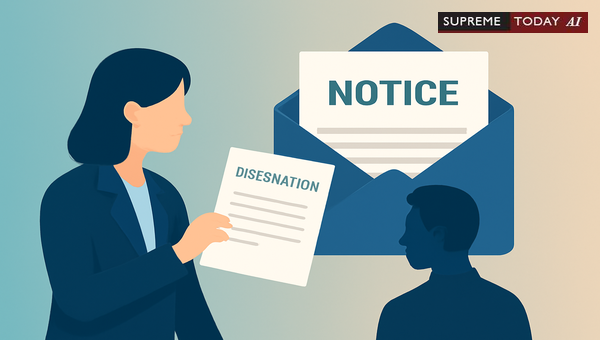
Imagine this: An employee resigns from your company in , walks out the door, and suddenly you discover unpaid loans, breached , or . Can you still send them a ? This is a common dilemma for employers navigating . In this article, we break down the legal landscape, drawing from key judgments and principles to provide clarity.
Important Disclaimer: This is general information based on legal precedents and is not specific legal advice. Consult a qualified lawyer for your situation.
The question at hand is straightforward: If any Person Left Job in can be Send to Party? The short answer is yes, generally, but only if there are valid legal grounds such as , non-payment of dues, or other actionable issues. Simply leaving a job doesn't bar notices; the timing (like post-) is irrelevant if obligations persist. 2025 0 Supreme(Bom) 436 2021 0 Supreme(Del) 1227
Legal notices serve as formal , demanding compliance or warning of action. They remain viable even after employment ends, provided they're justified.
Courts emphasize fairness in contractual and employment matters. For instance, 2025 0 Supreme(Bom) 436 highlights that notices and actions must be fair and justified, especially when involving public law elements or . This applies post-employment, where unresolved issues like dues recovery trigger notices. 2025 0 Supreme(Bom) 436
Resignation procedures also underscore notice importance. 2021 0 Supreme(Del) 1227 details requirements like giving proper notice and obtaining () during disengagement. Failure here can lead to disputes, justifying later notices. 2021 0 Supreme(Del) 1227
There's no blanket prohibition on post-termination notices. 2024 Supreme(Bom) 1104 illustrates that contractual clauses on termination allow notices for breaches even afterward. Similarly, 1975 0 Supreme(SC) 54 stresses actions in termination, implying remedies persist. 2024 Supreme(Bom) 1104 1975 0 Supreme(SC) 54
Judgments reinforce this flexibility. In 2025 Supreme(Online)(Mad) 32237, a business relationship ended on , yet the plaintiff sent a and filed suit for reliefs, showing post-relationship actions are maintainable. The court noted: Since the request and demand which included , the respondent filed a suit in question for the relief setout therein.
Abrupt departures don't shield parties either. 2025 Supreme(Online)(NCDRC) 2715 mentions a legal manager who abruptly left the job on , amid ongoing legal matters, highlighting how exits don't halt proceedings. 2025 Supreme(Online)(NCDRC) 2715
In family-employment analogies, 2025 Supreme(HK)(HKFC) 303 describes a husband leaving without any prior notice in , shifting responsibilities and implying potential claims afterward. While not pure employment, it parallels sudden exits leading to notices. 2025 Supreme(HK)(HKFC) 303
Malaysian cases like
address job changes without notice: The grounds of review are that there was no notice of job description, and notice of reimbursements... Courts ruled additional duties within contracts don't constitute dismissal, but disputes require proper channels—extendable to post-exit notices.
However, context matters:
| Context | Validity of Post-Exit Notice ||---------|------------------------------|| Full Settlement | Low – Unnecessary 2022 0 Supreme(Bom) 1005 | | Outstanding Breach | High – Justified 2025 0 Supreme(Bom) 436 || Time-Barred Claim | Low – Challengeable |
Not every notice flies:- No Valid Grounds: Frivolous notices risk being vexatious.- Settled Disputes: Mutual agreements bar further action.- Statutory Limits: Claims may be time-barred (e.g., under ).
2025 0 Supreme(Ker) 347 warns contempt can't create new obligations: cannot be used to introduce new orders... confined to determining willful disobedience. Analogously, notices must stick to original issues. 2025 0 Supreme(Ker) 347
In impleadment contexts, 2015 0 Supreme(Del) 1105 notes banks () can't be forced against non-grievances, but necessary parties can be added for real issues—relevant for multi-party post-employment suits. 2015 0 Supreme(Del) 1105
Before sending a notice post-:1. Verify Grounds: Check contracts for clauses on dues, breaches. 2024 Supreme(Bom) 11042. Document Everything: Reference specifics in the notice.3. Time It Right: Act promptly to avoid .4. Seek Legal Review: Ensure compliance with local laws.5. Consider Alternatives: Negotiation or mediation first (e.g., ). 2025 Supreme(Online)(Mad) 32237
Maintain records, as courts value procedural compliance. 2025 0 Supreme(Bom) 436
In summary, yes—you can typically send a to a party who left their job in if backed by legal or contractual grounds. Timing isn't a barrier, but validity hinges on merits. Cases like 2021 0 Supreme(Del) 1227 and 2025 Supreme(Online)(NCDRC) 2715 affirm actions persist post-exit.
Key Takeaways:- Justify with breaches or dues.- Follow fair procedures.- Consult professionals.
Stay informed on employment law to protect your interests. For tailored advice, reach out to a legal expert.
References:1. 2025 0 Supreme(Bom) 4362. 2021 0 Supreme(Del) 12273. 2024 Supreme(Bom) 11044. 1975 0 Supreme(SC) 545. 2025 Supreme(Online)(Mad) 322376. 2025 Supreme(Online)(NCDRC) 2715
#EmploymentLaw #LegalNotice #ResignationRights


the vehicle with the custody of the Opposite Party under acknowledgment, but the Opposite Party have failed to rectify/repair the said mistake and violated the warranty condition which amounts to deficiency of service on the part of Opposite Parties hence, the complainant got issued a legal notice on ... Filed on: 12.06.2014 Disposed on: 03.01.2025 BEFORE THE KARNATAKA STATE CONSUMER DISPUTES REDRESSAL CO....

The petitioner was running a power loom factory and they used to send the materials for sizing to the plaintiff on a job work basis. The two had been having business relationship from 03.04.2015 to 09.11.2017. ... Since the request and demand which included legal notice, the respondent filed a suit in question for the relief setout therein. 4. ... IN THE HIGH COURT OF JUDICATURE AT MADRAS Dated : 12.02.2025#HL_EN....

Though the said legal notice was received by both the opposite parties, the second opposite party alone has sent a reply dated 18.05.2018 requesting the complainant to send the copy of the documents, but they did not comply the demand. ... PRESIDENT Index : Yes/ No GR/SCDRC/Chennai/Orders/January/2025 F.A. ... For which the second opposite party sent a reply e-mail dat....

Hence, the complainant issued a legal notice on 09.06.2022 to both the opposite parties. ... Sd/- R.SUBBIAH PRESIDENT Index : Yes/ No AVR/SCDRC/Chennai/Orders/January/2025 ... The complainant again approached the 2nd opposite party complaining that the left side of the screen has turned black. ... Friday, the 31st day of January 2025 1. Sony India ....
R.SUBBIAH PRESIDENT GR/SCDRC/Chennai/Orders/January/2025 F.A. ... Having acknowledged the legal notice, the opposite parties had not sent any reply but remaining dormant. ... Since the 2nd opposite party is the agent of the 3rd opposite party, the legal notice caused to the 2nd opposite party has been intimated to the 3rd opposite #H....

Mukherji, learned Senior Counsel and Opposite Party No.2 in person, this Court finds that there is no legal impediment for learned Presiding Officer, Labour Court, Bhubaneswar to take a decision on the application dated 19th September, 2025 (Annexure-6) filed by Petitioner-Company ... Keeping in mind the nature of the order purposed to be passed in this writ petition, this Court feels that no notice in th....

Since the husband left the matrimonial home in 2020 without any prior notice to the wife, the responsibility of raising the son has fallen onto the shoulders of the wife. ... In July 2020, he left the matrimonial home without her prior notice and did not return since then. The parties thus separated. 10. ... The wife even told in her oral evidence that in the beginning when the husband l....

At the time of passing of the impugned order the legal matters of the appellant company were being looked-after by its earlier AR/Legal Manager Mr. Kartik Shrivastava who abruptly left the job on 24.04.2025. ... NC/FA/412/2025 (Against the Order dated 9th January 2023 in Complaint SC/7/CC/385/2018 of the State Consumer Disputes Redressal Commission Delhi) SHREE VARDHMAN....
Notice Of Detailed Job Description And Reimbursements [63] The grounds of review are that there was no notice of job description, and notice of reimbursements can be taken ... SG Concrete Products (m) Sdn Bhd & Another Appeals [2024] MLRAU 340; [2025] 4 MLJ 274; [2025] 2 ILR 201; [2025] 5 CLJ 222 had cause to determine the interpretation of s 25 of Ac....
Notice Of Detailed Job Description And Reimbursements [63] The grounds of review are that there was no notice of job description, and notice of reimbursements can be taken together. ... SG Concrete Products (m) Sdn Bhd & Another Appeals; [2025] 4 MLJ 274; [2025] 2 ILR 201; [2025] 5 CLJ 222 had cause to determine the interpretation of s 25 of Act A1615....

16. The Contempt Petition will be heard on its own merits. The Appeal is disposed of in the above terms. 13. As regards the case at hand, the contempt petition is still pending and has not been disposed of. The learned Single Judge has not concluded that there is any wilful disobedience on the part of the Appellant Board to proceed to take action for contempt. There is no discussion in the order dated 15 January 2025 as to whether it is passed to implement the order dated 27 October 2017, or i....

8. Ms. Shilpa Singh, ld. Counsel for the NIA, has been queried by theCourt as to why the Appellant could not be taken immediately after the order granting custody parole was passed on 9th January, 2025. She submits that since the cost of the entire custody parole was to be borne by the State, necessary approvals were to be obtained and thereafter arrangements were made for the travel of the troupe along with the Appellant. 9. Since, by the time the Appellant reached Srinagar, his father had pa....

Of course, it appears from the record that after reaching USA, the so-called email transaction has been sent in the name of Arvindbhai Babarbhai Bhatia addressed to the concerned Judge. Had there been real objection of such withdrawal purshis then he himself should have personally appear before the Court below and told the Court that he has objection for withdrawal of suit and do not intend to withdraw the suit. The practice adopted by the original plaintiff Arvindbhai Babarbhai Bhatia cannot ....

We have already stated hereinabove that we are not deciding which of these two options is the correct option but we are clearly of the view that at least one of these two options, either a fresh writ petition or a review petition should be available to the writ appellant Harendra Debbarma. 6. No party to legal proceedings can be left remediless.
The Tribunal below ought to have realized that the appellant Bank is a dominus litis and it could not be forced to prosecute its lis against the persons against whom it has not grievance or against it is not claiming any relief. Any person can be permitted to be impleaded as party if he is necessary or proper party. “The Tribunal below has allowed the prayer of the respondents to implead various persons named in the order on the ground that the Bank official in connivance wit....


An indispensable Tool for Legal Professionals, Endorsed by Various High Court and Judicial Officers
Please visit our Training & Support
Center or Contact Us for assistance

Scan Me!
India’s Legal research and Law Firm App, Download now!


For Daily Legal Updates, Join us on :



 Back to top


