Searching Case Laws & Precedent on Legal Query..!
Scanned Judgements…!



Searching Case Laws & Precedent on Legal Query..!
Scanned Judgements…!
Rama Chandra Mishra VS State of Orissa - Crimes
"], ["1994 0 Supreme(Ori) 203"], ["2008 0 Supreme(MP) 1089"], ["2014 Supreme(Online)(KER) 14081"].Rama Chandra Mishra VS State of Orissa - Crimes
"], ["1994 0 Supreme(Ori) 203"].Servants are explicitly excluded from being considered family members for service purposes ["
Rama Chandra Mishra VS State of Orissa - Crimes
"].Analysis and Conclusion:
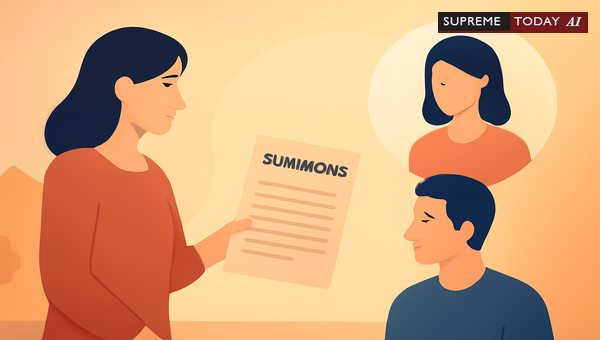
In civil litigation, proper service of summons is crucial for . A common question arises: whether service on female member of family is sufficient service under CPC? This issue touches on fairness, accessibility, and evolving judicial standards under the (CPC). While traditional views sometimes favored male members, modern interpretations lean towards inclusivity. This post breaks down the legal framework, key rulings, conditions, exceptions, and practical guidance—generally speaking, as laws may vary by context.
Service of summons ensures defendants know of proceedings and can respond. outlines methods, prioritizing personal service but allowing alternatives when the defendant is absent.
Order V, Rule 15 states that where the defendant cannot be found, service of notice can be made on an adult member of the family, whether male or female who resides with them 2011 0 Supreme(Bom) 1096. This provision explicitly permits service on adult female family members, marking a shift from outdated gender biases.
Multiple judicial sources affirm: family, whether male or female, who is residing with him
. Similarly, on any adult member of the family, whether male or female, who is residing with him
. These underscore that gender is irrelevant if the recipient is an adult resident.
Early rulings showed caution. In ILR 21 Bom 223, service on a female member was deemed not sufficient1966 0 Supreme(J&K) 47. However, this was distinguished in later cases. The in AIR 1914 Cal 84 held that service suffices if the defendant has the opportunity to communicate with his family who has received notice 1966 0 Supreme(J&K) 47.
Post-1983 amendments, the directed courts to ignore male-only restrictions, validating service on any adult family member residing with the defendant 2011 0 Supreme(Bom) 1096. Courts now emphasize communication opportunity and proper execution.
Recent cases reinforce this. In one, service on the petitioner's mother (an adult female) was upheld under Order V, Rule 15, as she received it under signature 2015 0 Supreme(Gau) 1074. Another notes: service of notice can be made on any adult member of the family whether male or female 2015 0 Supreme(Gau) 107.
For service to hold:- Adult Status: Recipient must be an adult (major) 2009 0 Supreme(MP) 1319.- Residency: Must reside with the defendant
.- Defendant's Absence: Typically when defendant is not at residence 2010 0 Supreme(All) 3641.- Communication Opportunity: Defendant must likely learn of the notice via family ties 1966 0 Supreme(J&K) 47.- Proper Effectuation: Process server must follow protocols, like obtaining acknowledgment.
Courts take a lenient view in restoration applications if service was on an adult family member during absence, urging less technical scrutiny 2010 0 Supreme(All) 3641.
Not all scenarios permit such service:- Trustee Contexts: Service on female family members of a trustee in land acquisition is invalid 1976 0 Supreme(Mad) 663.- Minors or Non-Residents: Service on minors or non-residents fails 2009 0 Supreme(MP) 1319.- Specific Restrictions: Rare cases or statutes may mandate personal or male service, though not commonly supported post-amendments.- No Proof of Communication: If no evidence defendant knew, service may be challenged.
In tax matters under , akin CPC rules apply, requiring adult family service only if properly verified
. Refusal by defendant doesn't validate improper service on unauthorized persons.
Service rules extend beyond family suits. In disciplinary proceedings, notice to a constable's mother was valid, as she was an adult family member 2015 0 Supreme(Gau) 1074. echoed: service may be made on any adult member of the family, whether male or female, who is residing with him
.
In partition suits under special laws like , family management by senior-most (male or female) doesn't alter core CPC service norms 2011 0 Supreme(Ker) 776. Income tax appeals stress verifying recipient's adulthood and relation 2009 0 Supreme(MP) 1319.
These cases illustrate a liberal, gender-neutral trend, prioritizing substantial justice over form.
To ensure validity:- Confirm recipient is an adult female family member residing with defendant.- Document service meticulously, including photos/signatures.- Assess communication likelihood—e.g., shared home.- In trustee/land cases, opt for personal service 1976 0 Supreme(Mad) 663.- File affidavits proving absence and relation.- Challenge via if service disputed, but courts favor restoration if bona fide.
Always consult local rules; post-1983, male-only biases are obsolete 2011 0 Supreme(Bom) 1096.
In conclusion, while service on a female family member is generally sufficient under CPC, success hinges on procedure and facts. This is informational—not legal advice. For case-specific guidance, consult a qualified lawyer. Stay informed on summons service to avoid .
References:- 1966 0 Supreme(J&K) 47 Judicial views on communication.- 2011 0 Supreme(Bom) 1096 Order V Rule 15 interpretations.- 1976 0 Supreme(Mad) 663 Trustee exceptions.-
,
, 2010 0 Supreme(All) 3641, 2015 0 Supreme(Gau) 1074, etc., for affirming quotes. #CPCService, #LegalServiceIndia, #CivilProcedure


family, whether male or female, who is residing with him.” ... of the family whether male or female who is residing with him. ... may be on an adult terms of Rule 15 of Order 5 C.P.C. ... as sufficient the learned court below has dismissed the application filed p style="position:absolute;white-space

Therefore ‘service held sufficient’. 2. ... Therefore, ‘service held sufficient’. 6. Perused the material available on record. ... The petitioner/wife herein filed the present petition under Section 24 of the Code of Civil Procedure, 1908, (for ‘short the C.P.C.’) seeking for withdrawal of F.C.O.P.No.377 of 2024 on the file of the Judge, Family Court-cum-VI Additional District Judge, Nellore, S.P.S.R ... During their wedlock period, the petitioner/wife and the res....

service of the summons on his behalf, service may be made on any adult member of the family, whether male or female, who is residing with him. ... to accept the service of summons on his behalf and in that event, service may be made on any adult member of the family, whether male or female, who is residing with him. ... In case where the defendants may not be found at their resid....

Accordingly in Rule 15, service on any adult member of the family, whether male or female, who is residing with him is provided for. But the position is different in section 64 of the Code. Legislature has left the position undisturbed in the Code, which replaced the Old Code of 1898. ... The question is whether by application of section 13 of the General Act offer of summons to a female is permissible. ... In the context in which the word "male" has been used in sect....

Accordingly in Rule 15, service on any adult member of the family, whether male or female, who is residing with him is provided for. But the position is different in section 64 of the Code. Legislature has left the position undisturbed in the Code, which replaced the Old Code of 1898. ... The question is whether by application of section 13 of the General Act offer of summons to a female is permissible. ... In the absence of proof that the person summoned cannot, afte....

within a reasonable time and he has no agent empowered to accept service of the summons on his behalf, service may be made on any adult member of the family, whether male or female, who is residing with him. ... (iii)That he has no agent empowered to accept service of the summons on his behalf. If the above three conditions exist, then the summon may be served on the adult member of the family, whether male or #HL_....

and he has no agent empowered to accept service of the summons on his behalf, service may be made on any adult member of the family, whether male or female, who is residing with him." ... and he has no agent empowered to accept service of the summons on his behalf, service may be made on any adult member of the family, whether male or female, who is residing with him. ... The lea....

on his behalf, service may be made on any adult member of the family, whether male or female, who is residing with him. ... Thus, as per Order V, Rule 15 of the CPC, service of a summons issued by a civil court can be made on any adult member of the family of the defendant, residing with him, whether male or female. ... So, in accordance with section 282(1) of the Income-tax Act, servic....

his behalf, service may be made on any adult member of the family, whether male or female, who is residing with him.” ... According to Order V Rule 15, C.P.C., “service upon adult member of the family is permissible only when he is absent from his residence.” Order V Rule 15, C.P.C. is quoted below: ... “15. Where service may be on an adult member of defendant’s family....

of the summons on his behalf, service may be made on any adult member of the family, whether defendant's family male or female, who is residing with him.” ... 2.Whether to be referred to the Reporters or not?

The records have revealed that one Smt. Sonti Bora, who is the mother of the petitioner received the f additional charge sheet dated 18.7.2008 on 16.8.2008. As per the provisions of order 5, rule XV of the Code of Civil Procedure, 1908, service of notice can be made on any adult member of the family whether male or female. On perusal of the said records, it appears that the additional charge e sheet was received by the mother of the petitioner under her clear signature. It is not the case of the petitioner that the additional charge sheet was not served on his mother or tha....

As per the provisions of Order 5 Rule XV of the Code of Civil Procedure, 1908, service of notice can be made on any adult member of the family whether male or female. It is not the case of the petitioner that the additional charge sheet was not served on his mother or that the mother did not inform him about the additional charge sheet. The records have revealed that one Smt Sonti Bora, who is the mother of the petitioner received the additional charge sheet dated 18.07.2008 on 16.08.2008. On perusal of the said records, it appears that the additional charge sheet was recei....

Requirement of law for service of summons is that attempt should be made to serve the notice personally on the party unless there is no agent empowered to accept service on behalf of the party., the absence of defendant from his residence, no likelihood of his being found at the residence within a reasonable time and there being no agent empowered to accept service. "Service on any adult member of the family, male or female is sufficient provided the conditions set out in the rule are satisfied, viz. In Mulla, The Code of Civil Procedure, 18th Edition, 2011 (page 1660 & 166....
Just as statutory intervention in the Marumakkathayam law brought about some healthy changes in the Marumakkathayam law, the same happened in the case of Aliyasanthanam law also with the coming into force of the Madras Aliyasanthanam Act of 1949. The senior-most member, whether male or female, is entitled to carry on the family management. No member of the tarwad had a right to claim partition or separate possession of his share without the concurrence of other members. In this system of law the eldest member is known as Ejaman and the eldest female member is known as Ejama....
In the present matter from the side of the Department/Revenue nothing has been brought on record to show, suggest or prove that the person upon whom service was effected was major. When the defendant or a noticee is not found then the service can be effected on the adult member of the family and in such case the service so effected would be taken to be proper. Requirement of Rule 15 of Order V of CPC is that service may be made on any adult member of the family, whether male or female, who is residing with notice. On the other hand, present appellant had filed before CIT(A)....


An indispensable Tool for Legal Professionals, Endorsed by Various High Court and Judicial Officers
Please visit our Training & Support
Center or Contact Us for assistance

Scan Me!
India’s Legal research and Law Firm App, Download now!


For Daily Legal Updates, Join us on :



 Back to top


