Searching Case Laws & Precedent on Legal Query..!
Scanned Judgements…!



Searching Case Laws & Precedent on Legal Query..!
Scanned Judgements…!
Mentioning of direction of movement - Not necessarily required to establish offences under Section 341 IPC when the complainant is riding a bike and the accused is caught on the handle, restraining his way. The key elements are wrongful restraint and obstruction, regardless of the specific direction of movement ["2025 0 Supreme(Ker) 152"], ["2025 Supreme(Online)(Ker) 21912"], ["2024 Supreme(Online)(Ker) 79792"].
Main points and insights:
The courts have also noted that in cases where the accused obstructed the rider's path or forcibly restrained the rider's movement, the specific direction of movement is not a necessary element for conviction under Section 341 IPC ["2025 0 Supreme(Ker) 2535"].
Analysis and conclusion:
References:- ["2025 0 Supreme(Ker) 152"]- ["2025 Supreme(Online)(Ker) 21912"]- ["2024 Supreme(Online)(Ker) 79792"]- ["2025 0 Supreme(Ker) 2535"]
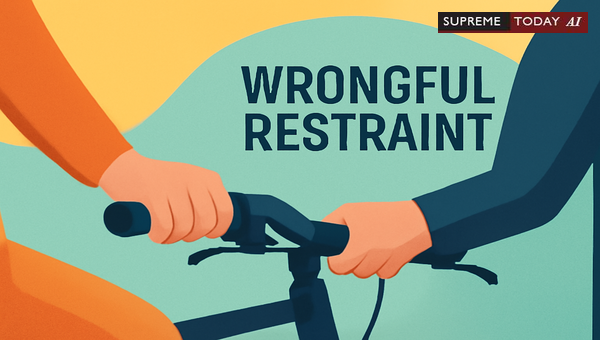
Imagine riding your bike when someone suddenly grabs the handle, stopping you in your tracks. Does this count as under Section 341 of the ()? A common question arises: As per s.341 , whether mentioning of direction of movement is necessary, if a complainant is riding a bike and the accused caught on the handle of the bike and restrained his way?
In this post, we dive into the legal nuances of , drawing from key case laws and interpretations. This analysis shows that such physical obstruction typically qualifies as , even without specifying a precise direction. Note: This is general information based on precedents and not specific legal advice—consult a lawyer for your situation.
punishes with up to one month's imprisonment, fine, or both, if committed outside a public way. The core definition comes from : Whoever any person so as to prevent that person from proceeding in any direction in which that person has a , is said wrongfully to restrain that person.2022 0 Supreme(Ker) 157
Key elements include:- Voluntary act: Intentional obstruction, not accidental.- : Preventing progress in a direction the person has a right to go.- : Generally, any lawful path or direction.
Courts interpret this broadly. The term proceed isn't limited to walking—it includes movement via vehicles or bikes. As held: The word 'proceed' in the definition of in Section 339 of the ... includes proceeding by outside agency, such as a motor vehicle.1963 0 Supreme(Cal) 211
No, explicitly stating the direction isn't always necessary. applies if the act obstructs movement in any direction the victim has a . Holding a bike's handle physically restricts forward motion (or any intended path), fulfilling the criteria. 2022 0 Supreme(Ker) 157
In bike-related scenarios, courts focus on the obstructive impact:- Grabbing the handle prevents the rider from accelerating or steering freely.- This mirrors vehicle obstruction cases, where blocking a motor vehicle restrains passengers and the driver. 1963 0 Supreme(Cal) 211 2018 0 Supreme(Pat) 176
For instance, in a case where police caught a bike's handle at a checkpoint, leading to an altercation, the act was scrutinized as potential restraint, though sanction under was required for public servants. 2024 Supreme(Online)(KER) 14530
Physically gripping a bicycle or motorbike handle to halt the rider constitutes . The act creates a physical barrier, obstructing the rider's entitled movement. Courts have clarified: encompasses physical acts like holding onto a bicycle handlebar that impede progress. 2022 0 Supreme(Ker) 157
Supporting facts from precedents:- In motor vehicle cases, obstructing the vehicle restrains those inside, extending to bikes. 1963 0 Supreme(Cal) 211- Similar to pushing a rider off their bike, which was alleged as illegal restraint. 2022 Supreme(Online)(KER) 810
Another example: An accused allegedly restrained a complainant riding a motorcycle by pushing him down—framed as . 2022 Supreme(Online)(Ker) 72448
Indian courts consistently apply to vehicle obstructions:- Obstructing a motor vehicle with passengers amounts to restraining the crew and occupants. 2018 0 Supreme(Pat) 176- In a stabbing incident post-restraint, the pillion rider's intervention after grabbing a bike was noted, though bail focused on non-premeditation.
Even in non-criminal contexts, like accidents, bike handles are focal points for control loss. 2023 Supreme(Online)(KAR) 26520 But criminally, intentional grabs trigger liability.
In police encounters, catching a bike handle led to assault charges, emphasizing the act's obstructive nature—though prosecutorial safeguards apply. 2024 Supreme(Online)(KER) 14530
Not every touch qualifies:- Accidental or incidental: If unintentional, no . 2022 0 Supreme(Ker) 157- Public servants: Sanction under may be needed if acting officially. 2024 Supreme(Online)(KER) 14530- Contextual intent: Courts examine if the act was voluntary and aimed at obstruction.
For example, in a traffic stop, grabbing might be lawful duty, but excess force invites scrutiny.
Law enforcement should document directions but note they're not mandatory—impact matters.
This evolving area underscores 's protection of personal mobility. Stay informed on case updates, and for personalized guidance, reach out to a qualified attorney.
References:1. 2022 0 Supreme(Ker) 157: Clarifies physical handlebar restraint as obstruction.2. 1963 0 Supreme(Cal) 211: Expands proceed to external agencies like vehicles.3. Other integrated cases: 2024 Supreme(Online)(KER) 14530, 2022 Supreme(Online)(KER) 810, 2018 0 Supreme(Pat) 176,
#Section341IPC, #WrongfulRestraint, #IPCLaw


Sections 341 and 354 of IPC would not be possible in a place where the vehicles are passing frequently, as per the prosecution allegation. ... As her husband removed the helmet, the 1st accused attempted to slap him and she stepped down from the bike. Soon, the 2nd accused caught PW1 on her hand and twisted her hand and pulled her aside. ... tendered by the prosecution otherwise established guilt of the accused, reference to precedents is n....

key and restrained the further movement of PW1 and PW2. ... standing on the road, after sharing common intention blocked the motorcycle and wrongfully restrained the movement of the defacto complainant and her husband by standing in front of the motorcycle and then they removed the ignition key of the motorcycle and restrained the further movement of the defacto ... between accused Nos.1 to 3 and thereby all the accused committed of....
The brother of the de facto complainant, who was riding the bike, cautioned the accused. The 1st accused, who was riding pillion, took out a knife from his pocket and brandished the same. He is alleged to have stabbed the de facto complainant on his back. ... According to the de facto complainant, on 11.6.2018, at about 5.15 p.m., while he along with his brother, were traveling on a bike, the accused Nos.1 and 2, a....
removed ignition key and restrained the further movement of PW1 and PW2. ... standing on the road, after sharing common intention blocked the motorcycle and wrongfully restrained the movement of the defacto complainant and her husband by standing in front of the motorcycle and then they removed the ignition key of the motorcycle and restrained the further movement of the defacto ... Further commission of offence under Sections 341 and 354 of #HL_STAR....

The complainant purchased a new Hero Honda Passion Plus petrol motor bike from the 1st opposite party. The allegation is that during the 1st journey from the show room to house; the complainant felt riding difficulties in smooth movement of the handle. ... On other side the Motor bike is along with complainant as per the evidence from 14-5-2007 on words. It is presumed he is using the motor bike for his pers....
When he reached the Police check point where the 2nd respondent was checking vehicles, one Policeman asked him to stop the Motor Bike all of a sudden and 3rd petitioner caught hold the handle of the bike by which the bike accelerated and came to a stop. ... It is alleged that the accused assaulted the complainant. It is also alleged that from the Police Station also the accused attacked the complainant. ... According to the #HL_STAR....
It is submitted going by the contents of the First Information Statement of the de facto complainant, the petitioner had illegally restrained the de facto complainant and had pushed him down when he was riding his bike. ... The allegation against the petitioner is that when the de facto complainant was riding his motor cycle, the petitioner wrongfully restrained the de facto complainant and pushed him down and attacked him with a st....

He admitted 15 that the bike was caught between the wheels in front. ... He denied 13 that he was riding the motorcycle at high speed and on seeing the bus from the opposite direction, he lost control and the bike skidded. ... The bus was moving from Kadur towards Chowlahiriyur, while PW.1 was riding his bike from Chowlahiriyur. ... The learned counsel for the petitioner/accused submitted that as per Ex.P12, the accident o....

The said Dhandapani was riding his bike with Reg.No.TN-38-BD-1260. ... PW1 states that he was behind the deceased, who was riding his bike. ... PW1 does not mention anything with regard to Raghu riding bike on Vs. ... The accused is acquitted of all charges levelled against him.
It is submitted going by the contents of the First Information Statement of the de facto complainant, the petitioner had illegally restrained the de facto complainant and had pushed him down when he was riding his bike. ... The allegation against the petitioner is that when the de facto complainant was riding his motor cycle, the petitioner wrongfully restrained the de facto complainant and pushed him down and attacked him with a st....

The second bike which was left at the place of occurrence was with the other miscreants. He further stated that when he caught hold of the accused persons, they pushed him aside and sped away riding the bike.

The PW stated that he was returning to Kamalpur from Manik Bhander on the motor bike of deceased accused Amar Deb. When they reached Kalachari accused Biswajit Ghosh who was riding motor bike carrying registration No. TR-04-A-6726 dashed against their motor bike from the opposite direction. As a result of the accident, the PW slipped from the motor bike and sustained fatal injuries. According to the PW, the accident occurred because accused Biswajit Ghosh was driving his motor bike in excessive speed.
He would also contend that accused admitted during cross examination on one occasion that his father had not seen himself sustaining injury. P1 that accused restrained the bike and he fell down from the bike. Further, he would contend that the accused has stated on one occasion that himself and his father sustained injury in two places.

When they reached near Daulatabad T-point at 17:45, they noticed that one truck coming from their back side, went speedily and gave dash to the bike of Pandharinath. Pandharinath was riding a bike while he and Bhadre were on another bike. He stated that, on the day of the incident, he and his friend Bhadre all were proceeding to Khultabad for darshan of Lord Maruti.

It is alleged that the accused rode past them very speedily and within a very short distance from the complainant and her friend and further made lewd gestures at them. It is alleged that the complainant was being teased and harassed by the accused since the past three months from the date of the FIR in question. 3. The factual matrix of the present case is that the on 04.02.2016, the accused came riding on a bike with his roommate and rode past the complainant and her friend.


An indispensable Tool for Legal Professionals, Endorsed by Various High Court and Judicial Officers
Please visit our Training & Support
Center or Contact Us for assistance

Scan Me!
India’s Legal research and Law Firm App, Download now!


For Daily Legal Updates, Join us on :



 Back to top


