Back





2026 Supreme(SC) 976
SUPREME COURT OF INDIA
SANJAY KAROL, NONGMEIKAPAM KOTISWAR SINGH, JJ.
State of Uttar Pradesh & Anr. – Appellants
Versus
Brij Pal Singh & Anr. – Respondents
Criminal Appeal No. 2938 of 2025
Decided On : 20-08-2026
Important Points
Subject
Criminal Law - Medical and Health Law
Act Referred
Headnote
(B) Interpretation of Statutes - Special law overrides general law - Provisions of a special statute prescribing its own procedure for investigation and cognizance prevail over general procedural law (CrPC/BNSS) - Principle that courts must harmonise provisions and avoid rendering any part of the statute nugatory - Golden rule of literal interpretation: grammatical meaning must be adhered to unless it leads to absurdity or inconsistency - Where two sections are irreconcilable, later provision prevails; leading provision must be determined.
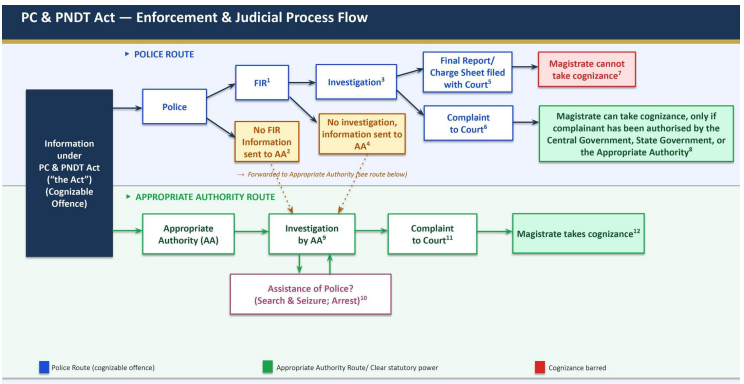
(C) PCPNDT Act - Scheme of the Act - Appropriate Authority (AA) is the designated investigator for offences under the Act - Section 17(4) confers on AA the function to investigate complaints and initiate independent investigations - Section 17A grants AA powers of summoning, production, search warrant - Section 30(1) empowers AA to search and seize with assistance - Section 28 provides exclusive mechanism for taking cognizance: only on complaint by AA or authorised officer, or by a person after notice to AA - Use of word 'cognizable' in Section 27 does not confer general police powers; it only denotes seriousness and restricts bail - Police cannot register FIR or investigate PCPNDT offences independently - Police may provide supplemental assistance when specifically sought by AA - Rule 18A(3)(iv) has statutory force and mandates that police shall not be involved 'as far as possible' - Once a police charge sheet is filed, court cannot take cognizance due to complete bar under Section 28.
(D) Overlap with IPC/BNS offences - Where the same transaction discloses both PCPNDT and IPC/BNS offences, two distinct procedural tracks operate - AA investigates PCPNDT component; police investigate independent IPC/BNS component - Police must transmit any PCPNDT-related information to AA - AA must communicate any IPC/BNS offence material to police - Neither agency can encroach upon the other's statutory domain - Reciprocal coordination is permissible without merging jurisdictions. (E) Precedents - Jeewan Kumar Raut v. CBI, (2009) 7 SCC 526 (TOHO Act) - Union of India v. Ashok Kumar Sharma, (2021) 12 SCC 674 (Drugs and Cosmetics Act) - State (NCT of Delhi) v. Sanjay, (2014) 9 SCC 772 (MMDR Act) - State of M.P. v. Narmada Bachao Andolan, (2011) 7 SCC 639 (interpretation of 'as far as possible') - Lalita Kumari v. Govt. of U.P., (2008) 14 SCC 337 (mandatory registration of FIR for cognizable offence - held not applicable to PCPNDT offences due to special regime).
Facts of the case:
The appeal arose from a certificate issued by the High Court of Allahabad under Article 134-A read with Article 134(1)(c) of the Constitution. The respondent had filed a petition under Section 482 CrPC seeking quashing of a chargesheet drawn against him under Sections 315 and 511 IPC and Sections 4, 5(2), 6(a), 23 and 25 of the PCPNDT Act. The FIR was based on secret information received by the District Magistrate (who is the Appropriate Authority) about illegal sex determination. The District Magistrate deputed the Tehsildar as Authorised Officer to conduct a decoy operation, which led to a raid at the hospital and subsequent proceedings. The High Court allowed the quashing petition and issued a certificate of appeal framing three questions: (1) whether registration of FIR is permissible for PCPNDT offences merely because they are made cognizable and non-bailable; (2) whether police investigation is permissible and who can investigate; (3) whether the magistrate can take cognizance on a police chargesheet. The Supreme Court considered conflicting views of various High Courts. Finddings of Court: The Court answered the reference as follows: (1) Registration of FIR by police for PCPNDT offences is not permissible - the special regime under the Act vests investigation exclusively in the AA; (2) Police investigation is not permissible - only the AA can investigate PCPNDT offences, though police may provide supplemental assistance when specifically requested by the AA; (3) The competent magistrate cannot take cognizance on a police chargesheet - Section 28 imposes an absolute bar, cognizance can only be taken on a complaint by the AA or authorised officer. The Court further held that where the same transaction also discloses IPC/BNS offences, the police may investigate those independently, and the two tracks must operate in parallel with reciprocal communication of material.
Issues: The main issues were (i) whether the police can register an FIR and investigate offences under the PCPNDT Act despite the offences being made cognizable, in light of the specialised enforcement mechanism provided by the Act; (ii) who is competent to investigate complaints under the Act; (iii) whether a magistrate can take cognizance of a police chargesheet for PCPNDT offences.
Ratio Decidendi: The court ruled that the PCPNDT Act, being a special statute, establishes a self-contained regime for investigation and prosecution. Section 17(4) read with Section 17A and Rule 18A(3)(iv) vests investigatory powers exclusively in the Appropriate Authority. The use of the word 'cognizable' in Section 27 does not override the specific procedure for cognizance in Section 28. A harmonious construction of Sections 27 and 28 leads to the conclusion that police have no independent power to investigate PCPNDT offences; they can only assist the AA when required. The bar on cognizance in Section 28 is absolute and prohibits a court from taking cognizance on a police report. However, independent IPC/BNS offences arising from the same transaction remain within police jurisdiction.
Result: Reference answered accordingly; appeal disposed of and remanded to High Court for decision in accordance with judgment. CONCURRING by N. Kotiswar Singh, J., with supplementary observations on coordination between AA and police in cases of overlapping offences.
For the Appellant(s) : Mr. Vishwa Pal Singh, AOR Mr. Divyesh Pratap Singh, Adv. Mr. Srikant Singh, Adv. Mr. Akash, Adv. Mr. Srajan Shankar Kulshreshtha, Adv. Mr. Amit Kumar, Adv. Mr. Manoj Sharma, Adv. Mr. Danish Alvi, Adv. Mr. Pramod Kumar Dubey, Sr. Adv. Mr. Vikalp Sharma, Adv. Mr. Satyam Sharma, Adv. Mr. Pranteek Uniyal, Adv. Ms. Prachi Dubey, Adv. Mr. Rup Raj Banerjee, Adv. Mr R.B.Siddhartha, adv. Mr. Yash Saxena, Adv. Mr. Jot Parkash Singh Teji, Adv. Ms. Prachi Dubey, Adv. Mr. Yadish Arora, Adv. Ms. Mukta Gupta, Sr. Adv. Mr. Nitin Saluja, AOR Ms. Nitya Gupta, Adv. Mr. Vittal Bala Subrahamanyam, Adv. Ms. Ishita Soni, Adv. Ms. Pranya Madan, Adv. Mr. Karan Singh, Adv.
For the Respondent(s): Mr. Kamal Kumar Pandey, Adv. Mr. Pawan Kumar Shukla, Adv. Mr. Pankaj Kumar Singh, Adv. Mr. Sk Warish Ali, Adv. Mr. Raj Singh Rana, AOR Mr. G. P. Mahto, Adv. Mr. Vikramjit Banerjee, A.S.G. Ms. Madhulika Upadhyay, AOR Mr. A.K.Srivastava, Adv. Ms. Seema Bengani, Adv. Mr. Nachiketa Joshi, Adv. Mr. Amit Sharma-B, Adv. Mr. Prashant Singh-A, Adv. Mr. Sanjay Kumar Dubey, Adv. Mr. Ayush Anand, Adv. Ms. Seema Bengani, Adv. Mr. Kartik Dey, Adv. Mr. Sahil Bhacotia, Adv. Mr. Hritik Pathak, Adv. Ms. Sanjana, Adv. Mr. Aditya Kashyap, Adv. Mr. Vikalp Sharma, Adv. Mr. Palash Soni, Adv. Mr. Harshit Sharma, Adv. Mr. Atharva Kamble, Adv. Ms. Sakshi Arora, Adv. Ms. Nishita Gupta, Adv. Ms. Ramneek Kaur, Adv. Mr. Sanjay Kumar Dubey, AOR Ms. Priyal Gupta, Adv. Mr. Akash Awana, Adv.
| Table of Content |
|---|
| 1. factual and procedural background of the appeal (Para 1 , 2 , 3 , 4) |
| 2. arguments presented by counsels and amicus (Para 5) |
| 3. supreme court's previous interpretations (Para 7 , 8) |
| 4. comparative analysis with other special laws (Para 9) |
| 5. harmonious construction of sections 27 and 28 (Para 10) |
| 6. answers to the three questions and disposal (Para 11 , 12 , 13) |
| 7. parties' arguments on police powers under act. (Para 14) |
JUDGMENT :
SANJAY KAROL J.
| Contents |
| THE APPEAL |
| THE BACKGROUND TO THE QUESTIONS |
| PROVISIONS OF LAW |
| SUBMISSIONS BY COUNSEL |
| Ms. Mukta Gupta, Senior Counsel |
| Mr. Pramod Kumar Dubey, Senior Counsel |
| Mr. Siddharth Aggarwal, Senior Counsel |
| Mr. Gyanendra Kumar, Senior Counsel |
| Ms. Sakshi Arora, Counsel |
| Mr. Harshit Sharma, Counsel |
| Mr. Vikalp Sharma, Counsel |
| Ms. Meera Kaura Patel, Counsel |
| Union of India |
| Ministry of Health and Family Welfare |
| ANALYSING THE PROVISIONS OF THE ACT |
| Precedents Of This Court |
| Similar Provisions in Other Legislations |
| Crucial Aspects to be Considered |
| ANSWERING THE REFERENCE |
THE APPEAL
1. This appeal proceeds on a certificate issued by the High Court of Judicature at Allahabad and under Article 134-A read with Article 134(1)(c) of the Constitution of India regarding the interpretation of the provisions of the Pre-conception and Prenatal Diagnostic Techniques (Prohibition of Sex Selection) Act, 19941[PCPNDT Act /the act], arising out of a petition under Section 482, Code of Criminal Procedure, 19732[CrPC] filed by the Respondent, seeking quashing of the chargesheet drawn against him under Sections 315 and 511 of the Indian Penal Code, 18603[IPC] and Sections 4, 5(2), 6(a), 23 and 25 of the PCPNDT Act, flowing from FIR No. 628 of 2017. The FIR was a consequence of secret information having been received by the District Magistrate, Bulandshahar, who is the appropriate authority4[AA] within the Act, of illegal sex determination of foetus, being carried out by Respondent no.1 and others, who then deputed the Tehsildar of the Khurja District as the Authorised Officer5[AO] to conduct a decoy operation to unearth the truth. Having found out information through such operation, a raid was conducted at the hospital, which led to the initiation of proceedings, the subject matter of the quashing petition.
2. While the quashing petition ultimately came to be accepted, the learned Single Judge undertook an extensive overview of the provisions of the Act and the decisions given by other High Courts, eventually to point out that contrary views had been taken on the same question regarding the role of police in investigation and the applicable procedure in PCPNDT Act offences. As such, considering the importance of the questions involved, the learned Single Judge issued the certificate of appeal, observing as under:
“Question 1 Whether, for offences under the PC & PNDT Act the registration of FIR at the police station is permissible, merely because the offences under the PC & PNDT Act have been made cognizable and non-bailable?
Question 2 – Whether the police investigation is permissible for the offences under the PC & PNDT Act? AND Who can investigate the complaints, received for violation of the provisions of the PC & PNDT Act?
Question 3 – Whether on the chargesheet submitted after the investigation by the police, the competent magistrate can take cognizance of the offence under the PC & PNDT Act?”
THE BACKGROUND TO THE QUESTIONS
3. The background to these questions is the difference of opinions between High Courts on whether State Police is competent to register FIRs and investigate offences under the Act and also whether the concerned Magistrate can take cognizance of the chargesheet so filed. The following two tables encapsulate the judgments considered by the Learned Single Judge to frame the questions for consideration we extracted above.