
 Back
Back





IN THE HIGH COURT OF ANDHRA PRADESH AT AMARAVATI
VENKATA JYOTHIRMAI PRATAPA, J.
Madras Cements Limited – Petitioner
Versus
The Management of Madras Cements Ltd. – Respondent
Writ Petition No. 16716 of 2019
Decided On : 25-01-2024
(A) Industrial Disputes Act, 1947 - Section 10 and Rule 12 - Writ of Mandamus - Petition challenging dismissal of amendment application in industrial dispute proceedings - Court held that proposed amendments were repetitive of earlier demands and did not alter the nature of the reference - No merit found in the petition. (Paras 7.1, 21, 22)
(B) Amendment - Scope of amendments in industrial dispute proceedings - Amendments can be allowed if necessary for determining real issues but cannot introduce new claims contrary to original demands. (Paras 20, 21)
Facts of the case:
The Petitioner Union sought to amend its claim statement in an ongoing industrial dispute regarding the termination of contract workers, which was dismissed by the Labour Court.
Findings of Court:
The Court found no merit in the petition as the proposed amendments were already covered in the Charter of Demands and did not necessitate alteration of the original claims.
Issues: The main issue was whether the dismissal of the amendment application was sustainable in law.
Ratio Decidendi: The Court ruled that the proposed amendments were repetitive and did not introduce new claims, thus the Labour Court's discretion was not arbitrary.
Result: Writ Petition dismissed.
ORDER :
1. This Writ Petition is filed under Article 226 of the Constitution of India seeking Writ of Mandamus, for the following relief:
“........declaring the order dated 25.09.2019 in I.A. No. 281/2019 in I.D. No. 107/2011 on the file of the 4th respondent Court, as arbitrary, violative of Article 14 of the Constitution of India, without application of mind and without any rationale basis and is also in violation of provisions of I.D. Act, 1947 and Rules made there under, by setting aside the same.....”
2. The facts of the case, as projected by the Petitioner in brief, are as follows:
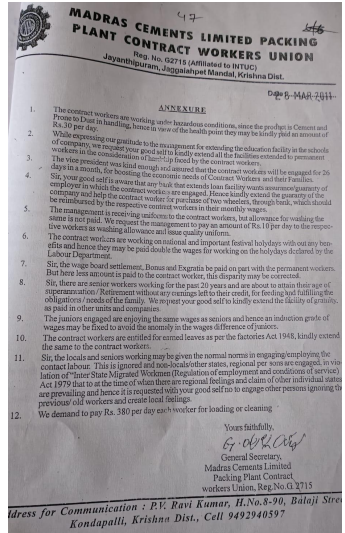
2.1. Petitioner union is a registered Trade Union established with the object of promoting the welfare of the workmen in Respondent No. 1 industry, particularly for the contract labour. Due to non-conciliation on the charter of demands submitted on 28-03-2011, a reference vide proceedings No. L2/4719/2011 dated 12.08.2011 was made to the Commissioner of Labour, Andhra Pradesh in the year 2011 and it was registered as I.D. No. 107 of 2011 by the Respondent No. 4. Respondent Nos. 2 and 3 were impleaded in the said I.D. as respondents.
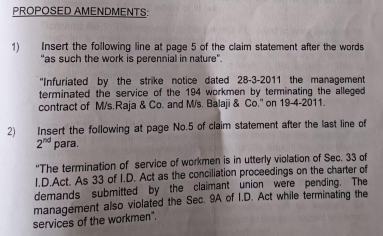
2.2. It is their case that pending the proceedings, the Respondent terminated the Work Contractor, consequently terminating the service of the workmen covered in the I.D. While so, the Petitioner-Union filed I.A. No. 281 of 2019 in the I.D. under Section 11 of the Industrial Disputes Act, 1947 [In short “I.D. Act 1947”] r/w Rule 12(1)(e) of the Andhra Pradesh Industrial Dispute Rules, 1958 [In short “A.P. I.D. Rules”] seeking amendment of its claim statement by incorporating certain facts which are required to be pleaded. Vide Order dated 25.09.2019, the Respondent No. 4 dismissed the said I.A. Aggrieved by the same, the present W.P. has been filed before this Court.
Version of the Respondents in the Counter
3. Resisting the claim of the Petitioner-Union, the Respondent No. 1 filed counter inter alia stating that the Respondent No. 1 is now called as “Ramco Cements Limited.” It is also stated that quotations for arranging manpower for landing and cleaning operations in the packing unit and view of the agreement thereto, the Contractor was in obligation to comply with State and Central Labour Laws, including Contract Labour (Regulation and Abolition) Act.
3.1. It is also averred that there is no employer-employee relationship between the Respondent industry and the workmen, that since the Work Contractor was not able to supply the workmen, the contract agreement was terminated by the management by letter dated 20.04.2011 and that the amounts due to the contractor workers were also paid, vide the Act through cheques.
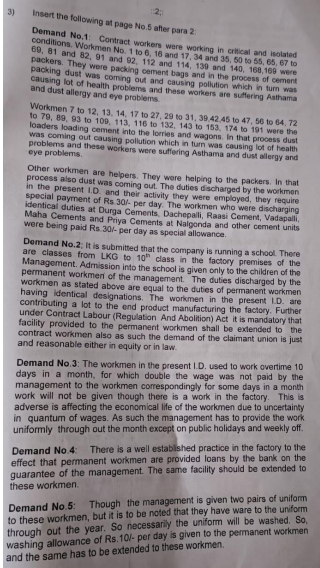
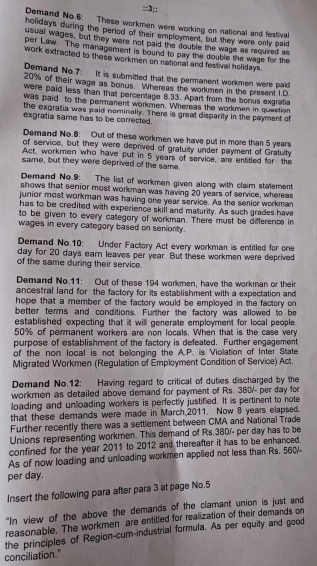
3.2. It is also stated that the Respondent No. 4 rightly dismissed the I.A. holding that there is no ambiguity in the reference requiring an amendment to the claim statement and that the amendment is nothing but what has been covered under the Point No. 1 formulated by the Joint Commissioner of Labour and would cause multiplication of the proceedings. The maintainability of the present W.P. was also questioned.
4. Heard Sri M. Pitchaiah, learned counsel for the Petitioner and Sri M. Srikanth, learned counsel for the Respondent No. 1 and perused the record.
5. Learned counsel for the Petitioner in elaboration to what was stated in the W.P. would contend that the amendment sought for, is the crux of the case of the Petitioner and that vide Rule-12 of A.P.I.D. Rules, the respondent No. 4 is supposed to allow the I.A. He would further submit that the proposed amendment is necessary and forms the basis for charter of demand dated 28.03.011, which is the cause for the industrial dispute. Thus, learned counsel prayed to allow the W.P.
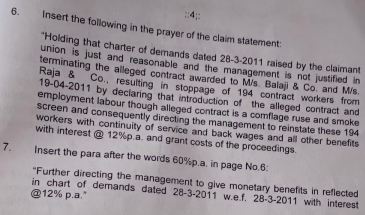
6. On the other hand, learned counsel for Respondent No. 1 filed written arguments stating that Respondent No. 4 rightly dismissed the I.A. He would submit that the Petitioner-Union sought for amendment of prayer seeking continuity of service, back-wages of all other benefits with interest at
AI
The court upheld the dismissal of an amendment application in industrial dispute proceedings, ruling that proposed changes were repetitive and did not introduce new claims, affirming the Labour Court....

The central legal point established is that the Labour Court must prima facie satisfy itself on the fairness and justness of settlements under Section 11 of the Industrial Disputes Act, by examining ....


Appropriate Government cannot suo motu amend industrial dispute reference to include termination during conciliation absent demand notice; fresh cause requires new dispute or Section 2A application. ....

The court affirmed that references of industrial disputes by the government require a prima facie satisfaction that a dispute exists, and amendments to pleadings after trial commencement are restrict....

The court ruled that a reference to the Industrial Tribunal is premature when disciplinary proceedings against employees are still pending.

The main legal point established in the judgment is that a dispute under the Industrial Disputes Act can only be considered a dispute if a specific demand has been made by the workmen, and any refere....

Point of Law- Law does not prescribe any time-limit for the appropriate Government to exercise its powers under Section 10 of the Act. It is not that this power can be exercised at any point of time ....

The court established that disputes under the Industrial Disputes Act must be resolved within its framework, and writ jurisdiction is not appropriate when an alternative remedy exists.
The main legal point established in the judgment is that under Section 2A of the Industrial Disputes Act, 1947, an individual workman can approach the Labour Court directly against alleged terminatio....



An indispensable Tool for Legal Professionals, Endorsed by Various High Court and Judicial Officers
Please visit our Training & Support
Center or Contact Us for assistance

Scan Me!
India’s Legal research and Law Firm App, Download now!


For Daily Legal Updates, Join us on :



 Back to top


