
 Back
Back





HIGH COURT OF ANDHRA PRADESH AT AMARAVATI
RAVI NATH TILHARI, J.
Pilla Venkateswara Rao Alias Allabakshu - Petitioner
Versus
Kancherla Malyadri – Respondent
CIVIL REVISION PETITION NO: 2460 of 2025
Decided On : 19-09-2025
ORDER :
RAVI NATH TILHARI, J.
On the request made citing urgency by the learned counsel for the petitioner, lunch motion was granted.
2. The matter is taken up as lunch motion, listed in Lunch motion list.
3. Heard Sri A. Ravindra Babu, learned counsel for the petitioner.
4. The petitioner is the Judgment Debtor (in short 'J.Dr.') in O.S.No.623 of 2002 on the file of the Principal Senior Civil Judge, Vijayawada. The suit was filed by the respondent (plaintiff/decree holder), which was decreed vide judgment & decree dated 08.12.2006 which is in the following terms:
“1) that the suit be and the same is hereby decreed directing the defendant to vacate and deliver vacant possession of the 2nd floor premises of the plaint schedule building to the plaintiff on or before 8th February, 2007, failing which the plaintiff is at liberty to recover the same through process of Law, and
2) that the defendant do also pay a sum of Rs.8,128/- to the plaintiff towards institutional costs of this suit and do bear his own costs of Rs.Nil.”
5. Challenging, the decree dated 08.12.2006, A.S.No.33 of 2007 was filed, which was dismissed for non-prosecution on 20.03.2023.
6. The decree holder filed E.P.No.73 of 2025, in which the learned Execution Court has issued notice dated 02.09.2025 to the petitioner to appear and file objections, if any, fixing 06.10.2025. The same reads as under:-
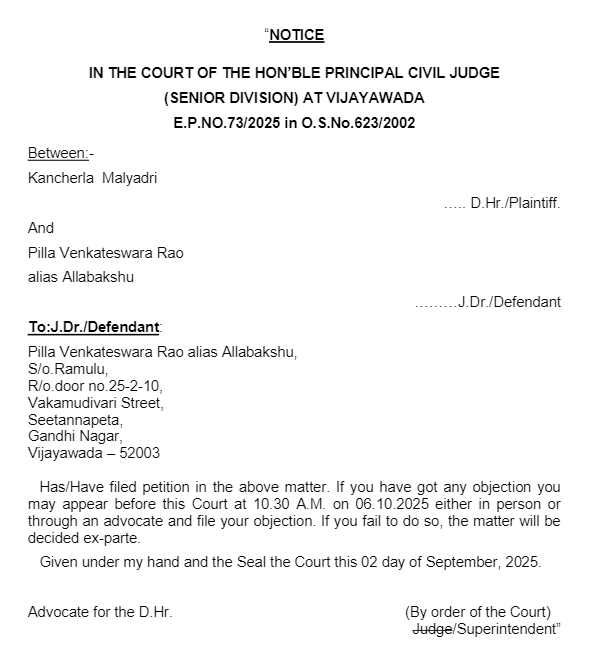
7. The present Civil Revision Petition under Section 115 of the Code of Civil Procedure (CPC) has been filed to set aside the aforesaid notice dated02.09.2025.
8. Learned counsel for the petitioner submits that in A.S.No.33 of 2007 the petitioner has filed I.A.No.3 of 2025 for setting aside the order of dismissal which is pending. The appeal was dismissed in default and this Court did not decide the appeal on merits. So, the Trial Court's decree did not become final. It cannot be executed. He submits that any provision of law under which notice has been issued has also not been mentioned.
9. I have considered the above submissions and perused the material on record.
10. The aforesaid submissions deserve rejection being misconceived and having no substance for the following reasons:.
10.1 In the absence of the appellant's counsel an appeal under Section 96 CPC cannot be decided on merits. It has to be dismissed for want of prosecution, in view of Order 41 Rule 17 CPC Explanation which reads as under:-
“17. Dismissal of appeal for appellant's default: (1) Where on the day fixed, or on any other day to which the hearing may be adjourned, the appellant does not appear when the appeal is called on for hearing, the Court may make an order that the appeal be dismissed.
Explanation- Nothing in this sub-rule shall be construed as empowering the Court to dismiss the appeal on the merits.”
a) In Ashwathamma v. Lakshmamma, (2016) 16 SCC 615 the Hon'ble ApexCourt held as under:
“3. In support of the said submission, he has commended us to the decision in Ghanshyam Dass Gupta v. Makhan Lal [(2012) 8 SCC 745. In the said decision, it has been held as follows :
"7.Rule 17(1) of Order 41 deals with the dismissal of appeal for appellant's default. The above mentioned provision, even without explanation, if literally read, would clearly indicate that if the appellant does not appear when the appeal is called for hearing, the court has to dismiss the appeal. The provision does not postulate a situation where, the appeal has to be decided on merits, because possibility of allowing of the appeal is also there, if the appellant has a good case on merits; even if no body had appeared for the appellant.
8. Prior to 1976, conflicting views were expressed by different High Courts in the country as to the purport and meaning of sub-rule (1) of
Rule 17 Order 41 CPC. Some High Courts had taken the view that it was open to the appellate court to consider the appeal on merits, even though there was no appearance on behalf of the appellant at the time of hearing. Some High Courts had taken the view that the High Court cann
Judicial proceedings must ensure that all relevant applications are addressed before execution to uphold the principles of justice and fair trial.


Only parties with a direct legal relationship with an advocate can file complaints of professional misconduct against them under Section 35 of the Advocates Act, 1961.

The main legal point established in the judgment is that a party approaching the court must do so with clean hands and must not engage in forum shopping. Additionally, the judgment and decree passed ....

The main legal point established in the judgment is the requirement of filing a certified copy of the decree along with the memorandum of appeal, and the court's consideration of the maintainability ....

The executing court cannot go behind the decree unless it is a nullity, and re-agitating objections already dismissed in a previous petition would amount to an abuse of process of law.

The executing court cannot stay execution of its own decree; such authority lies with the appellate court.


Claims for unpaid legal fees by an Advocate must be pursued in civil courts, and attempts to halt legal proceedings over fee disputes violate the ethics and dignity of the profession.



An indispensable Tool for Legal Professionals, Endorsed by Various High Court and Judicial Officers
Please visit our Training & Support
Center or Contact Us for assistance

Scan Me!
India’s Legal research and Law Firm App, Download now!


For Daily Legal Updates, Join us on :



 Back to top


