1. Writ petition seeking direction to release payment for construction works under multiple agreements with Gram Panchayat. (Para 1 , 3 , 4 )
 Back
Next 


2026 Supreme(AP) 1288
IN THE HIGH COURT OF ANDHRA PRADESH: AMARAVATI
SUBBA REDDY SATTI, J.
Kota Venkata Narayana, S/o. Venkateswararao - Petitioner
Versus
The State Of Andhra Pradesh, rep. By Its Principal Secretary, Panchayat Raj Department And Others –Respondents
Writ Petition No. 27799 of 2025
Decided On : 24-02-2026
Advocates Appeared:
For the Petitioner: Sri D.V. Sasidhar learned counsel
For the Respondents: Sri P. Rajesh, learned Assistant Government Pleader for Panchayat Raj and Finance Department and Sri Chaitanya, learned counsel representing Sri Y. Koteswara Rao, learned standing counsel.
For the Petitioner: Sri D.V. Sasidhar learned counsel
For the Respondents: Sri P. Rajesh, learned Assistant Government Pleader for Panchayat Raj and Finance Department and Sri Chaitanya, learned counsel representing Sri Y. Koteswara Rao, learned standing counsel.
Writ petitions for admitted contractual dues are maintainable if no disputed facts exist. However, where multiple distinct agreements form separate causes of action, the petitioner must pay the aggregate court fee rather than a single fixed fee for the entire petition.
Headnote:(A) Andhra Pradesh Court-Fees and Suit Valuation Act, 1956 - Section 6(3) and Schedule-II Article 11(S) - Writ Proceedings Rules 1977 - Rule 4-A - Constitution of India - Articles 226 and 300-A - Court fee vs. Tax - A court fee is a charge for special service or benefit rendered for the administration of justice and not a compulsory extraction of money for public purposes; thus, it is a fee and not a tax. (Paras 20, 23-27)
(B) Writ Jurisdiction - Maintainability in contractual matters - A writ petition under Article 226 is maintainable even in contractual matters, provided there are no disputed questions of fact that require formal evidence. The court may intervene where the State's conduct is arbitrary, unreasonable, or violates constitutional mandates, specifically in cases of non-payment of admitted dues. (Paras 28-34)
(C) Court Fee for multiple causes of action - Where a single writ petition is filed seeking relief based on multiple distinct and different agreements, each constituting a separate cause of action, the petitioner is liable to pay an aggregate court fee. Applying the rationale of Section 6(3) of the Andhra Pradesh Court-Fees and Suit Valuation Act, 1956, the payment of a single fixed fee for multiple distinct agreements is insufficient. (Paras 36-41, 44(f))
Facts of the case:
The petitioner was entrusted with 19 different works for the construction of drains under separate agreements. Despite completing the works and the authorities passing the bills for payment, the amount remained unpaid. The petitioner filed a single writ petition seeking the release of the admitted amount, paying a single court fee of Rs.100/- for all 19 distinct agreements.
Findings of Court:
The authorities admitted that the petitioner is entitled to the amount after statutory deductions. However, the court found that since the works were executed under 19 separate agreements with distinct causes of action, the single court fee paid was inadequate and the deficit fee had to be made good.
Issues: The main issues were whether a writ petition is maintainable for the enforcement of contractual money claims against the State and whether a single fixed court fee is legally permissible when a petition arises from multiple distinct agreements and causes of action.
Ratio Decidendi: The court ruled that writ jurisdiction can be exercised in contractual matters to prevent arbitrary action by the State, especially regarding admitted dues. Furthermore, while a single petition for multiple agreements is maintainable to avoid multiplicity of proceedings, the petitioner must pay the aggregate court fee treating each agreement as a separate cause of action, following the principle that fees are intended to cover the cost of administering justice for each distinct relief sought.
Result: Respondents directed to release the admitted amount of Rs.29,58,648/- within four months; petitioner directed to pay the deficit court fee of Rs.1,800/- within seven days.
Legal Category Hierarchy
- practice and procedure
- constitutional law
- administrative law
Table of Contents
2. Petitioner sought release of admitted dues; respondents initially resisted but later conceded undisputed amount payable. (Para 2 , 5 , 6 )
3. Single writ petition for multiple distinct agreements requires aggregate court fee under Section 6(3) APCF and SV Act. (Para 10 , 11 , 12 , 37 , 38 , 39 , 41 , 44 )
4. Writ petition maintainable in contractual matters for admitted dues; but multiple distinct causes of action require aggregate court fee. (Para 44 )
5. Writ petition disposed directing release of admitted amount within four months; petitioner to pay deficit court fee. (Para 45 , 46 )
6. Is a writ petition maintainable for enforcing contractual money claims against the State?
Yes, writ petition is maintainable for admitted dues where State's conduct is arbitrary, even in contractual matters, unless disputed questions of fact exist. (Para 29 , 30 , 31 , 32 , 33 , 34 )
7. What court fee is payable when a single writ petition challenges multiple distinct agreements?
Applying Section 6(3) of APCF and SV Act, aggregate court fee must be paid treating each agreement as separate cause of action. (Para 39 , 41 , 44 )
8. Is court fee under APCF and SV Act a fee or a tax?
Court fee under the Act is a fee, not a tax, being a charge for special service or benefit rendered for administration of justice. (Para 23 , 24 , 25 , 26 , 27 )
9. Can fundamental rights enforcement be equated with contractual claims for court fee purposes?
While enforcing fundamental rights, revenue generation is not dominant; however, contractual claims may require different court fee treatment. (Para 43 )
ORDER :
SUBBA REDDY SATTI, J.
The above writ petition was filed to declare the action of the respondents in not releasing an amount of Rs.31,18,844/- payable to the petitioner in relation to the works done by him i.e. 'Construction of CC Drains in Muppala village, Chandralapadu Mandal, NTR District', as illegal and arbitrary.
2. Heard Sri D.V.Sasidhar, learned counsel for the petitioner, Sri P. Rajesh, learned Assistant Government Pleader for Panchayat Raj and Finance Department, for respondents 1 to 5, 8 and 9, and Sri Chaitanya, learned counsel representing Sri Y. Koteswara Rao, learned standing counsel for respondents 6.
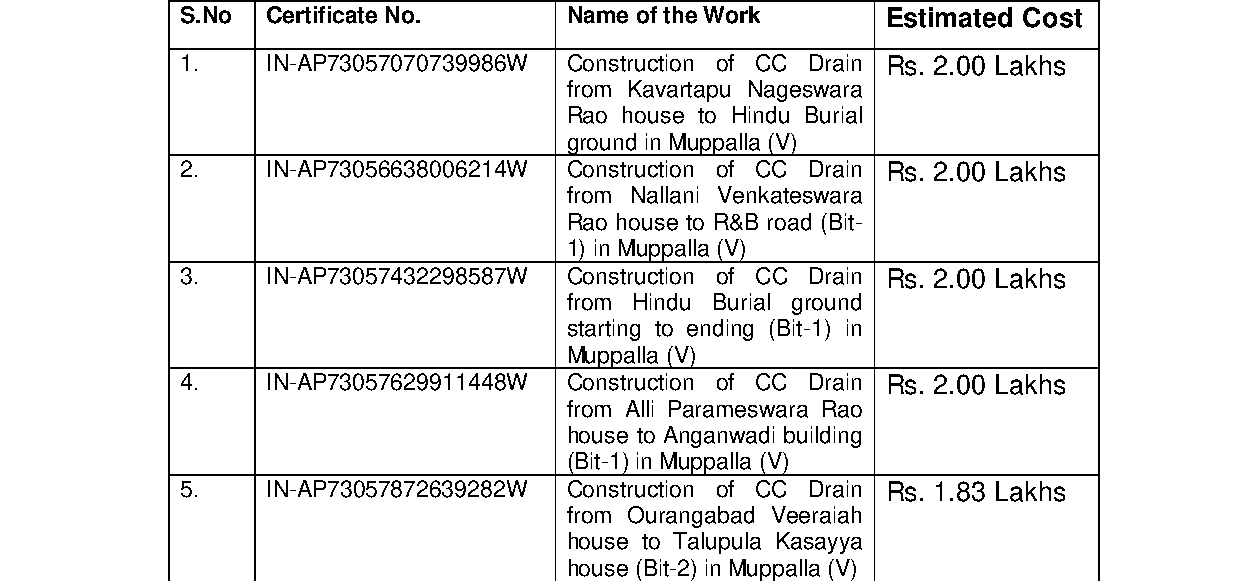
3. The Panchayat Secretary of respondent No.6-Gram Panchayat entrusted different works to the petitioner, a member of the Works Committee, Muppala Village. Though the orders were dated 20.02.2024, 19 different orders were issued for distinct works and entrusted to the petitioner. All the works, as seen from the orders/agreements, relate to the construction of C.C. drains in Muppalla Village. In the orders-Ex.P1, it was noted as follows:
“Hence, after careful consideration of the proposals received and in the light of Guide lines received in following works sanctioned under 15th Finance funds of Grama Panchayat, Muppalla is hereby entrusted to Sri Kota Venkata Narayana, Member, Works Committee, Muppalla.”
4. Thereafter, separate agreements were entered into, and the petitioner, the Panchayat Secretary and Sarpanch of respondent No.6, signed the said agreements. The copies of the agreements are filed as Ex.P4. As seen from the averments of the writ affidavit, the petitioner completed the work. In fact, as seen from Ex.P2, the Sarpanch of Gram Panchayat issued the proceedings, whereby the bill was passed to pay the amount in respect of each of the works. However, the amount was not paid, and hence, the petitioner filed the above writ petition.
5. The writ petition was listed on 09.10.2025 and adjourned at the request of learned counsel for the respondents, enabling them to get instructions.
6. Today, when the matter is taken up, Sri Y. Koteswara Rao, learned standing counsel, submitted the written instructions of Panchayat Secretary of respondent No.6. In the instructions, it was noted as follows:
“Pursuant to the filing of the writ petition, the issue was brought to the notice of the Pay and Accounts Office, Vijayawada and the technical problem has since been rectified. At present, the petitioner's bills have been successfully forwarded from the Gram Panchayat login to the PAO through CFMS with few remarks the bills are Returned from PAO login hence Remarks has been updated measurement books in bill payments and are under processing at the approval stage (ready to send) bill processing dates from 17th to month ending in every month. The relevant bill numbers are enclosed.
Upon approval by the Pay and Accounts Office, the bill amounts will be directly credited to the petitioner’s bank account. The bill will be processed within three months, and the bill amount will be directly credited to the vendor's account.”
7. Thus, as seen from the written instructions of Panchayat Secretary coupled with Ex.P2-proceedings issued by the Gram Panchayat, the petitioner completed the works in pursuance of Ex.P1-orders and Ex.P4- agreements and is entitled to the amount of Rs.29,58,648/-, after statutory deductions.
8. Learned counsel for the petitioner endorses the same.
9. Of late, several writ petitions are being instituted seeking a writ of Mandamus to direct the State and its authorities to release the amount in respect of the works, be it a statutory contract or non-statutory contracts, executed by the contractors. Those writ petitions are disposed of either by this court or other coordinate benches, directing the State and its authorities to pay or release the admitted amounts.
10. It is pertinent to mention here that in several writ petitions, including the present one, the petitioners, be it individuals or companies or proprietary