


 Back
Back





2023 Supreme(Kar) 1041
IN THE HIGH COURT OF KARNATAKA
Sachin Shankar Magadum, J.
Puttagangamma – Appellant
Versus
Rangaraju – Respondent
R.S.A. No. 506 of 2007 (DEC & INJ)
Decided On : 06-01-2023
S.K.Nagarathna, Advocate, Nitheshk.N., Advocate, K.V.Narasimhan, Advocate
Adverse possession requires clear evidence of hostile intent and exclusive possession, which was not established in this case; mere possession or entries in revenue records do not suffice to claim adverse possession.
Headnote:
ADVERSE POSSESSION - PROPERTY DISPUTE - Limitation Act, Articles 58, 64; Specific Relief Act, Section 6 - The court discussed the principles of adverse possession, emphasizing that mere possession does not equate to adverse possession without the requisite elements of hostility, exclusivity, and intent to dispossess. The court found that the defendant's claim of adverse possession was not substantiated, as the plaintiffs maintained ownership and the defendant's possession was permissive. The court also highlighted the misapplication of limitation provisions by the lower courts, ultimately ruling in favor of the plaintiffs.
Fact of the Case:
The plaintiffs, siblings of the defendant, filed a suit for declaration and possession of land they claimed to have inherited from their deceased father. The defendant contended that he had acquired title through adverse possession after being given possession by the plaintiffs under a condition of trust.
Finding of the Court:
The court found that the defendant's claim of adverse possession was unsubstantiated as he admitted the plaintiffs' ownership and failed to demonstrate the necessary elements of adverse possession. The lower courts erred in applying limitation provisions that barred the plaintiffs' claim.
Issues: 1) Whether the plaintiffs were entitled to a declaration of ownership despite the defendant's claim of adverse possession? 2) Was the suit barred by limitation under the Limitation Act?
Ratio Decidendi: The court held that mere possession does not equate to adverse possession without clear evidence of hostility and intent to dispossess. The defendant's admission of the plaintiffs' ownership negated his claim of adverse possession. The court also clarified that limitation provisions were misapplied by the lower courts.
Final Decision: The second appeal was allowed, the judgments of the lower courts were set aside, and the defendant was ordered to hand over possession to the plaintiffs.
JUDGMENT
1. The captioned second appeal is filed by the plaintiffs feeling aggrieved by the judgment and decree of the Courts below wherein plaintiff's suit seeking relief of declaration and possession is dismissed by both the Courts.
2. For the sake of brevity, the parties are referred to as per their rank before the trial Court.
3. This Court deems it fit to refer to the family tree as it is relevant for effective adjudication of the controversy between the parties. The family tree is as under:
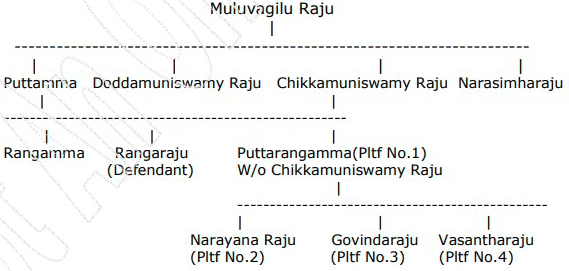
4. The plaintiff No.1 and defendant Rangaraju are brother and sister. Both are children of one Puttamma. The plaintiff No.1 is given in marriage to the brother of Puttamma. The present plaintiffs have filed the suit seeking possession which is based on title. The plaintiffs contended that the suit land was owned by Chikkamuniswamy Raju and after his death, the plaintiffs being the only class-I heirs i.e., widow and children have inherited the property left behind by Chikkamuniswamy Raju. It is the specific case of the plaintiffs that after death of Chikkamuniswamy Raju, plaintiff No.1 delivered possession to defendant who is none other than her brother on a condition that he would handover the suit land as and when demanded. The plaintiffs alleged that the defendant having misused the trust reposed by the plaintiff No.1, got his name mutated to the revenue records and started acting adversely to the interest of plaintiffs in the month of April 1992 and hence, the present suit.
5. The defendant, on receipt of summons, tendered appearance and filed written statement and set up adverse title contending that he has perfected his title by way of adverse possession.
6. The plaintiffs and defendant to substantiate their respective claim led in oral and documentary evidence.
7. The trial Court referring to the evidence on record, drew adverse inference against the plaintiffs that though defendant's name was mutated to the revenue records, plaintiffs have not chosen to question those mutations. The trial Court was of the view that if plaintiff No.1 has given a statement indicating that her husband has given 33 1/4 guntas to the defendant and if they have submitted no objection to change the katha, the Court was of the view that having regard to the conduct of plaintiffs in not securing any document to substantiate their stand that defendant is in permissive possession, the trial Court concluded by holding that defendant has succeeded in proving his title by way of adverse possession. Consequently, suit was dismissed.
8. Feeling aggrieved by the judgment and decree of the trial Court, plaintiffs preferred appeal before the Appellate Court.
9. The Appellate Court referring to the material on record was of the view that plaintiffs have admitted that possession was handed over to defendant two years after the death of first plaintiff's husband. Therefore, Appellate Court was of the view that if plaintiff's husband died in 1967 and if possession was delivered to defendant in 1969, the suit for possession filed by the plaintiffs after 22 years is barred by Article 64. The Appellate Court was also of the view that relief of declaration is covered by Article 58 of Limitation Act . The Appellate Court was of the view that cause of action accrued to the plaintiff in 1985 and therefore, plaintiffs ought to have brought into action by approaching the Court within three years as stipulated under Article 58 of Limitation Act . The Appellate Court though did not concur with the findings of the trial Court in regard to plea of adverse possession, however, proceeded to dismiss the suit on the ground that plaintiff's relief of possession squarely falls under Section 6 of the Specific Relief Act and therefore, the present suit is hit by Article 64 of the Limitation Act . On these set of reasonings, the Appellate Court having partially concurred with the findings of the trial Court has proceeded to dismiss the appeal.
10. This Court vide order dated 24.04.2009 was












