
 Back
Back





IN THE HIGH COURT OF KARNATAKA
Suraj Govindaraj, J.
Karnataka Silk Industries Corporation Ltd – Appellant
Versus
Commissioner – Respondent
Writ Petition No. 4483 of 2018 (LB-BMP)
Decided On : 28-08-2023
DISPUTE RESOLUTION - RENT DISPUTE BETWEEN GOVERNMENT DEPARTMENTS - KARNATAKA MUNICIPAL ACT, 1976; KARNATAKA STATE DISPUTE RESOLUTION POLICY, 2021 - The court discussed the provisions of the Karnataka Municipal Act, 1976, specifically Sections 470 and 471, which pertain to municipal disputes, and the Karnataka State Dispute Resolution Policy, 2021, which promotes alternative dispute resolution mechanisms for inter-departmental disputes. The court emphasized the importance of resolving disputes through the Inter-Departmental Dispute Redressal Committee to prevent litigation and promote efficiency in government operations.
Fact of the Case:
The petitioner, Karnataka Silk Industries Corporation Limited, challenged an order from the Additional City Civil Judge regarding rent disputes with Bruhat Bengaluru Mahanagara Palike (BBMP). The dispute involved the rents payable for properties rented by the petitioner from the respondents.
Finding of the Court:
The court found that the dispute was suitable for resolution through the Inter-Departmental Dispute Resolution Committee as per the Karnataka State Dispute Resolution Policy, 2021, rather than through litigation.
Issues: The primary issue was whether the rent dispute between the petitioner and the respondents should be resolved through litigation or through the newly established inter-departmental dispute resolution mechanisms.
Ratio Decidendi: The court held that the Karnataka State Dispute Resolution Policy, 2021, provides a framework for resolving disputes between government departments through alternative dispute resolution mechanisms, which should be utilized to avoid unnecessary litigation.
Final Decision: The petition was disposed of with directions for the Chief Secretary to constitute an Inter-Departmental Dispute Redressal Committee within three weeks to resolve the dispute, allowing the petitioner to revive the petition if the dispute was not resolved within 90 days.
JUDGMENT
1. The petitioner is before this Court seeking for the following reliefs: a. To set aside the order passed by the learned Additional City Civil Judge in MISC Petition No.910/2015 dtd. 5/12/2017 on the file of the Court of V Additional City Civil Judge Bengaluru City, vide Annexure-A. b. Issue any other direction/order/writ as deemed fit in the circumstances and probability of the case and same may be considered in the interest of justice and equity.
2. The petitioner is the Karnataka Silk Industries Corporation Limited and the respondents are Bruhat Bengaluru Mahanagara Palike (BBMP). The dispute in the above matter is relating to the rents payable by the petitioner to the respondents in respect of the properties which has been rented out to the petitioner. It is in respect of the said dispute that the proceedings were initiated in Misc.No.910/2015 before the Additional City Civil Judge, Bengaluru under Ss. 470 and 471 of the Karnataka Municipal Act, 1976 (for short 'KMC Act') and the order dtd. 5/12/2017 in the said matter is under challenge in the present proceedings.
3. The issue involved in the said proceedings is as regards the rents payable and/or the increase in the rents payable by the respondents to the petitioner. This in my considered opinion, it would be a fit case for resolution by the Inter-Departmental Dispute Resolution Committee envisaged under Chapter VII of the Karnataka State Dispute Resolution Policy, 2021. The said policy, having been notified in the Karnataka Gazette on 20/2/2021 envisages the use of alternative dispute mechanisms for the purpose of resolving disputes between the government department and private parties as also interdepartmental disputes. It is one thing for the private citizen to have a dispute against the State and approaching this Court, it is another for two departments within the Government having a dispute and approaching this Court or a Trial Court.
4. The Government being the biggest litigator, the Karnataka State Dispute Resolution Policy, 2021, has apparently been formulated to better address these kinds of litigations. In terms of Clause 1.2.3 of Chapter VII, in order to resolve inter-departmental disputes, i.e., disputes between two or more departments, it is envisaged that there is an Inter-Departmental Dispute Redressal Committee headed by the Chief Secretary or Additional Secretary, and the Committee to use suitable mechanisms to address the conflict and resolve disputes as far as practicable without resort to litigation.
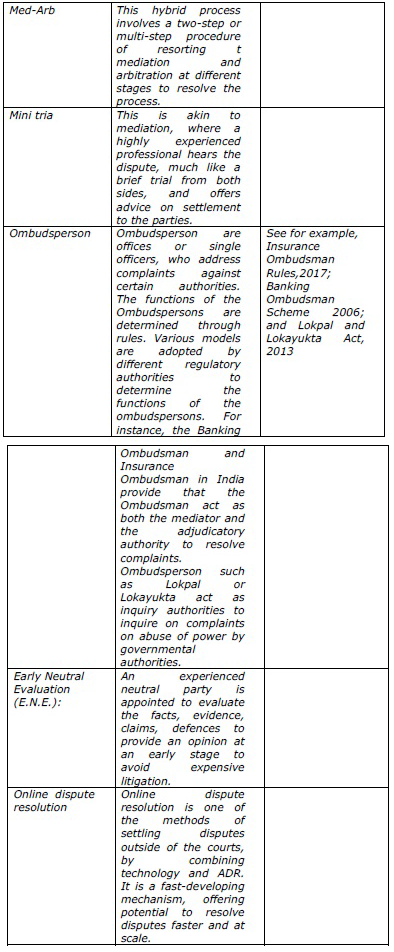
5. The typology of Alternative Dispute Resolution (ADR) mechanism is also provided under Clause 2 of Chapter VII. Clause 2 of Chapter VII deals with the incorporation of ADR in Government dispute system which reads as under:
"2. Typology of ADR Mechanisms 2.1. To design a suitable system or opt for a suitable ADR process, Stakeholders must be aware of the range of ADR options. The following Tables offer a non-exhaustive typology of ADR mechanisms. The Tables provide a starting point, from which stakeholders can develop suitable ADR system designs for their disputes/dispute areas. Table A: Voluntary Settlement-Based ADR Mechanisms
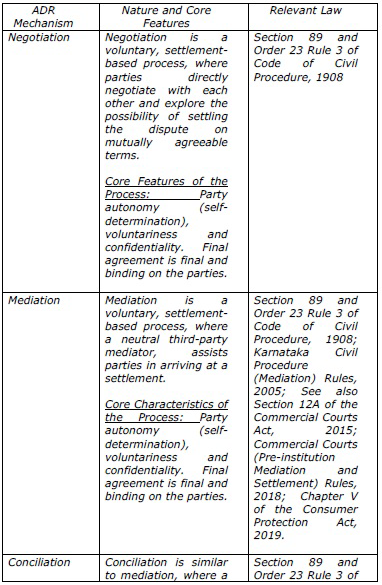
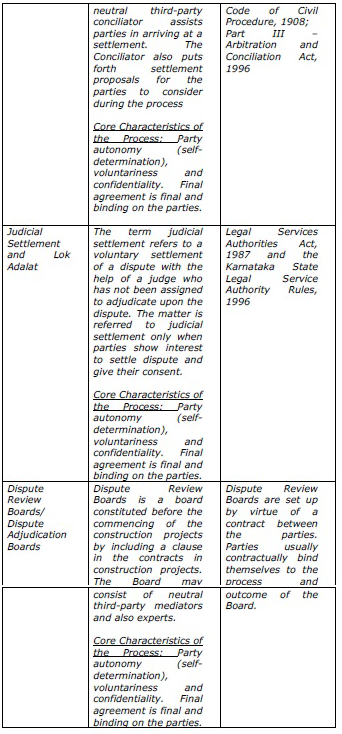
Table B: Private Adjudication/Determination (Consensual Submission of dispute, Binding Outcome)
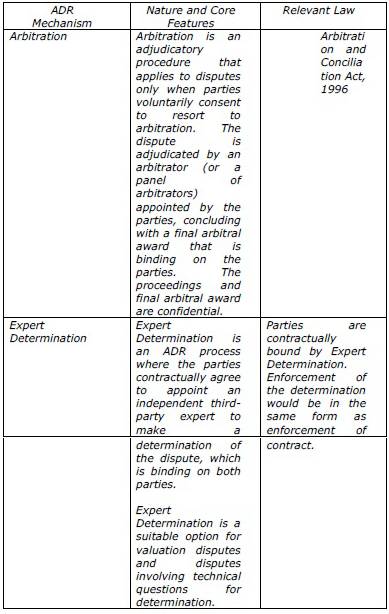
Table C: Hybrid/Flexible Mechanisms
6. Clause (6) of Chapter VII deals with incorporating ADR in Government Dispute System. Clause (6.1) to (6.4) are reproduced hereunder for easy reference:
6. Incorporating ADR in Government Dispute System 6.1. In government disputes, ADR can be incorporated at two levels - first, at the Department level, where the conflict emerges (in case of inter-departmental disputes, ADR can be incorporated at the time that the conflict emerges between departments); secondly, at adjudication level, where the conflict is escalated and involves Law Officers representing the government. Two objectives must drive each of these two levels: dispute prevention and dispute resolution. It is recommended that ther
AI

Point of Law : If the Chief Secretary, Government of Karnataka, is of opinion that the matter cannot be resolved due to any legal impediment and is a matter to be decided by the Court, matter may be ....


The Supreme Court ruled that the absence of clearance from the Committee on Disputes does not invalidate the right to file a suit, and that disputes between government corporations should be adjudica....


The court found that interim orders can be granted under S.95(4) of the Maharashtra Co-operative Societies Act even before the Registrar determines if a dispute exists.

Disputes between landlords and tenants governed by rent control legislation are non-arbitrable and must be addressed exclusively by statutory authorities.



An indispensable Tool for Legal Professionals, Endorsed by Various High Court and Judicial Officers
Please visit our Training & Support
Center or Contact Us for assistance

Scan Me!
India’s Legal research and Law Firm App, Download now!


For Daily Legal Updates, Join us on :



 Back to top


