
 Back
Back





IN THE HIGH COURT OF KARNATAKA
C.M. Joshi, J.
Shekar – Appellant
Versus
Manikappa – Respondent
Regular Second Appeal No. 7256 of 2009 (PAR/POS)
Decided On : 07-07-2023
PARTITION - FAMILY LAW - Hindu Succession Act, Sec. 6 - The court discussed the provisions of the Hindu Succession Act, particularly Section 6, which addresses the rights of daughters as coparceners in a joint family. The court emphasized that the amendment to this section discourages oral partitions and requires proof of partition by metes and bounds. The court concluded that the defendants failed to prove the existence of a prior partition, leading to the affirmation of the First Appellate Court's decision to grant partition to the plaintiff and his sisters.
Fact of the Case:
The plaintiff, Manikappa, filed a suit for partition of ancestral properties against his brothers and their mother, claiming that despite living separately, no formal partition had occurred. The defendants contended that a partition had taken place in 1997-98, which the plaintiff denied.
Finding of the Court:
The Trial Court initially dismissed the plaintiff's suit, accepting the defendants' claim of prior partition. However, the First Appellate Court reversed this decision, finding that the defendants did not adequately prove the existence of a partition, particularly due to inconsistencies in their evidence and the lack of a formal document evidencing the partition.
Issues: The primary issue was whether a partition had occurred in 1997-98 as claimed by the defendants, and whether the First Appellate Court was justified in reversing the Trial Court's decision.
Ratio Decidendi: The court held that mere separate enjoyment of property does not constitute a partition. The defendants failed to provide sufficient evidence of a formal partition, and the absence of a registered document further weakened their claim. The court also noted the implications of the amendment to Section 6 of the Hindu Succession Act, which grants daughters equal rights as coparceners.
Final Decision: The appeal was dismissed, upholding the First Appellate Court's decree for partition. The shares were modified to ensure equal distribution among all parties, including the plaintiff's sisters, Droupadi and Narasamma, who were recognized as entitled to a share in the properties.
JUDGMENT
1. This Regular Second Appeal is filed against the divergent findings by the Trial Court and the First Appellate Court in OS No.69/2006 by the learned I Additional Civil Judge (Jr.Dn), Chincholi and in RA No. 26/2008 by the learned Civil Judge (Sr.Dn) Chincholi, whereby the suit filed by the plaintiff for partition came to be decreed. The defendants are in appeal before this Court.
2. The parties would be referred to as per their ranks before the Trial Court for the sake of the convenience.
3. Brief facts are as below: The genealogical tree of the family of the plaintiff and defendants is not in dispute. The propositus of the family Hanmantappa had four sons and two daughters, namely; Bheemanna (who is now represented by defendant Nos. 4 to 7), Manikappa- the plaintiff, Shekhardefendant No.1, Sharanappa-defendant No.2 and Mallappa-defendant No.3 and two daughters, namely Droupadi and Narasamma.
4. The plaintiff-Manikappa contended that his two sisters i.e. Droupadi and Narasamma were given in marriage long back and since they were given money and gold at the time of the marriage, they are not made as parties to the suit. It was contended that due to the misunderstanding between the women folk of the family, there was a family arrangement and they were residing separately by making divisions in the house property. For the purpose of eking out their livelihood, even though, there was no partition between them, the brothers were living separately by making an arrangement enjoying separate portions of lands. Plaintiff demanded the partition in the suit schedule properties and the defendants refused to effect the partition. Therefore, he was constrained to file a suit for partition in respect of the suit schedule properties. He claim that there shall be six shares and to allot one such share to him.
5. The defendant Nos. 4 to 7 contended that there was no partition and they also sought for partition in the suit schedule properties and share may be allotted to them as they represent the son of propositus Hanmantappa, i.e. Bheemanna.
6. The defendant Nos. 1 to 3 are sons and defendant No.8 happens to be the mother of the plaintiff and defendant Nos.1 to 3. They contended in the written statement that the relationship between the parties and the nature of the properties is admitted and they have denied the contention of the plaintiff that there was no partition in the joint family properties. They admit that the suit schedule properties were owned by Hanamantappa and as such, they are the ancestral properties of the plaintiff and defendants. They contended that in the year 1997-98 in the presence of the villagers, there was a partition between the plaintiff and defendants and the memorandum of partition was also written and signed by all the parties. They contended that in pursuance to the partition, the lands were divided and they started enjoyment of the properties independently and separately. They narrate the manner in which the partition was effected in the joint family properties and they contend that though the mutation entries had been effected in respect of the properties belonging to defendant Nos. 1 to 3 and 8, the mutation was not effected in respect of the properties which were allotted to plaintiff and defendant Nos. 4 to 7. It is contended that the defendant Nos. 1 to 3 and 8 got mutation order in their names relating to lands allotted to them but the plaintiff and defendant Nos.4 to 7 had not made any attempt to get the mutation effected in their name. Therefore, they contended that the suit is not maintainable and the same be dismissed with costs.
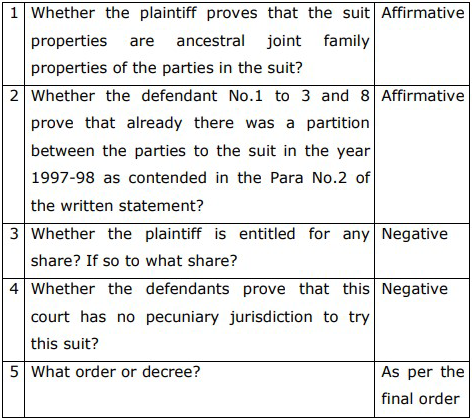
7. On the basis of the above pleadings, the Trail Court framed the following issues and they were answered as below:
8. Before the Trial Court, the plaintiff has been examined as PW1 and two witnesses were examined on his behalf as PWs- 2 and 3 and Exs.P1 to P8 were marked. Defendant No.1 got himself examined as DW1 and two witnesses were examined on their behalf as
AI
The amendment to Section 6 of the Hindu Succession Act establishes that daughters are coparceners with equal rights in ancestral property, and oral partitions are not sufficient without formal docume....

The main legal point established in the judgment is that unless prior partition is established, there shall be a presumption that the property is joint family property, and a family arrangement in th....

The burden of proof in establishing joint family property and partition lies with the party alleging its existence. The court also emphasized the entitlement of daughters to share in joint Hindu fami....
The heavy burden of proof upon the proponent of oral partition before it is accepted, as per the settled principle of law by the Apex Court.

A joint family is presumed to remain joint unless a clear severance of status is proven, even without a physical division of property.

The court affirmed that ancestral property remains so despite partition, and daughters are entitled to equal shares under the Hindu Succession Act, 1956, as amended.
The court reaffirmed that daughters have equal rights as sons in ancestral properties, emphasizing the applicability of Section 6 of the Hindu Succession Act.

The court ruled that an oral partition was established and the plaintiff cannot claim partial partition without including all relevant properties, adhering to heirs' rights under Hindu law.



An indispensable Tool for Legal Professionals, Endorsed by Various High Court and Judicial Officers
Please visit our Training & Support
Center or Contact Us for assistance

Scan Me!
India’s Legal research and Law Firm App, Download now!


For Daily Legal Updates, Join us on :



 Back to top


