


 Back
Back





2024 Supreme(Kar) 613
IN THE HIGH COURT OF KARNATAKA AT BENGALURU
C.M. JOSHI, J.
Sri Lakshman Reddy, S/o. Late Govinda Reddy – Appellant
Versus
Smt. G. Danamma, W/o. Jayaramreddy and Ors. – Respondents
Regular First Appeal No. 323 of 2009 (PAR)
Decided on : 04-12-2024
Advocate Appeared:
For the Appellant : Sri Abhinav R., Adv.
For the Respondents: Sri Prasanna Kumar R.S., Adv., Sri Vishwanath Shetty, Adv., Sri H.R Anantha Krishnamurthy, Sri Jayaprakash, Sri S.M. Manjunatha, Adv., Sri A. Madusudhana Rao, Adv.
The court affirmed that ancestral property remains so despite partition, and daughters are entitled to equal shares under the Hindu Succession Act, 1956, as amended.
Headnote:(A) Hindu Succession Act, 1956 - Section 6 - Partition of ancestral property - Plaintiffs claimed partition and separate possession of their share in ancestral properties, alleging exclusion from a partition deed dated 20-06-2003 - Trial Court held the partition deed invalid and granted plaintiffs 1/10th share in the properties - The court emphasized that ancestral property retains its character post-partition, allowing sons and daughters equal rights under the amended provisions of the Act. (Paras 1, 16, 54)
(B) Partition Deed - Validity - The court found that the partition deed dated 20-06-2003 was executed without including married daughters, thus not binding on them - The court upheld the partition but clarified that it does not affect the rights of the daughters to claim their share. (Paras 63, 64)
Facts of the case:
The plaintiffs, daughters of Govindareddy, sought partition of ancestral properties, claiming exclusion from a partition deed executed by their brothers and mother. They contended that the partition deed was invalid as it did not account for their rights as daughters under the Hindu Succession Act.
Findings of Court:
The court found that the partition deed was executed without the consent of the married daughters and upheld their right to claim a share in the ancestral properties, affirming the trial court's decision to cancel the partition deed.
Issues: The main issues were whether the partition deed was valid and whether the plaintiffs were entitled to a share in the ancestral properties.
Ratio Decidendi: The court ruled that the partition deed was not binding on the plaintiffs as it excluded married daughters, and that the properties remained ancestral, entitling all children to equal shares.
Result: The appeal was allowed in part, granting the plaintiffs and defendants specified shares in the ancestral properties.
JUDGMENT :
(C.M. Joshi, J.)
This appeal is filed by defendant No.3 in OS No.5761 of 2004 being aggrieved by the judgment and decree dated 22nd November 2008 passed by the learned XXXVIII Additional City Civil and Sessions Judge, Bangalore City.
2. The parties would be referred to as per their ranks before the trial Court for the sake of convenience.
3. The facts of the case as averred in the plaint are that, plaintiff Nos.1 to 5 before the trial Court who are respondent Nos.1 to 5 herein, claimed the relief of partition and the separate possession of their 1/9th share in the suit schedule properties and for other reliefs which are as below:
a) for revocation of Partition Deed dated 20.06.2003.
b) for partition of the suit schedule property by metes and bounds and to deliver their 1/9th share in the suit schedule property.
c) for separate possession of the plaintiff’s share in the suit schedule property.
d) and grant of permanent injunction, restraining the defendants from alienating or dispossessing the suit schedule property.
e) for grant of such other relief or reliefs, as this Hon'ble court deems fit to grant under the circumstances of the case, in the interest of justice and equity.
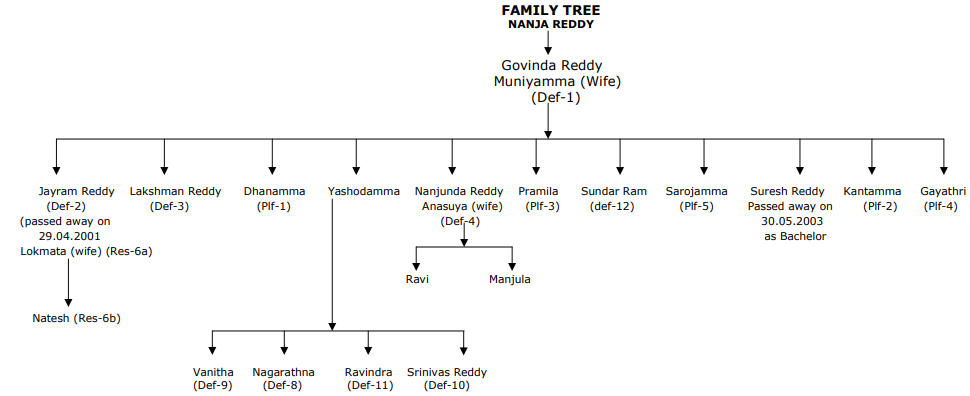
4. Initially, plaintiff Nos.1 and 2 had filed the suit and later, their sisters who were arrayed as defendant Nos. 5 to 7, got transposed themselves as plaintiff Nos. 3 to 5. It is the case of the plaintiffs that they are the daughters of defendant No.1 and their deceased father Govindareddy. It is stated that defendant Nos.1, 2, 3, husband of defendant No.4, defendant No.12 and another deceased Suresh Reddy were their brothers; mother of defendant No.8 to 10 Yashodamma, was another sister of the plaintiff. The family pedigree under Govindareddy is depicted as below:
5. It is relevant to note that initially, the suit was filed against defendant Nos.1 to 12 and later defendant Nos.5 to 7 were transposed as the plaintiffs. Defendant Nos. 13 to 22 were impleaded before the trial Court since they were the purchasers of the properties from the brothers of the plaintiffs. The plaintiffs, contended that their father, late Govindareddy, was allotted the land bearing Sy.No.9/2 measuring 02 acres 27 guntas, situated at Doddanekkundi village, in a partition among his brothers; during his lifetime 10 guntas of land in Sy.No.9/2 was acquired by the Railways; and after the death of Govindareddy, the plaintiffs and defendant Nos. 1 to 12 had succeeded to the property. After death of Govindareddy, defendant No.1 Muniyamma got transferred the Katha (revenue entry) in respect of the said Sy.No.9/2 in her name. Later, 28 guntas of land in the said land was acquired by the Government for formation of the ring road. Therefore, only 01 acre, 27 guntas of land was available to them, as described at item No.1 in the schedule to the plaint. It is also the case of the plaintiffs that the defendant Nos.1 to 4 have received a compensation amount of Rs.4,20,826/- which was awarded for the acquisition of 28 guntas by the Government and the plaintiffs are also entitled for share in the same. It is contended that defendant Nos.1 to 7 colluding with each other have entered into a partition in the suit schedule properties among themselves under a registered partition deed dated 20-06-2003. In the said partition, the plaintiffs were excluded and therefore, the said partition is not binding on them.
6. Later, when defendant Nos.5 to 7 were transposed as plaintiffs, it appears that they have also acceded to the said contention. Further, it is the case of the plaintiffs that after effecting the partition in the suit schedule properties, defendant Nos.1 to 4 have formed revenue sites in portions allotted to their share and sold the same to different people. Though the defendants were requested to effect partition and give share to plaintiffs, they failed and therefore, the plaintiffs are entitled for partition and legitimate share. Inter alia, the plaintiffs also contended that the suit sched












