
 Back
Back





IN THE HIGH COURT OF KARNATAKA
M.Nagaprasanna, J.
Mahantayya – Appellant
Versus
State of Karnataka – Respondent
Writ Petition No. 104804 of 2023 (GM-POLICE)
Decided On : 08-08-2023
EXTERNMENT - KARNATAKA POLICE ACT - Sec. 54, 55, 56, 57, 58, 59, 60 - The court analyzed the provisions of the Karnataka Police Act, particularly Sections 54 to 60, which govern the externment of individuals. It emphasized that externment is an extraordinary measure that infringes on the fundamental right to movement under Article 19(1)(d) of the Constitution. The court highlighted the necessity for objective material to justify such orders and the requirement for a fair hearing as per Section 58. The court found that the externment order against the petitioner was arbitrary and lacked sufficient justification, leading to its quashing.
Fact of the Case:
The petitioner challenged an externment order issued by the Assessment Commissioner, which removed him from Bailhongal to Bagalkot for three months based on three non-cognizable offences under Sec. 78(3) of the Karnataka Police Act, all of which had been closed with fines. The petitioner argued that his fundamental rights were violated and that the order was a misuse of power.
Finding of the Court:
The court found that the externment order was arbitrary and did not meet the legal requirements set forth in the Karnataka Police Act. It noted that the petitioner was not currently involved in any crimes and that the offences cited were not sufficient to justify the drastic measure of externment.
Issues: Whether the externment order was justified under the provisions of the Karnataka Police Act and whether it violated the petitioner's fundamental rights.
Ratio Decidendi: The court held that externment is a serious infringement of the right to movement and must be based on objective evidence of current danger or harm. The absence of such evidence and the lack of a fair hearing rendered the order invalid.
Final Decision: The writ petition was allowed, and the externment order dated 28/7/2023 was quashed, restoring the petitioner's rights and entitling him to all consequential benefits.
JUDGMENT
1. Learned HCGP is directed to accept notice for respondents.
2. The petitioner is before this Court calling in question the order dtd. 28/7/2023 passed by the 2nd respondent/Assessment Commissioner cum-Sub-Divisional Magistrate, Bailhongal externing the petitioner from Bailhongal Sub-Division to Bagalkot for a period of three months.
3. Heard Sri Shriharsh A.Neelopant, learned counsel appearing for the petitioner and Sri V.S. Kalasurmath, learned High Court Government Pleader appearing for the respondents.
4. Facts, in brief, germane are as follows:
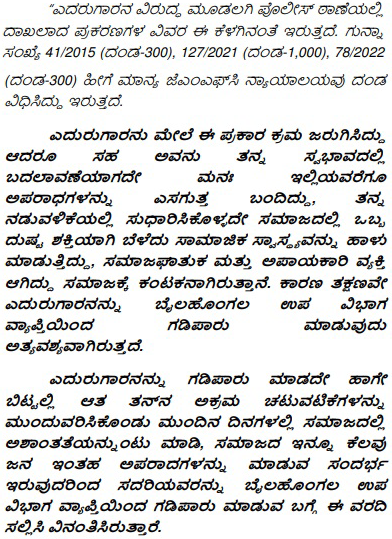
The petitioner is a resident of Bailhongal. The petitioner gets embroiled in 3 crimes, all for offences punishable under Sec. 78(3) of the Karnataka Police Act, 1963 ('Act' for short). The first of the crime was registered in the year 2015; the next in 2021 and the third in the year 2022, all for the aforesaid offence. The offence under Sec. 78(3) of the Act is admittedly noncognizable. It transpires that those cases which were in Crime Nos.41 of 2015, 127 of 2021 and 78 of 2022 have all been closed on imposition of fines. Notwithstanding their closure, a report appears to have been generated against the petitioner that he is involved in the aforesaid 3 crimes and on that score he has to be externed from Bailhongal to any other place. The said report against the petitioner is communicated to the petitioner to show cause as to why an order of externment should not be passed against him. The petitioner appears before the Assistant Commissioner and puts up his defence. Notwithstanding the said defence, the order of externment comes to be passed by the Assistant Commissioner on 28/7/2023. It is this order that is called in question in the subject petition.
5. The learned counsel appearing for the petitioner would contend with vehemence that the fundamental right of the petitioner is taken away for offences which are noncognizable and have all been closed by imposition of fines. He would contend that in gross misuse of power the order of externment is passed.
6. On the other hand, the learned High Court Government Pleader would seek to defend the action contending that the petitioner had become dangerous to the Society or the surrounding places and therefore, action had to be taken. He would submit that all the necessary procedures in law are followed prior to the order of externment.
7. I have given my anxious consideration to the submissions made by the respective learned counsel and have perused the material on record.
8. Before embarking upon consideration of the case on its merits, I deem it appropriate to notice the legal frame work under which an order of externment could be passed against any person. Chapter-II of the Act deals with dispersal of gangs and bodies of persons convicted of certain offences. Sec. 54 deals with dispersal of gangs and bodies of persons which is applicable to the case at hand. What is germane to be noticed is Ss. 55 to 60 and they read as follows:-
"55. Removal of persons about to commit offences.-Whenever it shall appear in the City of Bangalore and other areas for which a Commissioner has been appointed under sec. 7 to the Commissioner, and in other area or areas to which the Government may, by notification in the official Gazette, extend the provision of this sec., to the District Magistrate, or the Sub-Divisional Magistrate having jurisdiction and specially empowered by the Government in that behalf, -
(a) that the movements or acts of any person are causing or calculated to cause alarm, danger or harm to person or property, or
(b) that there are reasonable grounds for believing that such person is engaged or is about to be engaged in the commission of an offence involving force or violence or an offence punishable under Chapter XII, XVI or XVII of the Indian Penal Code, or in the abetment of any such offence, and when in the opinion of such officer witnesses are not willing to come forward to give evidence in public against such person by r

AI
Externment orders must be based on objective evidence of current danger or harm, and must comply with procedural safeguards to ensure the protection of fundamental rights under Article 19(1)(d) of th....

Section 54 deals with dispersal of gangs and bodies of persons which is applicable to case at hand.
The order of externment must stand the test of reasonableness and should be based on objective material, and the court can interfere when there is no material or the relevant material has not been co....
An order of externment must be based on subjective satisfaction supported by objective material and must meet the test of reasonableness as per Article 19(1)(d) of the Constitution of India.

Externment orders must be supported by objective evidence and must not violate the fundamental right to free movement; failure to comply with these requirements renders such orders invalid.

Order of externment is an extraordinary measure – As in case of any other administrative order, judicial review is permissible on the grounds of mala fide, unreasonableness or arbitrariness.

The court highlighted the importance of objective material for recording subjective satisfaction to pass an order of externment, the need for compliance with principles of natural justice, and the ne....

Externment orders under the Maharashtra Police Act must be supported by objective evidence and cannot infringe upon the fundamental right to free movement without justifiable grounds.



An indispensable Tool for Legal Professionals, Endorsed by Various High Court and Judicial Officers
Please visit our Training & Support
Center or Contact Us for assistance

Scan Me!
India’s Legal research and Law Firm App, Download now!


For Daily Legal Updates, Join us on :



 Back to top


