
 Back
Back





IN THE HIGH COURT OF KARNATAKA
Sachin Shankar Magadum, J.
Smt Ahalya H Shetty & Ors. – Appellants
Versus
Smt Vathsala S Shetty & Anr. – Respondents
Regular Second Appeal No.2190 of 2016
Decided On : 11-01-2024
ALIYASANTANA LAW - PARTITION AND SEPARATE POSSESSION - Madras Aliyasantana Act, 1949, Section 29(1), Section 29(2) - The court interpreted the provisions of the Madras Aliyasantana Act, particularly Section 29, which governs the alienation of property within a Hindu Undivided Family. The court emphasized that a member of an Aliyasantana family cannot alienate property without the consent of other family members. The court concluded that the plaintiffs, as non-alienating members, had a pre-existing right to seek partition without needing to cancel the sale deed executed by their mother, which was deemed not binding on them due to lack of consent.
Fact of the Case:
Plaintiffs, children of defendant No.1, filed a suit for partition and separate possession of family property, alleging that their mother alienated the property without their knowledge or consent. The trial court ruled in favor of the plaintiffs, granting them shares in the property, while the appellate court reversed this decision, leading to the current appeal.
Finding of the Court:
The appellate court's finding that the plaintiffs could not maintain a suit for partition without seeking cancellation of the sale deed was found to be erroneous. The court held that the plaintiffs had independent rights as members of an Aliyasantana family and did not need to question the sale deed to seek partition.
Issues: 1) Whether the appellate court justified in rejecting the relief of partition on the ground that plaintiffs have not sought the cancellation of the sale deed? 2) Whether the interpretation of Section 29(2) of the Madras Aliyasantana Act made by the appellate court is correct?
Ratio Decidendi: The court established that a non-alienating member of an Aliyasantana family can maintain a suit for partition without needing to seek a formal declaration that a sale deed is not binding on them, as their rights are pre-existing and not lost due to the alienation by another family member.
Final Decision: The second appeal was allowed, the appellate court's judgment was set aside, and the trial court's decree granting partition to the plaintiffs was confirmed.
JUDGMENT
Sachin Shankar Magadum, J. - The captioned second appeal is by plaintiffs assailing the judgment and decree rendered by the appellate Court wherein appellate Court has allowed the appeal filed by defendant No.2 and the plaintiffs suit seeking relief of partition and separate possession is dismissed. These divergent findings are under challenge at the instance of plaintiffs.
2. For the sake of brevity, the parties are referred to as per their rank before the trial Court.
3. The family tree is as under:
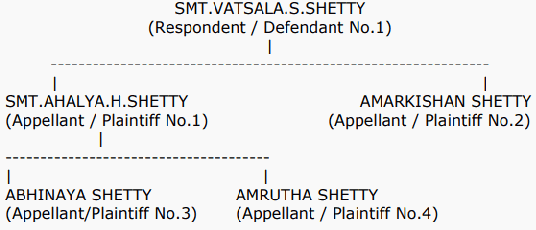
4. Plaintiff Nos.1 and 2 are the children of defendant No.1. It is not in dispute that plaintiff Nos.1 and 2 and defendant No.1 constitute a Hindu Undivided Family governed by Aliyasantana Law and defendant No.1 being a mother was managing the suit land bearing Sy.No.13/1 measuring 1 acre 70 cents. The plaintiffs feeling aggrieved by the alienation made by their mother have filed the present suit seeking relief of partition and separate possession. Plaintiffs have alleged in the plaint that they were not aware of alienation made by their mother/defendant No.1 in favour of defendant No.2. Plaintiffs have contended that suit land was granted by Land Tribunal and the said land which was subject matter of partition in the family was allotted to the branch of plaintiffs as well as defendant No.1 under registered family partition deed dated 25.05.1970. Therefore, feeling aggrieved by the alienation made by their mother, the plaintiffs have filed the present suit by contending that they are entitled to seek their legitimate share by effecting partition by metes and bounds.
5. Defendant No.1 who is the mother has not chosen to contest the proceedings. Defendant No.2 who is the purchaser of undivided interest filed written statement and stoutly denied the entire averments made in the plaint. Defendant No.2 on the contrary claimed that the sale transaction entered into by plaintiffs mother in his favour binds the plaintiffs as well. Defendant No.2 questioned the maintainability of the suit on the ground that plaintiffs cannot a maintain a simple suit for partition without seeking cancellation of the sale deed executed by their mother in his favour. Defendant No.2 also contended that on account of long passage of time and the plaintiffs conduct in not questioning the alienation also gives an indication that plaintiffs have waived off their undivided right in the property and the same amounts to abandonment.
6. Plaintiffs and defendants to substantiate their respective claim have let in oral and documentary evidence.
7. Trial Court having examined the pleadings answered issue Nos.1, 2 and 4 in the affirmative. While issue No.3 was answered in the negative and against defendant No.2. While answering issue No.3 in the negative, trial Court held that defendant No.2 has failed to prove that the sale by defendant No.1 in his favour was for family necessity and consequently, issue No.4 was answered in the affirmative and while answering the said issue in affirmative, trial Court held that sale deed executed by defendant No.1 is not binding on plaintiffs share. The defendant No.2 since questioned the very maintainability of the suit, issue No.5 was framed in that regard. Trial Court answered issue No.5 in the negative and held that suit is maintainable without seeking cancellation of the sale deed dated 27.02.1987. The trial Court while answering additional issue No.1 in the negative also held that defendant No.2's claim that plaintiffs having kept quite for such a long time amounts to deemed consent for the transaction entered into between defendant No.1 and defendant No.2 was also not acceded to by the trial Court and additional issue was answered in the negative and against the defendant No.2.
8. Trial Court having examined the records and having regard to the fact that there is no serious challenge and dispute in regard to the fact that suit land is an Aliyasantana property proceeded to hold that plaintiffs have got independent right in the su
AI
A member of an Aliyasantana family has a pre-existing right to seek partition of family property without needing to cancel a sale deed executed by another family member, provided the alienation was n....


In joint family property disputes, a guardian may transact on behalf of minors without court sanction, provided sales serve family interests.

The court reaffirmed that a sale deed executed for family and legal necessity by a joint family member is binding, barring challenge by family members after significant delay without sufficient cause....
Point of law: “Conduct of indifference or Acquiescence and held that, it is settled law that an estoppel may arise as against persons who have not willfully made any misrepresentation, and whose cond....

The main legal point established in the judgment is the binding nature of a sale deed executed by the family manager, the entitlement of daughters to ancestral property under the Amended Hindu Succes....
The legal principle established is that in cases involving the sale of joint family property, the burden of proving legal necessity lies with the purchaser only if the plaintiffs have properly pleade....
The burden of proof lies with plaintiffs to demonstrate ownership rights, and valid alienation of property by family members for legal necessity cannot be contested without sufficient evidence.
The court established that a sale of ancestral property requires clear evidence of family necessity to be binding on co-owners, and the limitation period for challenging such sales is twelve years un....



An indispensable Tool for Legal Professionals, Endorsed by Various High Court and Judicial Officers
Please visit our Training & Support
Center or Contact Us for assistance

Scan Me!
India’s Legal research and Law Firm App, Download now!


For Daily Legal Updates, Join us on :



 Back to top


