


 Back
Back





2024 Supreme(Kar) 290
IN THE HIGH COURT OF KARNATAKA AT BENGALURU
S. SUNIL DUTT YADAV, J.
Sri G Nagaraju, S/O Late Gangavenkataiah – Appellant
Versus
The Assistant Registrar Of Co-Op Societies – Respondent
Writ Petition No.13892 OF 2020 (CS-RES)
Decided on : 14-06-2024
Advocate Appeared:
For the Appellant :SRI. P ANAND, ADVOCATE
For the Respondent: SRI. SPOORTHY HEGDE, HCGP
IMPORTANT POINT
A member of a co-operative society remains disqualified for defaulting on dues at the time of election, even if the dues are cleared subsequently.
Headnote:
Disqualification - Co-operative Societies - Karnataka Co-operative Societies Act, 1959 - Section 29-C(1)(a) - The court interpreted Section 29-C(1)(a) to affirm that a member in default at the time of election is disqualified, regardless of subsequent repayment, emphasizing the importance of accountability in co-operative governance.
Fact of the Case:
The petitioner, elected as Director of a co-operative society, was disqualified for being a defaulter on loan dues at the time of election, despite clearing the dues later.
Finding of the Court:
The court found that the disqualification under Section 29-C(1)(a) was valid as the petitioner was in default from the date of election until the dues were cleared, affirming the continuing nature of the default.
Issues: Whether the disqualification under Section 29-C(1)(a) was applicable despite the petitioner clearing dues after the election.
Ratio Decidendi: The court held that disqualification for being a defaulter persists even if dues are cleared post-election, as the default existed at the time of election.
Result: The petition is rejected.
ORDER :
The present petition has been filed by the Director of the Janagere Primary Agricultural Credit Co-operative Society Ltd., calling in question the correctness of the order dated 11.09.2020 at Annexure-'G' disqualifying the petitioner in exercise of power under Section 29-C(1)(a) of the Karnataka Co-operative Societies Act, 1959 (for brevity 'the Act').
2. The facts relevant to the present adjudication is that the petitioner was elected as Director of the respondent No.4 Society on 16.02.2020. A complaint was stated to have been made by Ganga Rangaiah s/o late Ganga Boraiah on 19.05.2020 alleging that the petitioner was a defaulter not having cleared his loan dues to the Society as on the relevant date when he was elected as a Director and hence, ought to have been disqualified.
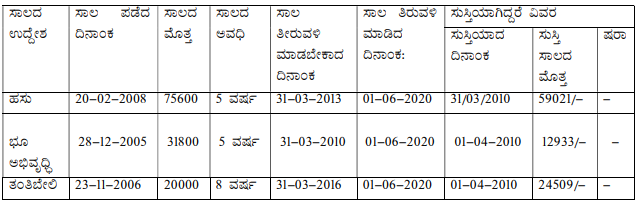
3. The details of the defaults as made out and extracted in the impugned order are extracted as hereinbelow:-
4. While notices were issued to the petitioner on 17.07.2020, 28.07.2020 and 10.08.2020, reply was made out by appearing on 28.08.2020 stating that he had cleared the dues and hence was not a defaulter and question of disqualification did not arise.
5. The Assistant Registrar of Co-operative Societies relying upon the report of the Bank had recorded a finding that the petitioner was in default for the period between 31.03.2010 and 01.06.2020 and accordingly, had disqualified him on the ground of being a defaulter.
6. The said order is in question and the grounds of attack as asserted by learned counsel Sri P. Anand on behalf of the petitioner are that the; show cause notice as regards the disqualification was issued on 17.07.2020 as on which date the dues were cleared and accordingly power under Section 29-C of the Act could not have been invoked, the power under Section 29-C of the Act could be invoked only as regards disqualification incurred after the election while the default in the present case was a pre- election default which could be enquired into only by invoking power under Section 70 of the Act. It is submitted that such contention was not taken note of appropriately.
7. On the other hand, learned High Court Government Pleader Sri Spoorthy Hegde appearing on behalf of respondent Nos.1 and 2 has contended; that the default was cured by payment subsequent to the election which does not take away the cause of action to proceed for disqualification which subsisted post-election till dues were cleared, that the default gave rise to a continuing cause of action and as the said default was also post-election, Section 29-C of the Act could be invoked.
8. Heard both sides.
9. It is to be noticed that the default in repayment subsisted till 01.06.2020 as made out in the Table extracted hereinabove which facts are not disputed. As the petitioner was elected on 16.02.2020, the default in repayment continued till the dues were repaid, which was subsequent to his election.
The provision providing for disqualification is Section 29-C(1)(a) of the Act, which reads as follows:-
29-C. Disqualification for membership of the board.- (1) No person shall be eligible for being elected or appointed or continued as a member of the board of any co-operative society, if-
(a) he is in default to that society or any other co- operative society in respect of any dues from him as borrower;
10. Clearly, the default extends to a person who owes "any dues from him as borrower." The clearing of dues only on 01.06.2020 after the petitioner was elected makes out a case for disqualification.
11. As regards the contention that as on the date of show cause notice the dues had been cleared and accordingly no proceedings for disqualification under Section 29-C of the Act could be proceeded with, the said contention is to be rejected. The petitioner was elected on 16.02.2020 and he has cleared the dues on 01.06.2020. In terms of Section 29-C of the Act, there was a ground for disqualification by virtue of being in default between 16.02.2020 and 01.06.2020. The mere initiation of a















