
 Back
Back





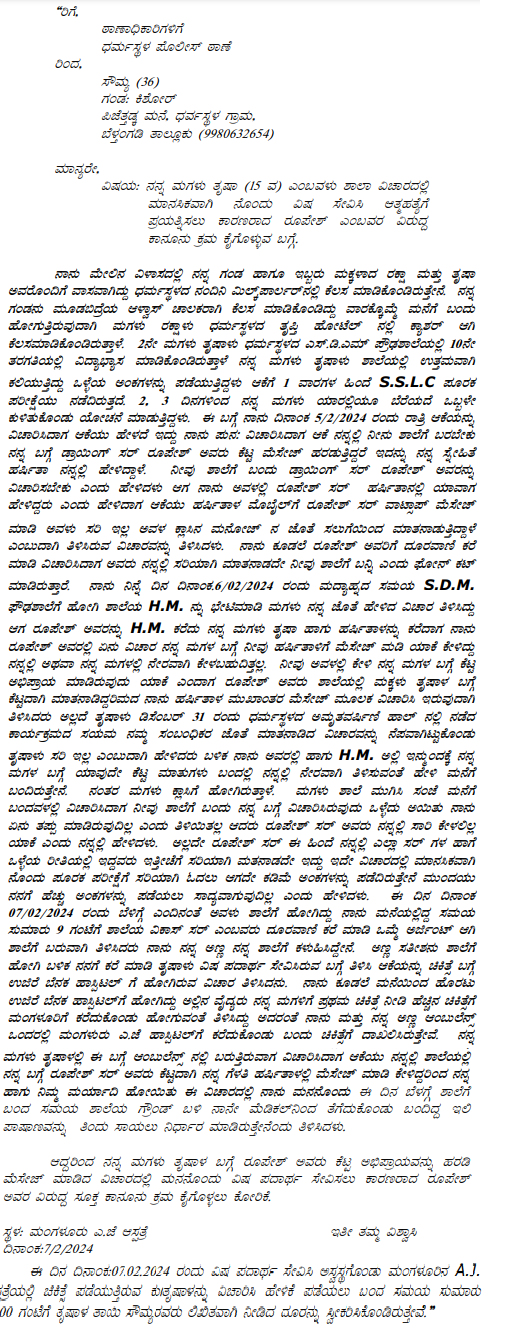
IN THE HIGH COURT OF KARNATAKA AT BENGALURU
M. NAGAPRASANNA, J.
ROOPESHA S/O RAMANNA POOJARY – Petitioner
Versus
THE STATE BY DHARMASTALA POLICE STATION – Respondent
Criminal Petition No. 4941 of 2024
Decided On : 05-07-2024
Discipline - Abetment to Suicide - IPC Sections 305, 506, 354D, 509; POCSO Act Section 12; JJ Act Section 75 - The court interpreted the provisions related to abetment of suicide, emphasizing the necessity of a direct link between the accused's actions and the victim's suicide, ultimately rejecting the petitioners' claims of mere discipline.
Fact of the Case:
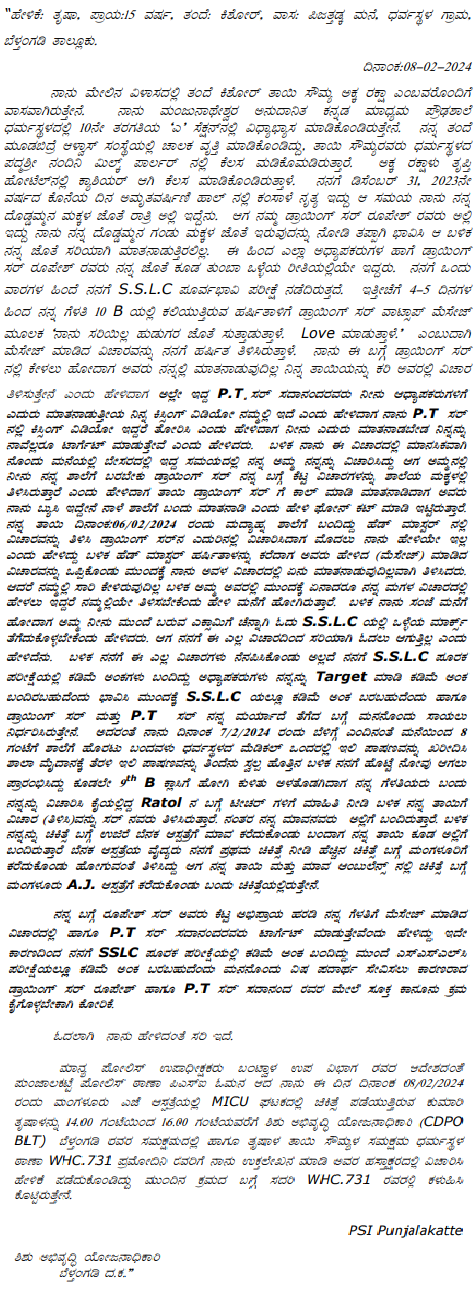
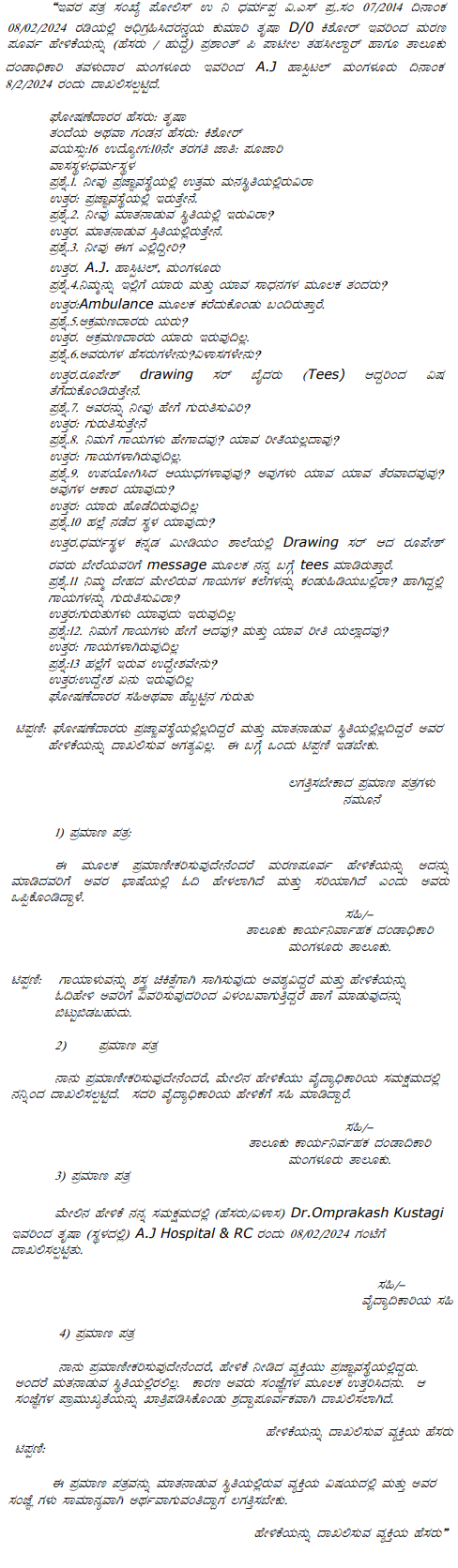
The petitioners, teachers at a school, faced allegations of abetting a student's suicide after they disciplined her for talking to a boy, leading to her consuming poison. The victim's mother filed a complaint after the incident.
Finding of the Court:
The court found that the petitioners' actions contributed to the victim's distress, establishing a prima facie case for abetment of suicide under IPC Section 305, as their behavior was deemed inappropriate and harmful.
Issues: Whether the actions of the petitioners constituted abetment to suicide under IPC Section 305, and if the FIR should be quashed.
Ratio Decidendi: The court held that the petitioners' conduct, which included harassment and threats, directly impacted the victim's mental state, fulfilling the criteria for abetment of suicide.
Result: The Criminal Petition was rejected.
ORDER :
1. The petitioners/accused 1 and 2 are before this Court calling in question registration of a crime in Crime No. 7 of 2024 registered by the Dharmasthala Police for offences punishable under Sections 305, 506, 354D, 509 r/w 34 of the IPC, Section 12 of the Protection of Children from Sexual Offences Act, 2012 and Section 75 of the Juvenile Justice (Care and Protection of Children) Act, 2015.
2. Shorn of unnecessary details, facts in brief, germane are as follows:
3. Heard Sri Ashwin Joyston Kutinha, learned counsel appearing for the petitioners and Sri B.N. Jagadeesh, learned Additional Special Public Prosecutor appearing for respondent No. 1.
4. The leaned counsel appearing for the petitioner would contend that the petitioners were only wanting to discipline the child as talking to other boys was subversive of discipline of the institution. Mere disciplining the child and the child consuming poison eventually leading to unfortunate death would not mean that the petitioners would become abettors to the said suicide for offence punishable under Section 305 of the IPC. He would contend that the allegations that are made against the petitioners or the complaint or the statements would none of them touch upon the ingredients of the offences so alleged against the petitioners.
5. Per contra, the learned Additional Special Public Prosecutor would vehemently refute the submissions to contend that it is the behavior of the petitioners that led the child to get frustrated and commit suicide. The matter is still at the stage of investigation. Therefore, this Court at this stage should not interfere with these proceedings. He would seek dismissal of the petition.
6. In reply, the learned counsel for the petitioners would again contend that the Apex Court in plethora of judgments has rendered that mere disciplining an undisciplined child by a teacher would n
Teachers' disciplinary actions must consider the psychological impact on students; inappropriate behavior can lead to legal consequences under abetment laws.

(1) Abetment of suicide – Act of death must be committed by deceased himself, irrespective of means adopted by him in achieving object of killing himself.(2) Disciplinary measures adopted by a teache....

Section 306 IPC provides for punishment of abetment of suicide.

The main legal point established in the judgment is that for abetment of suicide, there must be a clear mens rea to commit the offense, and the accused must have instigated, conspired, or intentional....

To establish abetment of suicide under Section 306 IPC, there must be clear evidence of instigation or incitement by the accused, which was not present in this case.


The court held that mere allegations of harassment do not establish abetment of suicide under Section 306 IPC without direct evidence of instigation or encouragement.

Legal proceedings alone, without direct instigation or proximity, do not amount to abetment of suicide under Sections 306 and 107 IPC.

Mens rea must be evident for abetment of suicide under IPC; mere disciplinary actions do not constitute instigation without specific intent or severe psychological harassment.



An indispensable Tool for Legal Professionals, Endorsed by Various High Court and Judicial Officers
Please visit our Training & Support
Center or Contact Us for assistance

Scan Me!
India’s Legal research and Law Firm App, Download now!


For Daily Legal Updates, Join us on :

 Back to top


