Back
Back





2024 Supreme(Kar) 466
IN THE HIGH COURT OF KARNATAKA AT BENGALURU
M. NAGAPRASANNA, J.
M. SUBRAMANI S/O LATE SHRI MUNIRAJU – Petitioner
Versus
STATE OF KARNATAKA – Respondent
Criminal Petition No. 5073 of 2023
Decided On : 05-07-2024
Advocate Appeared:
For the Petitioner: SOURABH R.K.
For the Respondents: B.N. JAGADEESH, JYOTHI S. KEMPAGOUDAR.
IMPORTANT POINT
A judicial discharge of an accused precludes further prosecution unless the discharge is overturned, emphasizing the finality of judicial orders.
Headnote:
Criminal - Quashment of Proceedings - Cr.P.C. Sections 239, 173(8) - The court interpreted the provisions of the Cr.P.C. regarding discharge of accused and supplementary charge sheets, emphasizing that a judicial discharge precludes further prosecution unless overturned.
Fact of the Case:
The petitioner, accused of forgery and impersonation in a property sale, was discharged by a magistrate. Following this, a supplementary charge sheet was filed re-adding him as an accused, prompting the petitioner to seek quashment of the proceedings.
Finding of the Court:
The court found that the supplementary charge sheet was invalid as the petitioner had already been judicially discharged, and the prosecution could not reinstate charges without a valid basis.
Issues: Whether the prosecution could file a supplementary charge sheet against the petitioner after he had been discharged from the charges by a judicial order.
Ratio Decidendi: The court held that once a judicial discharge is granted, the prosecution cannot file a supplementary charge sheet against the discharged accused unless the discharge order is overturned.
Result: The supplementary charge sheet against the petitioner was quashed.
ORDER :
1. The petitioner is before this Court calling in question an order dated 07-02-2023 passed by the IV Additional Civil Judge and JMFC at Anekal, Bengaluru Rural District in C.C. No. 185 of 2023 and seeks quashment of entire proceedings.
2. Facts, in brief, adumbrated are as follows:
The petitioner is accused No. 1. The petitioner, intending to purchase immovable property for the purpose of investment, enters into a deed of sale with one Mrs. Dorothy Roberts, the mother of the complainant, through her power of attorney holder in respect of property bearing Sy. No. 60/5 situate in Hebbagodi Village, Attibele Hobli, Anekal Taluk, Bengaluru Rural District registered in the office of the Sub-Registrar, Anekal. It is the averment in the petition that Mrs. Dorothy Roberts herself personally executed a confirmation deed of the aforesaid sale deed in favour of the petitioner. On 05-12-2019, after the sale of the property, the complainant sought to break open the lock of the property and therefore, the petitioner files a suit before the jurisdictional civil Court in O.S. No. 536 of 2019. A temporary injunction was granted against the mother of the complainant not to interfere with the possession and enjoyment of the property by the petitioner.
3. On 10-02-2020, immediately after grant of temporary injunction as aforesaid, a complaint comes to be registered by the 2nd respondent alleging that the sale deed was executed not by the mother of the complainant but by an imposter. Based upon the said complaint, a crime comes to be registered against the petitioner arraigning him as accused No. 1 and three others in Crime No. 50 of 2020. Police, after investigation, file a charge sheet in C.C. No. 185 of 2023 against three accused persons. On filing of the charge sheet, the petitioner takes recourse to two proceedings, one the subject criminal petition having been filed on 29-05-2023. When no interim order was passed during the pendency of the criminal petition, the petitioner takes other recourse of filing an application seeking discharge from the array of accused before the learned Magistrate under Section 239 of the Cr.P.C. The application was heard and order was passed on its merits on 21-11-2023 whereby the concerned Court discharged the petitioner from the array of accused.
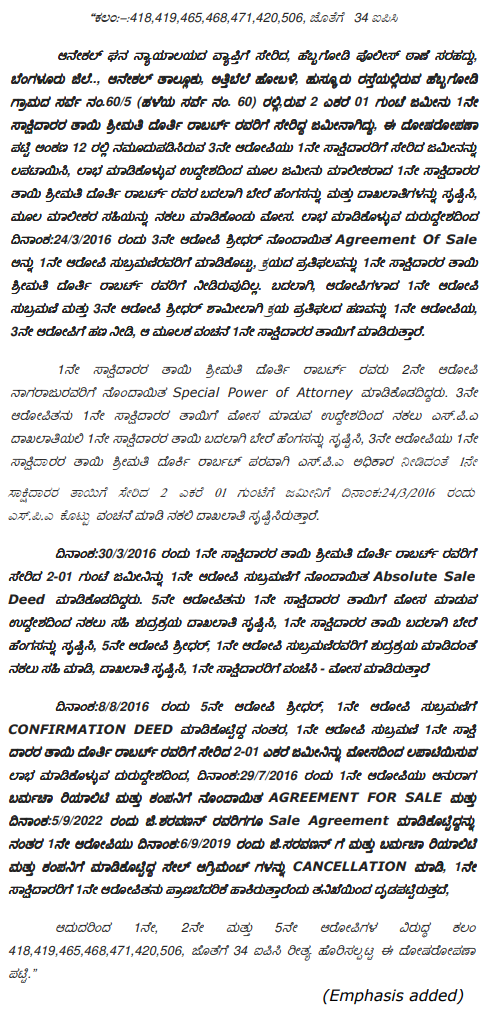
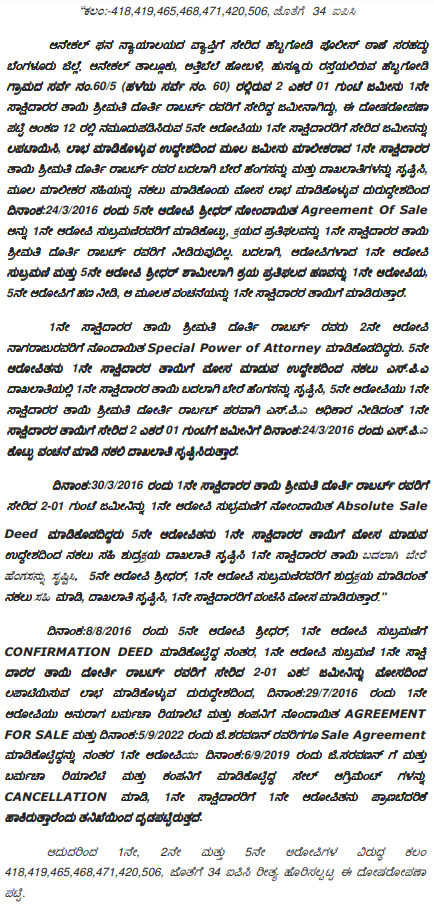
4. Two months after the discharge of the petitioner, the prosecution submits a supplementary charge sheet under Section 173(8) of the Cr.P.C. In the supplementary charge sheet, the petitioner is brought back as accused No. 1 and two others as accused Nos. 2 and 5. The learned Magistrate accepting the supplementary charge sheet, issues summons to all the accused including the petitioner. Issuance of summons leads the petitioner to file an application seeking amendment of the criminal petition raising a challenge to the summons so issued by the concerned Court. Therefore, the challenge now revolves round filing of the supplementary charge sheet and issuing of summons to the petitioner by the concerned Court.
5. Heard Sri R.K. Sourabh, learned counsel appearing for the petitioner, Sri B.N. Jagadeesh, learned Additional Special Public Prosecutor appearing for respondent No. 1 and Smt. Jyothi S. Kempagoudar, learned counsel appearing for respondent No. 2.
6. The learned counsel appearing for the petitioner would vehemently contend that the petitioner is discharged by a judicial order on merits of the matter. Once there is a judicial order of discharge, the foundation itself is knocked out against the petitioner. Therefore, there was no charge pending or charge sheet pending for the prosecution to file an additional charge sheet or supplementary charge sheet arraigning the petitioner again as accused No. 1, more so, in the light of the fact that the order of discharge has become final. The learned counsel would submit that to circumvent the rigour of Section 319, the prosecution has taken the step in connivance with the complainant. On merits of the matter, the learned coun