
 Back
Back





IN THE HIGH COURT OF KARNATAKA AT BENGALURU
M. NAGAPRASANNA, J.
Sri Lingesh K.S., S/o Late Sri Somashekarappa – Appellant
Versus
State Of Karnataka - Respondent
Criminal Petition No.5030 of 2023
Decided on : 13-09-2024
Criminal - Land Grant Fraud - IPC Sections 464, 465, 468, 471, 409, 420, 120B - The court discussed the applicability of various IPC sections concerning fraud and forgery in land grants, emphasizing the need for investigation into the alleged illegalities and the absence of required sanctions for public servants.
Fact of the Case:
The petitioners, members of a land regularization committee, are accused of illegally granting government lands to fictitious beneficiaries, leading to a complaint and subsequent investigation.
Finding of the Court:
The court found that the allegations of fraudulent land grants warranted investigation, as the evidence suggested serious irregularities in the land allocation process.
Issues: Whether the complaint against the petitioners was vague and whether the investigation should proceed despite the absence of sanction under Section 197 of the Cr.P.C.
Ratio Decidendi: The court held that the lack of specificity in the complaint does not preclude investigation, and the issue of sanction for public servants arises only post-investigation.
Result: The petition was rejected, allowing the investigation to proceed.
ORDER :
The petitioners/accused Nos. 1 to 9 are knocking at the doors of this Court calling in question registration of a crime in Crime No.98 of 2023 for offences punishable under Sections 468, 464, 465, 468, 471, 409, 420 and 120B of the IPC, pending before the XLII Additional Chief Metropolitan Magistrate, Bengaluru.
2. Facts, in brief, adumbrated are as follows:-
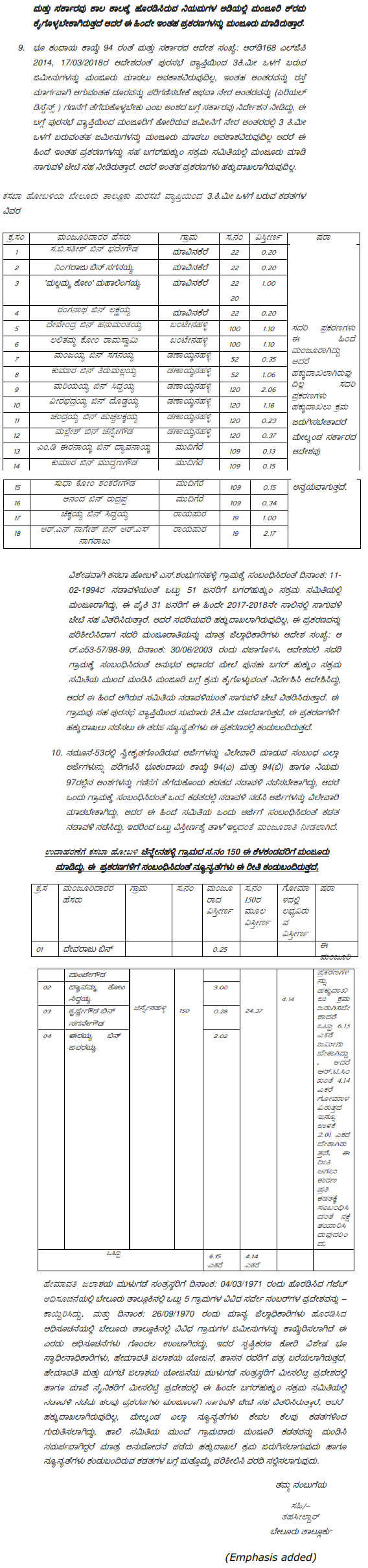
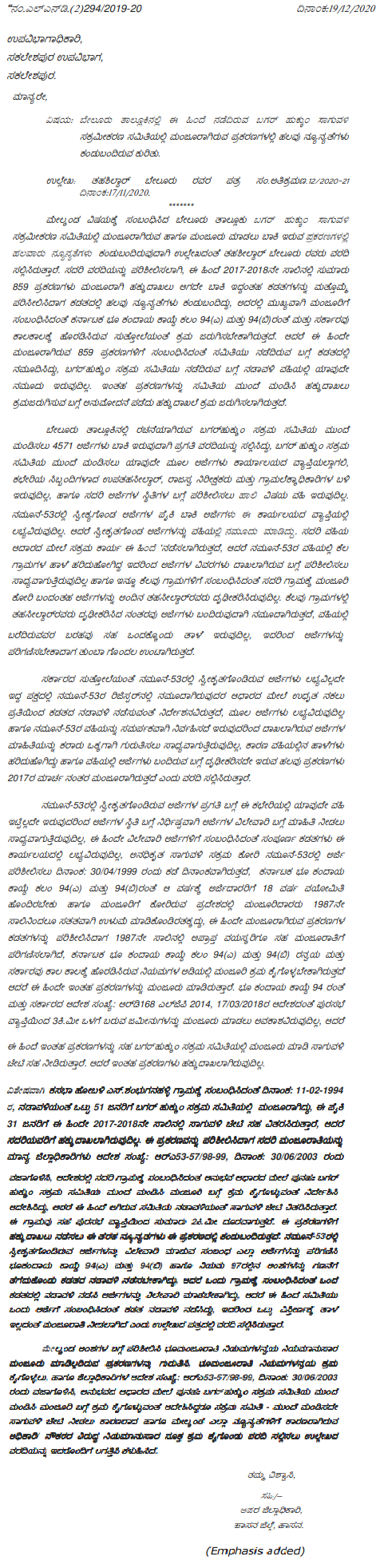
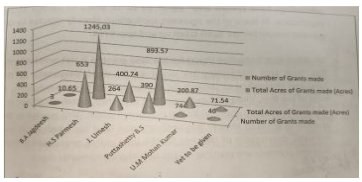
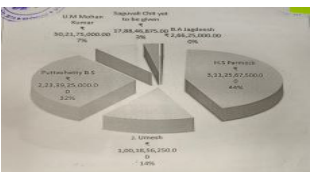
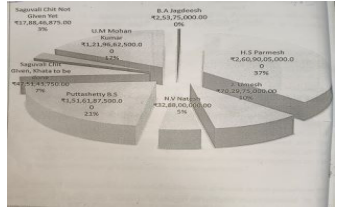
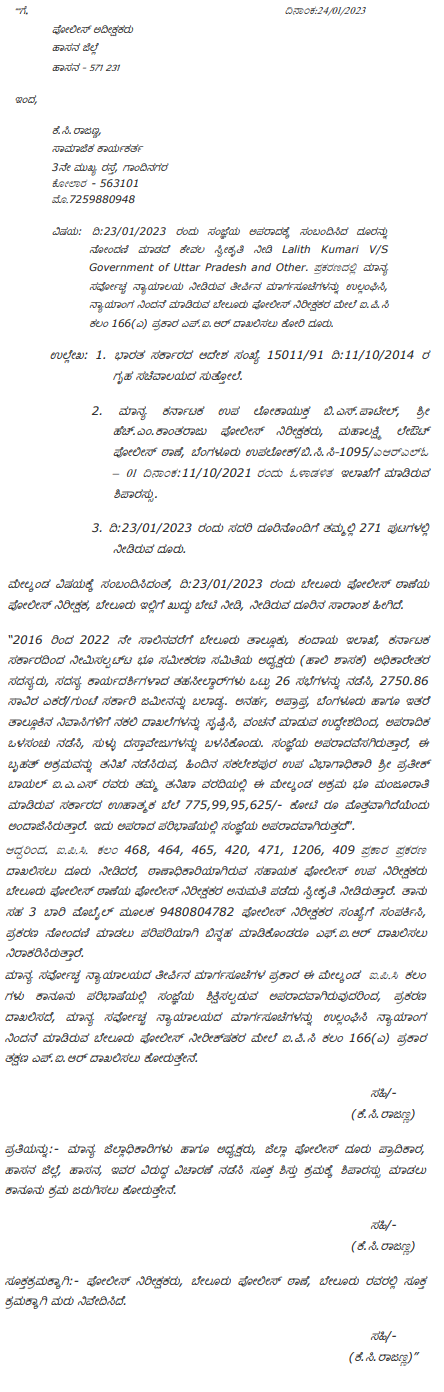
The petitioners at the relevant point in time i.e., between 2016 and 2023 were in the Council, all of them being political entities appointed as Chairman and Members of a particular Committee; the Committee known as Bagair Hukum Saguvali Samithi (hereinafter referred to as ‘the Samithi’ for short). Accused No.1/1st petitioner was at the relevant point in time a Member of the Legislative Assembly of Belur constituency. He was the Chairman of the Samithi. Accused Nos.2 to 4 were its members and accused Nos.5 to 10 were the erstwhile members. Accused Nos.11 to 14 are the Tahsildars who were functioning at the relevant point in time at the said place and were Secretaries of the Samithi. The allegation revolves around the functioning of the said Samithi. It is alleged that the Samithi has created records and bartered away Government lands to an extent of 2750 acres to 1430 bogus beneficiaries, which are valued at more than Rs.750/- crores in the constituency of accused No.1, who was the Chairman of the Samithi. Based upon this allegation, the 2nd respondent/complainant seeks to knock at the doors of the jurisdictional Police to register the complaint. No action was taken. He knocks at the doors of the learned Magistrate invoking Section 200 of the Cr.P.C. seeking a reference for conduct of investigation into the allegations so made. The complaint is referred for investigation to the jurisdictional Police under Section 156(3) of the Cr.P.C., after which a crime comes to be registered in Crime No.98 of 2023 for the afore-quoted offences. This Court by its order dated 16.06.2023 directed that no precipitate action be taken against the petitioners and the same is subsisting even as on date.
3. Heard Sri Ashok Haranahalli, learned senior counsel appearing for the petitioners, Sri B.N. Jagadeesha, learned Additional State Public Prosecutor appearing for respondent No.1 and Sri S. Umapathi, learned counsel appearing for respondent No.2.
4. The learned senior counsel would seek to contend that the complaint is bald and vague. What are the lands that are granted or what are the documents that are fabricated to grant the lands in favour of fictitious persons is not forthcoming from the complaint. If the complaint is so bald, the learned senior counsel would submit that what investigation the police would do, is un-understandable. He would submit that all the allegations are untrue and some of the accused being Government servants, no sanction is accorded under Section 197 of the Cr.P.C. The learned senior counsel would submit that the present complaint is an abuse of the process of law and the members of the Samithi have acted strictly in consonance with law.
5. Per contra, the learned counsel for the complainant would take this Court through the statement of objections so filed by him and reports of Government servants filed by themselves when enquiry was directed to be held by the Assistant Commissioner into the illegalities. The Assistant Commissioner clearly holds that all the lands granted were bogus based upon fake genealogical tree certificates and granted to fake beneficiaries. The Government land in this manner is illegally donated for personal gains of the members of the Chairman, members of the Samithi and officers. He would contend that the question of sanction would arise only after investigation. The matter should be permitted to be investigated.
6. The learned Additional Special Public Prosecutor would toe the lines of the learned counsel for the complainant and would contend that investigation is in progress and in the light of the direction not to precipitate, the inve

AI
The court established that vague complaints do not bar investigations into serious allegations of fraud, particularly in public office contexts.

The power entrusted to public representatives is a trust, and they are accountable for its exercise. Investigations into allegations of misuse of power should be conducted regardless of the status of....

Inherent powers under Section 482 CrPC do not permit quashing proceedings when prima facie evidence of a crime is present, mandating a trial to ascertain truth.

The need for prima facie evidence to proceed against the accused and the limited scope of the court's jurisdiction under Section 482 Cr.P.C.

Point of law: Quash of Criminal proceedings - There cannot be a criminal prosecution against the petitioners herein, which leads to an abuse of process and miscarriage of justice. If the Court fails ....

(1) If once court of competent jurisdiction did not take cognizance of offences when a complaint was made and said order became final, another complaint on same allegations though filed by complainan....
(1) Interim order of stay of investigation during pendency of quashing petition can be passed with circumspection.(2) When investigation by police is in progress, court should not go into merits of a....
The court emphasized that a complaint must disclose an offence and not be frivolous, allowing quashing of proceedings under Section 482 of Cr.P.C. when abuse of process is evident.


The power under Section 482 of Cr.P.C. should be used sparingly and with abundant caution, and criminal proceedings should not be used to settle purely civil disputes.



An indispensable Tool for Legal Professionals, Endorsed by Various High Court and Judicial Officers
Please visit our Training & Support
Center or Contact Us for assistance

Scan Me!
India’s Legal research and Law Firm App, Download now!


For Daily Legal Updates, Join us on :



 Back to top


