
 Back
Back





IN THE HIGH COURT OF KARNATAKA, DHARWAD BENCH
M.G.S. KAMAL, J.
Anwarbhashasab S/o. Mardansab Saragi – Appellant
Versus
The Divisional Controller, NEKRTC – Respondent
Writ Petition No.104702 of 2023(L-ID)
Decided on : 26-07-2024
Employment - Dismissal - Industrial Disputes Act, 1947 - Sections 10(4-A) - The court emphasized the necessity of fair inquiry procedures and the right to be heard, ruling that the dismissal was unjust due to procedural flaws and lack of evidence.
Fact of the Case:
The petitioner, a driver, was dismissed for unauthorized absence after a flawed inquiry process where he was not properly notified of the charges or given a fair chance to defend himself.
Finding of the Court:
The court found that the inquiry was not conducted fairly, as the petitioner was not served with necessary documents, and thus the dismissal was disproportionate and unjust.
Issues: Whether the dismissal was justified based on the inquiry conducted and whether the petitioner was entitled to reinstatement and consequential benefits.
Ratio Decidendi: The court held that a defective inquiry is no inquiry at all, and the principles of natural justice must be upheld in disciplinary proceedings.
Result: The petition is partly allowed; the petitioner is reinstated with consequential benefits.
ORDER :
1. The petitioner – workman is before this Court, seeking for the following reliefs:
(i) Issue a writ, order or direction in the nature of certiorari by quashing the order dated 22.02.2013 bearing Sl. No. EKaRaSaa. HoV. Sibandi: Gaiha/274/12/1092/2012-13 passed by respondent vide Annexure-A, in the interest of justice and equity. (ii) Issue a writ, order or direction in the nature of certiorari by quashing the order dated 30.01.2015 passed in KID No.78/2013 by the Hon’ble Labour Court vide Anneuxre-B, in the interest of justice and equity.
(iii) Issue a writ, order or direction in the nature of mandamus directing the respondent to pay the increments for the year 2013 to 2016, in the interest of justice and equity.
(iv) Pass such other order or orders that are deemed fit under the facts and circumstances of the case.
2. The case of the petitioner is that, he was appointed as a Driver in the respondent – Corporation. That, a charge memo was issued to him alleging that, he was absent for a period of 44 days without sanction of leave between 13.07.2012 to 09.08.2012. An enquiry was conducted by the respondent – Corporation, wherein the petitioner was held to be on unauthorised absence. Consequently, he was dismissed from service, vide order dated 22.02.2013, as per Annexure-A. Aggrieved by the same, the petitioner filed a claim petition before the Labour Court, Hubballi in KID No.78/2013 contending that, the order of dismissal was illegal and the enquiry that was held by the respondent – Corporation was not fair and proper. He also contended that, he was not gainfully employed anywhere and he had no source of income, for his livelihood. Accordingly, sought for setting aside of the order of dismissal, dated 22.02.2013 and prayed for his reinstatement into service with full back wages and continuity of service along with consequential benefits.
3. That, the Labour Court, while answering issue No.1, regarding fairness of the domestic enquiry in the affirmative, however held that the order of dismissal from service was disproportionate to the alleged misconduct.
Accordingly, the Labour Court set aside the order of dismissal and directed the respondent – Corporation to reinstate the petitioner into service with continuity of service without back wages by withholding two increments with cumulative effect, by order dated 31.01.2015. Being aggrieved by the same, the petitioner is before this Court.
4. Learned counsel appearing for the petitioner reiterating the grounds urged in the memorandum of petition submitted that:
(a) The respondent – Corporation had illegally and erroneously refused to grant leave, though sufficient leaves were available to the credit of the petitioner. That, he had through telegram, produced at Ex.W17 had sent the application for leave, as he was suffering from illness and the Doctor had advised him a complete bed rest, and that, though the Labour Court having taken note of the petitioner having made such application through telegram, failed to consider the same. Thereby erred in holding that, the petitioner was unauthorisedly absent.
(b) That, the petitioner was suffering from allergic bronchitis asthma, hypertension with lumber spondylolithasis and since, the petitioner was required to drive the Bus, his neck and back being weak due to the illness, was unable to attend to his duty. The petitioner was thus temporarily incapacitated, as such, he could attend the duty.
(c) That, the order of dismissal from service being one without material evidence and though, the Labour Court has set aside the order of dismissal, has not granted larger relief, which the petitioner was entitled to.
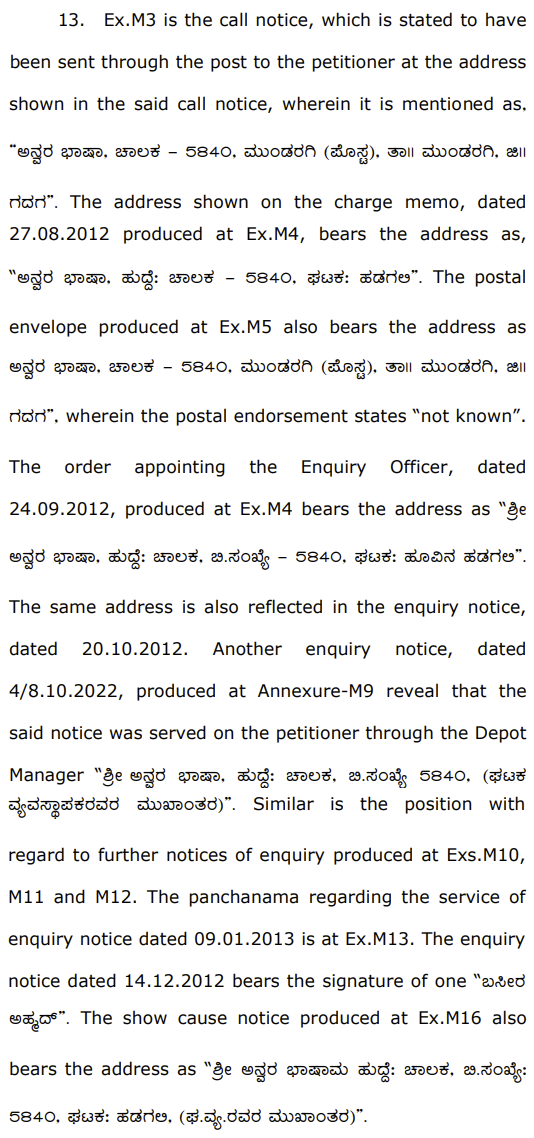
(d) That, the enquiry conducted by the respondent – Corporation was not fair and proper, in that, call notice purported to have been sent by the respondent – Corporation as per Ex.M3 was not served on the petitioner, as it did not contain full & correct postal address. He also submits that, the petitioner was not served with the charge mem
AI
The court established that procedural fairness is essential in disciplinary inquiries, and failure to adhere to this can render dismissals invalid.

Unauthorized absence without prior permission may amount to misconduct, and the principles of natural justice must be complied with in conducting an enquiry under Section 33(2)(b) of the Industrial D....

The court established that a fair domestic enquiry and proportional punishment for habitual unauthorized absence from duty are essential under the Industrial Disputes Act, 1947, and that the burden o....
The court emphasized the distinct nature of proceedings under Section 33(2)(b) and Section 10 of the I.D. Act, and the limited jurisdiction of the court under Article 226 of the Constitution of India....

The termination of employment must be in accordance with the principles of natural justice, and compensation may be awarded in lieu of reinstatement depending on the circumstances.

Prolonged unauthorized absence over 3 years without intimation or proof is gross misconduct justifying removal; Non-participation after ample opportunities does not violate natural justice; Penalty p....
Discretion under Section 11-A must be exercised judiciously; compassion cannot be the basis for modifying penalties in labor disputes involving misconduct.

The court clarified that judicial review in disciplinary matters is limited, focusing on procedural fairness and legality, thereby confirming the legality of dismissal for unauthorized absenteeism.

Modification of penalty that is imposed by disciplinary authority unless, in an exceptional circumstances, is a realm of the powers of Disciplinary Authority. Therefore matter is to be remitted back ....

Dismissal for unauthorized absenteeism upheld as justified despite claims of procedural unfairness due to failure of the petitioner to engage with the enquiry process.



An indispensable Tool for Legal Professionals, Endorsed by Various High Court and Judicial Officers
Please visit our Training & Support
Center or Contact Us for assistance

Scan Me!
India’s Legal research and Law Firm App, Download now!


For Daily Legal Updates, Join us on :



 Back to top


