
 Back
Back





IN THE HIGH COURT OF KARNATAKA AT BENGALURU
M. NAGAPRASANNA, J.
DEBASHISH SINHA S/O ALOK KUMAR SINHA – Petitioner
Versus
STATE OF KARNATAKA – Respondent
Writ Petition No. 15958 of 2024
Decided On : 06-08-2024
Negligence - Culpable Homicide - IPC Sections 304, 304A, 149 - The court interpreted Sections 304 and 304A of the IPC, determining that the petitioners' actions constituted negligence rather than culpable homicide, leading to a charge under Section 304A instead.
Fact of the Case:
The petitioners, members of a homeowners association, faced charges after a child drowned in a swimming pool at their apartment complex. The complaint alleged negligence leading to the child's death due to electric shock in the water.
Finding of the Court:
The court found that the petitioners were negligent in their duties as office bearers of the association, leading to the child's death. It quashed the charge under Section 304 and substituted it with Section 304A, indicating negligence.
Issues: Whether the charges under Sections 304 and 149 of the IPC were applicable to the petitioners given the circumstances of the child's death.
Ratio Decidendi: The court concluded that the absence of intent to kill negated the applicability of Section 304, and the situation warranted charges under Section 304A for causing death by negligence.
Result: The petitioners are charged with the offence under Section 304A and 149 of the IPC.
ORDER :
1. The petitioners/accused 1, 3 to 7 are before this Court calling in question proceedings in C.C. No. 3071 of 2024 pending before the II Additional Chief Judicial Magistrate, Bengaluru Rural District arising out of a crime in Crime No. 74 of 2024 registered for offences punishable under Sections 149 and 304 of the IPC.
2. Heard Sri Sandesh J. Chouta, learned senior counsel appearing for the petitioners and Sri P. Thejesh, learned High Court Government Pleader appearing for respondent No. 1.
3. Facts, in brief, germane are as follows:
The 2nd respondent is the complainant. The petitioners are the Members of Prestige Lake Side Habitat Home Owners Association (‘the Association’ for short), who are voted by the owners of the apartment complex, which manages an apartment complex at Gunjur, Varthur, Bengaluru. It is the case of the prosecution that on 28-12-2023 the daughter of the 2nd respondent slips into the swimming pool in the apartment complex and dies by drowning. On 08-02-2024, a complaint comes to be registered against the President and office bearers of the Association. The police conduct investigation and file a charge sheet against these petitioners and the builder of the apartment complex in C.C. No. 3071 of 2024. The concerned Court takes cognizance of the offence and issues summons. It is then the petitioners are before this Court calling in question the entire proceedings in the criminal case.
4. A coordinate Bench of this Court in a companion petition i.e., Writ Petition No. 8996 of 2024 has stayed further proceedings against the builder on the ground that the builder has handed over the apartment complex to the possession of the Association. The stay is granted on that score and the same is subsisting in the said writ petition is the submission of the learned senior counsel for the petitioners.
5. The learned senior counsel would contend that both the offences alleged which are punishable under Sections 304 and 149 of the IPC are not applicable to the facts of the case at hand. He would contend that there is no intention of the petitioners to commit homicide, which is the necessary requirement of Section 304 of the IPC. He would contend that if further proceedings are permitted to be continued it would become an abuse of the process of law. On the merit of the matter, the learned senior counsel would contend that the complainant has taken close to 40 days to register the complaint that too alleging that his daughter died of electric shock. He would, on this ground, seek quashment of the entire proceedings.
6. The learned High Court Government Pleader would contend that the petitioners are primarily responsible for the negligent act which has led to the death of the child. They are responsible for the affairs of the apartment complex, as they are the office bearers of the Association. The post-mortem report clearly indicates that the death was caused due to drowning of the child in the swimming pool. He would, therefore, contend that the petitioners/office bearers of the Association will have to come out clean in the trial.
7. I have given my anxious consideration to the submissions made by the respective learned counsel and have perused the material on record.
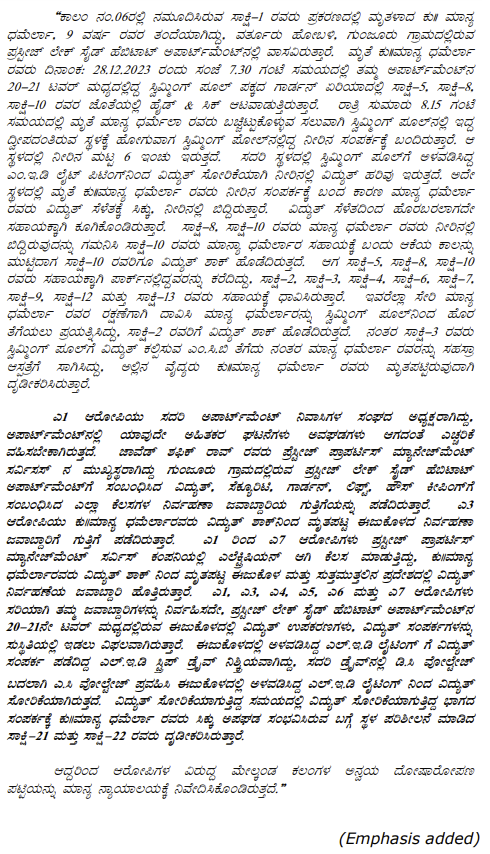
8. The incident happens on 28-12-2023 and the complaint comes to be registered on 08-02-2024. Since the entire issue has now sprung from the complaint, I deem it appropriate to notice the complaint. It reads as follows:
To
Dated: 8-02-2024
Sub-inspector of Police,
Varthur Police Station,
Bengaluru-560087.
From:
Rajesh Kumar Damerla,
S/o D.L. Kantha Rao, Aged 40 years,
Flat 17296,Prestige Lakeside Habitat,
Gunjur Varthur, Bengaluru-560087,
Phone 79955661.
Sub: Request to register FIR against ‘Prestige Lakeside Habitat Home Owners Association’ (PLH-HOA) and its deployed contractor ‘Prestige property management and Services (PPMS), Swimming Pool maintenance team of Prestige Lakeside Habitat Society, Gunjur, Bangalore East and other concern persons who have the knowledge of
AI
The court established that negligence leading to death can be charged under Section 304A of the IPC, rather than culpable homicide under Section 304 when intent is absent.

Criminal liability under IPC for negligence requires direct causation and gross negligence must be established; absence of presence at the incident absolves the petitioner of responsibility.

To establish criminal liability under IPC Sections 338 and 304, the accused must be proven to have directly caused death or injury without another's intervening negligence.

The judgment established the legal principles regarding culpable homicide under Section 304 IPC and rash and negligent act causing death under Section 304A IPC, emphasizing the requisite knowledge an....

The central legal point established in the judgment is the distinction between culpable homicide and death by negligence, as defined in Section 304 and Section 304A of IPC, respectively.

The court found that the appellants' actions during a sudden quarrel constituted culpable homicide not amounting to murder, justifying a conviction under Section 304 Part II of the IPC.

The main legal point established in the judgment is the requirement to prove the constitution of an unlawful assembly and the applicability of vicarious liability under Section 149 of IPC.

Point of law : A court exercising its inherent jurisdiction must examine if on their face, the averments made in the complaint constitute the ingredients necessary for the offence.
The court established that intent and premeditation are crucial to determine murder charges, and lack of such elements may warrant a conviction for lesser culpable homicide under Section 304 Part II.



An indispensable Tool for Legal Professionals, Endorsed by Various High Court and Judicial Officers
Please visit our Training & Support
Center or Contact Us for assistance

Scan Me!
India’s Legal research and Law Firm App, Download now!


For Daily Legal Updates, Join us on :



 Back to top


