
 Back
Back





IN THE HIGH COURT OF KARNATAKA (DHARWAD BENCH)
ANANT RAMANATH HEGDE, J.
Smt. Gourawwa and Ors. - Appellants
Versus
Kadappa and Ors. - Respondents
Regular Second Appeal No. 5898 of 2010 (PAR/POS-), Regular Second Appeal No. 5048 of 2011.
Decided on : 05-10-2023
| Table of Content |
|---|
| 1. court grants partition and finds share. (Para 1 , 2) |
| 2. analyzes ancestral properties and claims. (Para 5 , 11) |
| 3. distinguishes self-acquired from joint family property. (Para 12 , 13) |
| 4. court answers to legal questions framed. (Para 20) |
| 5. resulting order denies other property claims. (Para 21) |
JUDGMENT :
Mr. Anant Ramanath Hegde, J. - Preliminary decree for partition and separate possession is granted holding that plaintiffs No.1 to 5 have 1/6th share each in the suit schedule properties and a decree is also passed against defendant No.3 to render the accounts of Item No.13 property from the year 1994. Cost of the suit is also awarded in favour of the plaintiffs.
2. The First appellate Court confirmed the said judgment and decree, by dismissing in R.A.No.66/2009 on the file of Fast Track Court at Jamkhandi filed by defendants No.1 to 13. The cross-appeal No.99/2009 filed by defendants No.15 and 16 the purchasers of Item No.14 property is also dismissed. Hence, there are two regular second appeals before this Court. RSA No.5898/2010 is by the defendants No.1 to 13 and RSA No.5048/2011 is by defendants No.15 and 16.
3. Both these appeals were admitted on 07.06.2016 to consider the following substantial questions of law:
"Whether the judgment and decree passed by the lower Appellate Court is in conformity with Order 41, Rule 30 of Code of Civil Procedure?"
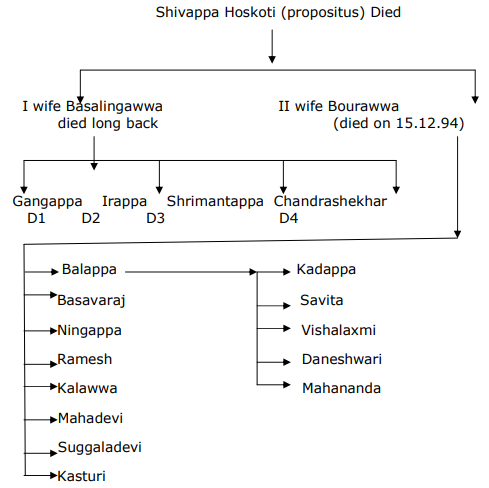
4. The genealogy of the parties is admitted which is as under:
5. Brief facts:
5.1 One Shivappa Hoskoti was the propositus. His first wife Basalingawwa died in 1946. Shivappa Hoskoti had four sons from first wife namely, Gangappa, Irappa, Shrimantapp and Chandrashekhar who are defendants No.1 to 4 in the suit.
5.2 After the demise of the first wife the propositus married second wife Bourawwa. Second wife died on 15.12.1994. From the second wife the propositus Shivappa Hoskoti had four sons namely, Balappa, Basavaraj, Ningappa and Ramesh and four daughters namely, Kalawwa, Mahadevi, Suggaladevi and Kasturi. These children from second wife are arrayed as defendants No.5 to 12. The propositus died in 1980.
5.3 The suit is filed by wife and children of elder son from second wife on the premise that all the properties are ancestral properties and there is no partition in the family after the death of the propositus. Thus, the plaintiffs claimed 1/6th share in the suit schedule properties. The suit is resisted by defendants No.2 to 4 by filing one set of written statement. The suit is also resisted by legal representatives of defendant No.1 Additional written statement is also filed pursuant to the amended plaint.
5.4 Defendant No.5 filed a separate written statement and defendants No.6 to 12 adopted the written statement filed by defendant No.5. Defendants No.15 and 16 contested the suit in respect of Item No.13 property which is a petrol bunk. Defendants No.13 and 14 contested the suit in respect of Sy.No.136 measuring 6 acres of land on the premise that they have purchased the property.
5.5 Defendants No.13 and 14 have not filed any appeal against the aforementioned judgment and decree. Defendants No.1 to 12 have contested the case on the premise that there is already a previous partition in the family. The defendants No.15 and 16 contested the case on the premise that the property purchased by them namely petrol bunk is the self-acquired property of their vendors.
5.6 The trial Court rejected the contention of the defendants and has held that previous partition is not established. In the appeal filed by defendants No.1 to 13 and also in the cross-objection filed by defendants No.15 and 16, the First Appellate Court by dismissing the appeal as well as the cross-objection has accepted the finding of the trial Court and dismissed the appeal and cross-appeal.
6. The learned counsel for the appellants would contend that the petrol bunk i.e. Item No.13 property purchased by defendants No.15 and 16 under registered sale deed of the year 1998 from defendants No.3 and 4 cannot be a
AI
The principles of self-acquired versus joint family property were affirmed, establishing the burden of proof on those claiming joint ownership, and determining that mere possession does not suffice f....

In joint family property disputes, the burden of proof lies with the party claiming self-acquisition, and failure to substantiate claims results in the affirmation of joint property status.

Daughters became coparceners under Hindu Succession (Tamil Nadu Amendment) Act, 1989, allowing them equal rights in joint family properties.

The burden of proof lies on the person claiming property as self-acquired to establish that it was acquired without the aid of joint family funds.
Female legal heirs are entitled to equal shares in ancestral properties, as established in 'Vineeta Sharma vs. Rakesh Sharma & Others', and the recent amendment to Section 23 of the Hindu Succession ....
Joint family properties are established through contributions from family income, and the validity of a gift deed in such cases necessitates consent from all joint owners.

In joint family property disputes, a claimant asserting self-acquisition must provide substantial proof, while joint ancestral claims are upheld unless clearly disproven.
The court affirmed that items 1 and 2 of suit properties are ancestral, and items 3 to 11 are self-acquired, highlighting the plaintiffs' burden to prove family property claims.
The judicial presumption of joint ownership requires proof of a family nucleus, and mere existence of a joint family does not automatically classify all properties as joint.
A party claiming self-acquisition of property within a joint family must provide substantial evidence; failure to do so, combined with existing partition evidence, undermines their claims.



An indispensable Tool for Legal Professionals, Endorsed by Various High Court and Judicial Officers
Please visit our Training & Support
Center or Contact Us for assistance

Scan Me!
India’s Legal research and Law Firm App, Download now!


For Daily Legal Updates, Join us on :



 Back to top


