
 Back
Back





IN THE HIGH COURT OF KARNATAKA, DHARWAD BENCH
HANCHATE SANJEEVKUMAR, J.
Smt. Surekha, W/o. Prakash Jadhav and Ors. – Appellants
Versus
Shri. Sanjay, S/o. Dasharath Jadhav and Ors. – Respondents
Regular First Appeal No. 100127 of 2017 (PAR/POS)
Decided On : 24-06-2025
| Table of Content |
|---|
| 1. challenge to the trial court's partition decree. (Para 1 , 3) |
| 2. ancestral properties and family genealogy. (Para 4 , 5 , 6) |
| 3. self-acquired property claim by defendants. (Para 7 , 16) |
| 4. issues framed for the trial court. (Para 8 , 10) |
| 5. arguments presented by both parties. (Para 12 , 13) |
| 6. points for consideration by the court. (Para 14 , 15) |
| 7. determination of independent income. (Para 18 , 19) |
| 8. modification of prior findings. (Para 20) |
| 9. court's final order. (Para 21) |
JUDGMENT :
(HANCHATE SANJEEVKUMAR, J.)
This Regular First Appeal is filed by defendant Nos.1 to 4 challenging the judgment and decree passed in O.S.No.55/2006 dated 31.01.2017 on the file of the Principal Senior Civil Judge, Chikodi (for short, ‘the Trial Court’), thereby, the suit filed for partition and separate possession is decreed with costs. Being aggrieved by granting of decree for partition in respect of suit properties bearing R.S.No.101/2 measuring 22-guntas, R.S.No.102/2 measuring 22 guntas, R.S.No.104/3 measuring 27 guntas and R.S.No.104/2 measuring 0.5 guntas (for short, ‘ the appeal properties’), the present appeal is filed.
2. For the sake of convenience and easy reference, the parties are referred to as per their rankings before the Trial Court.
3. The present appeal is confined to only being aggrieved by decreeing the suit for prior partition in the lands bearing R.S.No.101/2 measuring 22-guntas out of 4 acre 29 guntas, R.S.No.102/2 measuring 22 guntas out of 3 acre 22 guntas, R.S.No.104/3 measuring 22 guntas out of 4 acre 05 guntas and R.S.No.104/2 measuring 6 guntas (for short, ‘appeal properties’).
4. The plaintiffs have filed the suit in O.S.No.55/2006 for partition and separate possession of the suit schedule-A properties by metes and bounds, by stating the genealogy as follows :
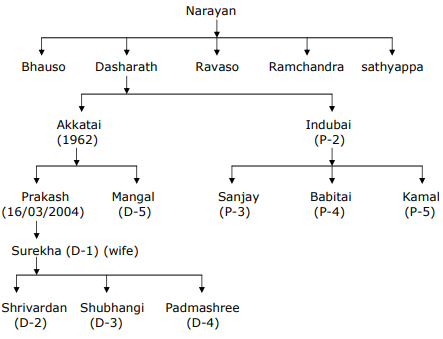
5. It is stated that all the suit properties are ancestral and joint family properties. One Narayan is the original propositus, who has five sons as above stated in the genealogy. Among them, Dasharath, who is plaintiff No.1, has two wives. After the death of 1st wife Akkatai in the year 1962, plaintiff No.1 has married Indubai i.e., plaintiff No.2 as 2nd wife. Plaintiff Nos.3 to 5 are children of plaintiff Nos.1 and 2. One Prakash and defendant No.5 are children of Dasharath-plaintiff No.1 through 1st wife Akkatai. Defendant No.1 is the wife of Prakash and defendant Nos.2 to 4 are children of Prakash and defendant No.1. When this being the joint and Hindu Undivided Family, and since the properties are ancestral and joint family properties, the plaintiffs have filed the suit for partition and separate possession.
6. In response to suit summons, defendant Nos.1 to 4 appeared through their advocate and defendant No.1 filed written statement, which is adopted by defendant Nos.2 to 5. It is stated that all the suit properties are joint family properties of plaintiffs and defendants.
7. It is the case of defendant No.1 that the above said appeal properties are the self acquired properties of defendants. That the plaintiffs have no share or right in the said appeal properties. It is submitted that the husband of defendant No.1 and father of defendant Nos.2 to 4 namely Prakash, out of his self earning, had purchased the above said appeal properties from Sathyappa, who is the last son of original propositus Narayan in the year 1998. As the said husband of defendant No.1 namely Prakash, was Secretary of the Gram Panchayat. Being Secretary of Gram Panchayat, he was having sufficient salary, separate residence, was cultivating sugarcane crop separately, transporting the same to sugar factory and was receiving price for supplying sugarcane crop separately. Therefore, the above said appeal properties are self acquired properties of Prakash. Therefore, prays to dismiss the suit.
8. Based on the pleadings of the parties, the Trial Court has framed the following issues:
ISSUES
1. Whether plaintiffs prove that, the suit properties are joint family properties?
2. Whether def
AI
A party claiming property as self-acquired must prove independent income, which can overcome the presumption of joint family property status.

A party claiming self-acquisition of property within a joint family must provide substantial evidence; failure to do so, combined with existing partition evidence, undermines their claims.
In joint family property disputes, a claimant asserting self-acquisition must provide substantial proof, while joint ancestral claims are upheld unless clearly disproven.

The absence of evidence proving the joint family status of properties allows a presumption that they are individual assets; thus, plaintiffs' claim for partition is dismissed.

The burden of proof lies on the party asserting that property is joint family property, and mere existence of a joint family does not presume property to be joint.

The burden of proof lies on the person claiming property as self-acquired to establish that it was acquired without the aid of joint family funds.
In joint family property disputes, the burden of proof lies with the party claiming self-acquisition, and failure to substantiate claims results in the affirmation of joint property status.
The plaintiff must prove the existence of a joint family nucleus to establish claims over joint family properties; mere relation does not imply entitlement.

The main legal point established in the judgment is that properties acquired from individual earnings of family members cannot be treated as joint family properties unless deliberate abandonment and ....



An indispensable Tool for Legal Professionals, Endorsed by Various High Court and Judicial Officers
Please visit our Training & Support
Center or Contact Us for assistance

Scan Me!
India’s Legal research and Law Firm App, Download now!


For Daily Legal Updates, Join us on :



 Back to top


