
 Back
Back





IN THE HIGH COURT OF JUDICATURE AT MADRAS
V. SIVAGNANAM, J.
V. Ravichandran - Appellant
Versus
Velappa Gounder @ Velappan (Deceased) - Respondent
A.S. No. 278 of 2017
Decided On : 04-03-2025
JUDGMENT :
1. Aggrieved over the Judgement and Decree dated 31.08.2016 passed in O.S.No.51 of 2013 on the file of the Additional District Court, Namakkal, the plaintiff has preferred the first appeal.
2. For the sake of convenience, the parties are referred to as per their rankings in the trial Court.
3. Suit for partition and separate possession.
4. The plaintiff in O.S.No.51 of 2013 on the file of the Additional District Court, Namakkal, is the appellant herein.
5. The plaintiff's case is as follows:
The plaintiff and the second defendant are the sons of the first defendant Vellappa Gounder @ Vellappan. The first defendant Vellappa Gounder @ Vellappan, in a partition with his brother held on 26.08.1966, got “A” schedule property. The plaintiff and the second defendant are the legal heirs of the first defendant Vellappa Gounder @ Vellappan. From the income of the abovesaid ancestral property, the plaint schedule property and other properties were purchased in the name of the first defendant Vellappa Gounder @ Vellappan, specifically, the properties were purchased in his name on 20.02.1969 and 21.04.1998. These properties were jointly enjoyed by all persons. The second defendant went to London in the year 2003. The expenses for the travel were met by the plaintiff by obtaining a loan from the third person. The plaintiff himself worked at Bakrin from 1990 to 1998. To clear the family debts, the properties obtained by the first defendant Vellappa Gounder @ Vellappan by way of partition dated 26.08.1966 (A schedule property) and the properties purchased in the name of the first defendant on 20.02.1969 and 21.04.1998 were sold to one Subramaniam by way of sale deed dated 02.09.2010. From the sale proceeds, family debts were cleared. In the plaint schedule properties, the plaintiff and the defendants 1 & 2 are equally entitled for 1/3rd share. The second defendant's marriage was held on 27.03.2013 after that there is a difference of opinion between them.
5.1. On perusing the encumbrance certificate with regard to the properties, the plaintiff came to know that the first defendant settled a portion of property in favour of the second defendant without his knowledge on 21.04.2005. The settlement deed is not valid. Now, the plaint schedule property is in common enjoyment of all. Therefore, the plaintiff demanded partition. Since the defendants have not agreed for partition, the plaintiff filed the suit for partition claiming 1/3rd share in the plaint schedule properties.
6. The defendants contested the suit and filed a common written statement. In the written statement, specifically, they denied the plaint allegation and contended that in the partition held on 26.08.1966, the first defendant got “A” schedule properties, from which, there was no income. The first defendant went to Bakrin on 27.02.1979 and he worked there till 02.01.1990 from the income earned by the first defendant, he purchased the plaint schedule property and other properties on 28.11.1984 and 21.04.1998. It is the self acquired property not joint family property and not purchased from the income of the ancestral property obtained by way of partition. In the sale deed executed to Subramaniyam on 02.09.2010 and 29.11.2010, it was specifically mentioned that the properties were self acquired properties of the first defendant, in which, the plaintiff also signed the document. Hence, the plaintiff has no right over the plaint schedule properties and is not entitled for partition and pleaded to dismiss the suit with costs as it is not maintainable.
7. The trial Court, upon the above pleadings, framed the following issues.
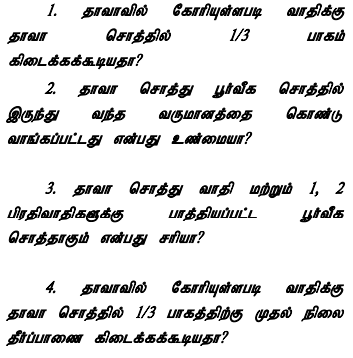
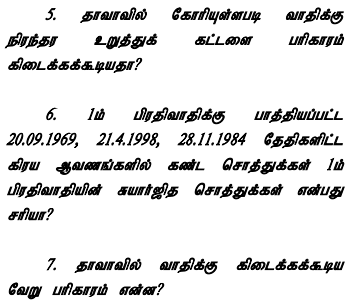
8. Before the trial Court, the plaintiff examined himself as PW1 and examined other two witnesses as Ex.PW2 & Ex.PW3 and also filed 8 documents as Exs.A1 to A8. The second defendant examined himself as DW1 and examined another witness as DW2 and no documents were marked. Further 3 documents filed as X1 to X3.
9. The trial Court, upon considering the oral and docume
The burden of proof lies on the party asserting that property is joint family property, and mere existence of a joint family does not presume property to be joint.

The plaintiff must prove the existence of a joint family nucleus to establish claims over joint family properties; mere relation does not imply entitlement.
In a partition suit, the burden of proving that property standing in an individual's name is joint family property lies upon the party asserting it, requiring proof of a sufficient ancestral nucleus.....

The burden of proof lies on asserting self-acquisition when joint family property is claimed, as evidenced in the judgment affirming the trial court's findings on property character.
Daughters became coparceners under Hindu Succession (Tamil Nadu Amendment) Act, 1989, allowing them equal rights in joint family properties.
The absence of evidence proving the joint family status of properties allows a presumption that they are individual assets; thus, plaintiffs' claim for partition is dismissed.

In joint family property disputes, the burden of proof lies with the party claiming self-acquisition, and failure to substantiate claims results in the affirmation of joint property status.
The main legal point established in the judgment is that properties acquired from individual earnings of family members cannot be treated as joint family properties unless deliberate abandonment and ....
The judgment established the principles of joint family property, partition, and the burden of proof in establishing separate income for property acquisition.



An indispensable Tool for Legal Professionals, Endorsed by Various High Court and Judicial Officers
Please visit our Training & Support
Center or Contact Us for assistance

Scan Me!
India’s Legal research and Law Firm App, Download now!


For Daily Legal Updates, Join us on :



 Back to top


