
 Back
Back





IN THE HIGH COURT OF KARNATAKA AT BENGALURU
K. V. ARAVIND, J.
Sri Sreeramaiah S/o Kunti Narayanappa - Appellant
Vs.
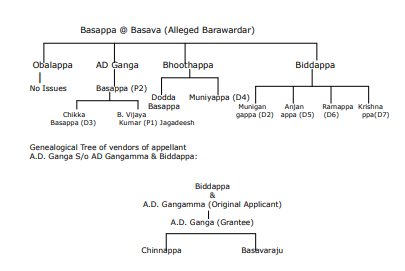
Sri Vijay Bhaskar, S/o A.D. Basappa - Respondent
Regular Second Appeal No.2912 Of 2006
Decided On : 02-05-2025
| Table of Content |
|---|
| 1. claim for partition based on familial relations. (Para 5 , 6 , 7 , 8) |
| 2. arguments regarding property rights and notice issues. (Para 10 , 12 , 13 , 14 , 16 , 17) |
| 3. court's analysis of parties' claims and requirements. (Para 19 , 20 , 21 , 22 , 23 , 24) |
| 4. no presumption of joint family property without evidence. (Para 27 , 28) |
| 5. final order remanding the case for further evidence. (Para 30) |
JUDGMENT :
K. V. ARAVIND, J.
Heard Sri. R. Subramanya, learned counsel for the appellant, Sri A. Krishna Bhat, learned counsel for respondent No.1, Sri V. Subhash Reddy, learned counsel for respondent No.3 and Sri. M.S. Venugopal, learned counsel for proposed R1(a).
2. This appeal is against the judgment and decree dated 19.04.2006 in R.A. No. 59/2001, passed by the Presiding Officer and Additional District Judge, Fast Track Court-IV, Kolar, dismissing the appeal and confirming the judgment and decree dated 24.07.1999 in O.S. No.468/1995, passed by the Additional Civil Judge (Jr. Dn.), Kolar.
3. This Court admitted the appeal to consider the following questions of law,
"(a) Whether the Courts below have committed an error in decreeing the suit when the land of A.D. Gangappa is sold on 27.03.1995 in favour of the appellant based on an order of regrant?
(b) Whether the Courts below have committed an error in decreeing the suit for partition in respect of inam land in the absnece of there being any re-grant order in favour of the inamdar - A.D. Basappa?"
4. By order dated 11.02.2025, additional question of law was framed as under,
" Whether in the facts and circumstances of the case and in light of the additional evidence and sale deed dated 27.03.1995, the matter requires re-consideration by the trial Court?"
5. The parties are referred to by their respective ranks as they appeared before the trial court. The plaintiffs instituted a partition suit, seeking a 1/3rd share in the property bearing Survey No. 63, which measures 1 acre 7 guntas and 8 guntas of Phut Kharab, out of a total extent of 2 acres 23 guntas, situated at Narasapur, Kolar Taluk and District.
6. The case of the plaintiffs is that the schedule property is Gasti Inam land. Basappa @ Basava was a Barawardar, who had four sons, namely, Obalappa, A.D.Ganga, Boothappa, and Biddappa. Obalappa died without legal representatives, and A.D. Ganga died leaving behind his son Basappa, the second plaintiff. B. Vijaya Baskar, the first plaintiff, is the son of Plaintiff No. 2. Boothappa died leaving behind his son Doddabasappa and others. Biddappa died leaving behind his son Munigangappa, the second defendant. According to the averments, after the deaths of Basappa and Obalappa, their sons, namely, A.D. Ganga, Boothappa, and Biddappa, succeeded to the property. The second plaintiff succeeded to the share of A.D. Ganga through his father. The first plaintiff also succeeded to the share of A.D. Ganga through his father. The second defendant succeeded to his father Biddappa's share, while the third defendant succeeded through his father Boothappa's share. The plaintiffs, along with defendants Nos. 2 and 3, have claimed three equal shares in the suit schedule property.
7. It is evident from the pleadings that 1 acre 8 guntas of land was granted in favour of one Moogappa, and the remaining 1 acre 7 guntas, along with 8 guntas of Phut Kharab, belongs to the plaintiffs and defendants Nos. 2 and 3. The plaint averments state that the name of the grandfather of the first plaintiff and the father of the second plaintiff, A.D. Ganga, appears in the cultivator's column of the RTC. The first plaintiff, second defendant, and third defendant are jointly cultivating the land.
8. It is further the case of the plaintiffs that defendant Nos. 1 and 2 are colluding inter se and fabricating false records, attempting to alienate the suit schedule property. Defendant Nos. 1 and 2 are stated to be represented by counsel, whereas defendant Nos. 3 to 5 have been placed ex-parte. The trial court recorded the evide
AI
There is no presumption of joint family property without substantial evidence proving such ownership; the burden of proof lies on the party asserting joint ownership.

A sale of joint family property executed by the Kartha may be valid unless evidence proves it was not for legal necessity, thereby affecting the rights of family members claiming share.
Proof of a joint family property requires demonstration of a nucleus to substantiate claims; mere assertion without evidence is insufficient.
The main legal point established is the application of Sec. 41 of the Transfer of Property Act, the exclusion of contrary evidence, and the principles of Hindu Law regarding co-parcenary property and....
A plaintiff can only establish entitlement to partition if they demonstrate joint ownership and the failure to do so, particularly through admissions and evidence of prior partition, warrants dismiss....

Joint family property retains its character unless proven otherwise; sales by co-parceners without all parties' consent do not extinguish shared rights.
The court reaffirmed that a sale deed executed for family and legal necessity by a joint family member is binding, barring challenge by family members after significant delay without sufficient cause....
The burden of proof to establish joint family property lies with the plaintiffs, which remains unchanged even when defendants do not contest the suit.

A claim of partition in Hindu joint family property must be substantiated with credible evidence; conjecture does not suffice.

A plaintiff must provide sufficient evidence to establish joint family ownership in partition cases; lack of such evidence leads to dismissal of claims.



An indispensable Tool for Legal Professionals, Endorsed by Various High Court and Judicial Officers
Please visit our Training & Support
Center or Contact Us for assistance

Scan Me!
India’s Legal research and Law Firm App, Download now!


For Daily Legal Updates, Join us on :



 Back to top


