
 Back
Back





IN THE HIGH COURT OF KARNATAKA AT BENGALURU
K.S. HEMALEKHA, J.
Malleshappa, S/o Late Sannegowda – Appellant
Versus
Puttamma, D/o Late Rangappa – Respondent
Regular First Appeal No.1051/2022 (PAR/POS)
Decided on : 04-08-2025
| Table of Content |
|---|
| 1. final order and dismissal of the appeal (Para 1 , 10) |
| 2. factual background of property ownership (Para 2 , 3 , 4 , 5) |
| 3. court's reasoning on property classification (Para 6 , 11 , 12 , 13 , 14 , 15) |
| 4. arguments from both appellants and respondents (Para 8 , 9) |
j
JUDGMENT :
K.S. HEMALEKHA, J.
The present regular first appeal is preferred by the plaintiffs assailing the judgment and decree dated 05.03.2022 in O.S.No.123/2014 on the file of the Senior Civil Judge and JMFC, Sira (hereinafter referred to as 'the trial Court' for short). By the impugned judgment and decree the trial Court dismissed the suit for partition and separate possession.
2. The brief facts of the case are as follows:
-
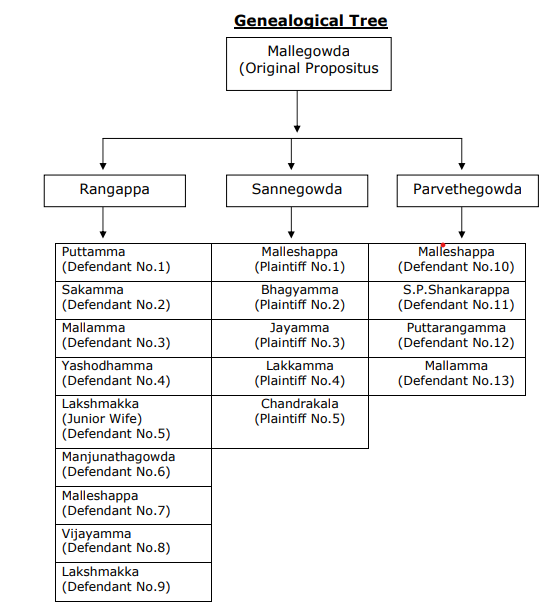
3. The original propositus had 3 children Rangappa, Sannegowda and Parvethegowda. The plaintiffs are the children of Sannegowda. Defendant Nos.1 to 9 are the children of Rangappa. Defendant Nos.10 to 13 are the children of Parvethegowda.
-
4. The suit was for partition and separate possession seeking 1/3rd share in Sy.No.88 measuring 7 acres 33 guntas situated at Mudigere Kaval, Kasaba Hobli, Sira Taluk (hereinafter referred to as 'the suit property' for short). The plaintiffs aver that the suit property was purchased under a registered sale deed in the name of their brother late Parvathegowda since Rangappa and Sannegowda were illiterates and Parvathegowda was an educated person. It is averred that during the lifetime of Rangappa, Sannegowda and Parvathegowda, the suit property was in their joint possession and enjoyment and hence, they are entitled for 1/3rd share in the suit property.
5. Pursuant to the suit summons issued by the trial Court, defendants Nos.1 & 3 were placed exparte. During the pendency of the suit, defendant No.2 died and her legal representatives were brought on record as defendant Nos.2(a) to (e) and defendant Nos.4 to 14 have appeared through their counsel and filed their written statement interalia admitting the relationship between the parties. The defendants contended that the suit property is not the ancestral property of the plaintiffs and defendant Nos.1 to 3, but an exclusive self acquired property of Parvathegowda, who is the father of defendant Nos.10 to 13. It was averred that the suit property was a Government land, which was granted in favour of one Giriyanna. During the lifetime of Giriyanna, he transferred his right and interest over the suit property in favour of Parvathegowda and pursuant to which, the name of Parvathegowda was entered in the revenue records. It is averred that from the date of the purchase, the name of Parvathegowda has been entered and he was in possession of the suit property.
-
6. The trial Court based on the pleadings, framed necessary issues. The trial Court, by considering the oral and documentary evidence, observed that the plaintiffs, who seek for partition and separate possession, have failed to establish that the plaintiffs and defendant Nos.1 to 13 are the joint family members and they are in joint possession and enjoyment of the suit property. The trial Court observed that the suit property is not the ancestral property, but the self-acquired property of Parvathegowda and by the judgment and decree dismissed the suit.
-
7. Heard the learned counsel appearing for the appellants and learned counsel appearing for the respondent Nos.9 to 13.
8. Learned counsel appearing for the appellants submits that the trial Court has failed to consider that the defendants have not produced any sale deed to indicate that the suit property was purchased by Parvathegowda. It is submitted that the purchase in the name of Parvathegowda is for the benefit of the joint family and not the exclusive property of Parvathegowda, which was erroneously considered by the trial Court. Learned counsel submits that the suit property was the ancestral property and the appellants/plaintiffs are entitled for 1/3rd share.
-
9. Per contra, learned counsel appearing for the respondent Nos.9 to 13 justifies the ju
AI
Proof of a joint family property requires demonstration of a nucleus to substantiate claims; mere assertion without evidence is insufficient.

A property must reflect active participation from all family members to be considered joint family property; claims based on mere assertions are insufficient for legal recognition.

A party claiming self-acquisition of property within a joint family must provide substantial evidence; failure to do so, combined with existing partition evidence, undermines their claims.
In joint family property disputes, a claimant asserting self-acquisition must provide substantial proof, while joint ancestral claims are upheld unless clearly disproven.

(1) Hindu Law – Partition – After joint family property has been distributed in accordance with law, it ceases to be joint family properties and shares of respective parties become their self-acquire....
A plaintiff can only establish entitlement to partition if they demonstrate joint ownership and the failure to do so, particularly through admissions and evidence of prior partition, warrants dismiss....
Oral relinquishments of joint family property rights are insufficient without written documentation; statutory rights persist despite prior agreements made by family members.
Joint family properties are established through contributions from family income, and the validity of a gift deed in such cases necessitates consent from all joint owners.

The burden of proof lies on the party alleging the existence of joint family property to demonstrate the sufficient joint family nucleus, and the presumption is that property held by the Kartha is jo....

The burden of proof lies on the party asserting that property is joint family property, and mere existence of a joint family does not presume property to be joint.



An indispensable Tool for Legal Professionals, Endorsed by Various High Court and Judicial Officers
Please visit our Training & Support
Center or Contact Us for assistance

Scan Me!
India’s Legal research and Law Firm App, Download now!


For Daily Legal Updates, Join us on :



 Back to top


