


 Back
Back





2025 Supreme(Kar) 855
IN THE HIGH COURT OF KARNATAKA, KALABURAGI BENCH
T.M. NADAF, J.
Kalavati, W/o. Srimanth and Ors. – Petitioners
Versus
The State of Karnataka, Through Kalaburagi Sub-Urban Police Station, Represented By Addl. SPP, High Court of Karnataka, Kalaburagi Bench and Anr. – Respondents
Criminal Petition No. 200541 of 2025 (482(Cr.PC)/528(BNSS)
Decided On : 22-05-2025
For the Petitioners:Sri Shivasharana Reddy, Advocate
For the Respondents: Sri G.B. Yadav, HCGP.
Prosecution cannot proceed against individuals absent specific allegations; mere familial ties do not implicate individuals in criminal conduct.
Headnote:(A) Indian Penal Code - Sections 376(2)(n), 109, 420 read with Section 149 - Quashing of proceedings - Petitioner seeks to quash proceedings initiated for serious offences based on allegations that do not implicate them directly - Petition allowed as the allegations lack specificity against the petitioners, constituting abuse of process of law. (Paras 6, 8 and 9) (
Facts of the case:
The petitioner sought to quash the proceedings based on allegations of sexual intercourse based on a false promise of marriage against accused No.1. Petitioners were merely opposing the marriage.) (
Findings of Court:
Continuation of proceedings against petitioners lacking specific allegations is an abuse of the judicial process.) (
Issues: Whether the complainant's allegations against the petitioners constitute enough grounds for prosecution.) (
Ratio Decidendi: The court emphasized that allegations lacking direct involvement of petitioners must not lead to prosecution, as it would contravene justice principles.) (
Result: Petition allowed; proceedings quashed.)
| Table of Content |
|---|
| 1. factual background of the case. (Para 1 , 2 , 3) |
| 2. arguments presented by both parties. (Para 4 , 5 , 6) |
| 3. observations on consent and criminal liability. (Para 7 , 8) |
| 4. legal conclusion on abuse of process. (Para 9) |
ORDER :
(T.M. NADAF, J.)
This petition is filed by the petitioners seeking to quash the proceedings in Crime No.372/2023 registered by Sub- Urban Police Station, Kalaburagi City, for the offences punishable under Sections 376 (2)(n), 109 , 420 read with Section 149 of IPC . The police having completed the investigation, filed charge-sheet, which is now committed to the Sessions Court and pending in S.C.No.17/2025 on the file of the V Additional District and Sessions Judge, Kalaburagi for the offences punishable under Sections 376 (2)(n) and 109 read with Section 149 of IPC . Though the offence under Section 420 of IPC was registered while filing of the FIR, the same has been dropped while filing charge-sheet.
2. The factual matrix leading to the prosecution case are as under:
The complainant/victim was working as a Staff Nurse at Bengaluru. She developed physical intimacy with the accused No.1 who is her relative. She filed a complaint against the accused on 25.12.2023 which reads as under:
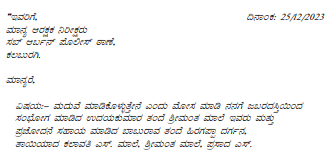
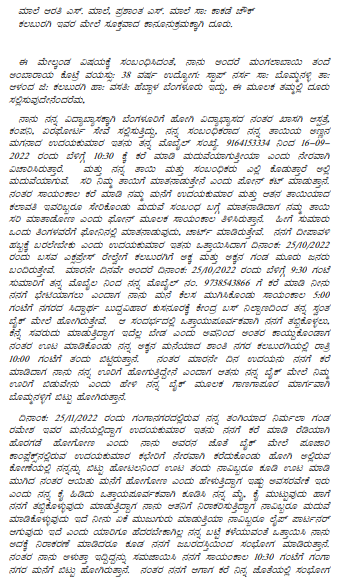
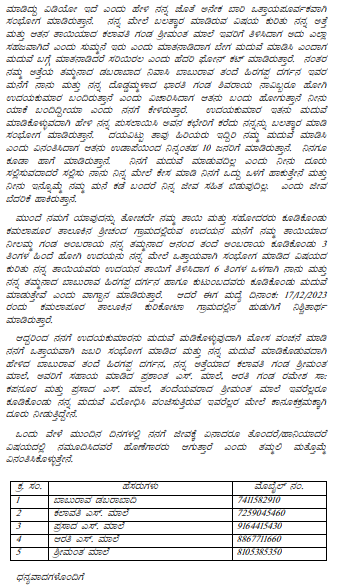
3. As per the averments alleged in the complaint, the accused No.1 on a promise of marriage had sexual intercourse with the complainant and subsequently he denied to marry her. As could be seen from the last paragraph of the complaint, it is alleged that the petitioners are opposing to the marriage of the complainant with the accused No.1. The entire allegations are against accused No.1. These petitioners were not at all in the picture when the alleged acts committed by the accused No.1 and even according to the complaint averments, the allegation made against the petitioners is that, they are opposing to the marriage of the accused No.1 with the complainant.
4. Heard Sri.Shivasharana Reddy, learned counsel appearing for the petitioner and Sri. G.B.Yadav, learned HCGP for the respondent-State. The respondent No.2-complainant though served is un-represented.
5. Learned counsel for the petitioner Sri.Shivasharana Reddy, vehemently submits that, on perusal of the entire complaint and the charge-sheet material it clearly goes to show that, the petitioners are not at all involved in any of the offences alleged against them. There cannot be any abetment as alleged by the police under Section 109 of IPC . The offence alleged under Section 376 of IPC is even according to the complaint and the charge-sheet material is against accused No.1 since he had sexual intercourse with the complainant on a false pretext of marriage. In these circumstances, registration of a case and continuation of the proceedings against the petitioners herein is an abuse of process of law and amounts to miscarriage of justice. To buttress his arguments, he relies on a Judgment of Hon’ble Apex Court in the case of Mahesh Damu Khare Vs. The State of Maharastra and another, in Special Leave Petition (Crl.) No.4326/2018 disposed of on 26.11.2024, wherein, the Hon’ble Apex Court has considered the case of the petitioner and quashed the proceedings even in respect of the person against whom charge-sheet has been filed under Section 376 of IPC . Accordingly, he prays to allow the petition.
6. Learned HCGP refuting the submissions of the petitioners vehemently submits that, the charges are serious in nature and the petitioners are close relatives of the accused No.1 and are creating obstacle in the marriage of the complainant with the accused No.1, all are equally responsible for the commission of the offences. Accordingly, he seeks to dismiss the petition.
7. The Hon’ble Apex Court at paragraph Nos.28 to36 has held as under:
28. Moreover, even if it is assumed that a false promise of marriage was made to the complainant initially by the appellant, even though no such cogent evidence has been brought on record before us to that effect, the fact that the relati















