
 Back
Back





IN THE HIGH COURT OF KARNATAKA, AT DHARWAD
S.R. KRISHNA KUMAR, C.M. POONACHA, JJ.
Shri. Balasab S/o Bharamu Jiragale - Appellant
Versus
Shri. Appasab S/o Annappa Mali - Respondent
Regular First Appeal No. 100568 of 2023 (PAR/POS)
Decided on : 12-09-2025
JUDGMENT :
S.R. KRISHNA KUMAR, J.
This appeal by the defendant No.4 in OS No.71/2016, directed against the impugned judgment and decree dated 16.06.2023 passed by the Principal Senior Civil Judge, Athani (for short, ‘the Trial Court’), whereby, the said suit filed by the respondent Nos.1 to 3 against the appellant/defendant No.4 and respondent Nos.4 and 5/defendant Nos.1 and 2 was decreed in favour of the plaintiffs against the defendants.
2. Briefly stated, the facts giving rise to the present appeal are as under;
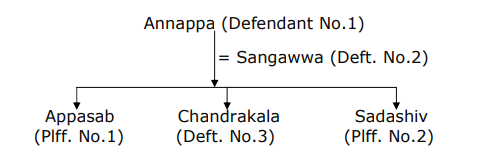
3. The defendant No. 1-Annappa is the husband of defendant No.2-Smt. Tangewwa and have three children namely, Appasab (plaintiff No.1), Sadashiv (plaintiff No.2) and Chandrakala (plaintiff No.3-originally defendant No.3), as can be seen from the genealogy, which is as under:
4. Initially, the plaintiff No.1 and plaintiff No.2 i.e. Appasab and Sadashiv instituted the aforesaid suit against their parents and sister Chandrakala (defendant No.3) and the appellant/defendant No.4, for partition and separate possession of their alleged share in the suit schedule properties. The suit schedule properties comprised of six (6) items of immovable properties which are described as hereunder:
2) DESCRIPTION OF THE SUIT PROPERTIES
| Sl. No. | R.S.No. | Area A.Gs. | Assessment Rs. Ps. | Extent | Village |
| 01 | 175/1+2 13-27 | PK0-04 | 16-58 | Full | Aigali |
| 02 | 219/1 | 5-34 | 3-92 | Full | Aigali |
| 03 | 219/2 | 4-16 | 1-46 | Full | Aigali |
| 04 | 219/3 | 8-03 | 7-68 | Full | Aigali |
| 05 | 1208/2 | 6-22 | 1-12 | Full | Athani |
| 06 | 1209/2 | 3-04 PK0-05 | 0-51 | Full | Athani |
5. The appellant/defendant No.4 is alienee in respect of item Nos.5 and 6 of the suit schedule properties and he is said to have acquired the same vide registered Sale Deed dated 10.12.2015, executed in his favour by the father/defendant No.1.
6. In the first instance, Chandrakala, the daughter of Annappa and Tangewwa was arrayed as defendant No.3 and she got herself transposed as plaintiff No.3 and she supported the claim of the plaintiff Nos.1 and 2.
7. It is a matter of record and an undisputed fact that the defendant Nos.1 and 2 did not file their written statement and contest the suit. It is only the appellant/defendant No.4 who claims to have acquired item Nos.5 and 6 of the suit schedule properties vide registered Sale Deed dated 04.12.2015, who is the contesting defendant only to the limited/restricted extent of item Nos.5 and 6 of the suit schedule properties. It was contended on behalf of the said defendant that there was earlier partition between the defendant No.1 and his family members and pursuant thereto, the defendant No.1 purchased item Nos.5 and 6 of the suit schedule properties, pursuant to which the same become his absolute, separated self-acquired properties. It was contended that since the item Nos.5 and 6 are the suit schedule properties were the separated self- acquired properties of the defendant No.1, he was entitled to sell the same in favour of the defendant No.4, who is the bona fide purchaser for value without any claim of the children of defendant No.1. It was also contended that the sale by the defendant No.1 in favour of defendant No.4 was for legal necessity and for the benefit of the estate and as such, the plaintiffs cannot claim any right over item Nos.5 and 6 of the suit schedule properties and the suit in this regard was liable to be dismissed.
8. The plaintiff No.2 examined himself as PW1, but did not tender himself for cross examination. The plaintiff No.3 examined herself as PW2 and the plaintiffs got marked documentary evidence at Ex.P1 to P11 on their behalf. As stated supra, the defendant Nos.1 and 2 remained exparte and did not contest the suit, nor filed their written statement, and the only contesting defendant who was defendant No.4/the appellant herein was examined himself as DW1 and documentary evidence at Ex.D1 to D14 were marked on his behalf. The appellant/defendant No.4 also examined two more witnesses as DW2 and DW3.
9. After hearing the appellant and the plaintiffs, the Trial Court came to the conclusion that item Nos.1 to 4 were the anc
The sale of property cannot supersede joint family ownership claims without valid evidence of prior partition or separate acquisition.
Joint family property retains its character unless proven otherwise; sales by co-parceners without all parties' consent do not extinguish shared rights.
The court ruled that the plaintiffs' claims over certain properties were invalid due to prior sales, emphasizing the necessity of declarations regarding property ownership in joint familial contexts ....


The burden of proof to establish joint family property lies with the plaintiffs, which remains unchanged even when defendants do not contest the suit.

A bona fide purchaser is one, who pays valid sale consideration and not a person who gets sale deed registered in his favour without payment of sale consideration.
The main legal point established is the application of Sec. 41 of the Transfer of Property Act, the exclusion of contrary evidence, and the principles of Hindu Law regarding co-parcenary property and....
Point of law: A daughter of a coparcener by birth becomes a coparcener in her own right in the same manner as the son. She has the same rights in the coparcenary property as she would have had if she....



An indispensable Tool for Legal Professionals, Endorsed by Various High Court and Judicial Officers
Please visit our Training & Support
Center or Contact Us for assistance

Scan Me!
India’s Legal research and Law Firm App, Download now!


For Daily Legal Updates, Join us on :



 Back to top


