
 Back
Back





IN THE HIGH COURT OF KARNATAKA AT DHARWAD BENCH
S.R. KRISHNA KUMAR, C.M. POONACHA, JJ.
Jakkavva W/o Mahadev Hanamannavar - Appellant
Versus
Ramappa S/o Laxman Yadranvi - Respondent
Regular First Appeal No. 100016 of 2021
Decided On : 08-09-2025
JUDGMENT :
1. The unsuccessful plaintiffs in O.S.No.194/2015 have knocked the doors of this Court being aggrieved by the impugned judgment and decree dated 09.09.2020 passed by the Principal Civil Judge (Sr.Dn), Gokak [Hereinafter referred to as ‘the Trial Court’] whereby the said suit filed by the appellants/plaintiffs against the respondents/defendants for partition and separate possession of their alleged share in the suit schedule properties was dismissed by the Trial Court.
2. Briefly stated facts giving rise to the present appeal are as under:
a) One Siddappa was the propositus of the family, who had a son Laxman, who undisputedly died intestate on 22.07.1996. The genealogical tree of the parties is as under:
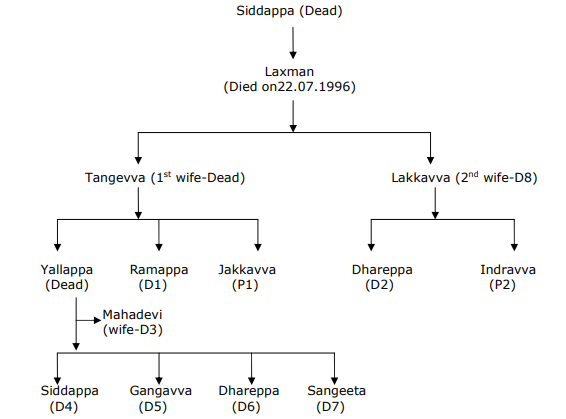
b) As can be seen from the aforesaid genealogical tree, the aforesaid Laxman, who died on 22.07.1996 was married to one Tangevva, who was his first wife through whom he had three sons viz., i) late Yallappa, ii) Ramappa and iii) Jakkavva. The deceased Yallappa left behind his wife Mahadevi and four children. The aforesaid Jakkavva is the plaintiff No.1 while her brother-Ramappa is defendant No.1 and Yallappa’s heirs are defendants No.3 to 7 in the suit.
c) During the lifetime of Tangevva, Laxman got married to Smt.Lakkavva, who is arrayed as defendant No.8 in the suit, while her son is defendant No.2. Lakkavva’s daughter-Indravva is plaintiff No.2 in the suit. Accordingly, the two daughters of the two wives of Laxman instituted the aforesaid suit against their siblings and Yallappa’s legal heirs and Lakkavva for partition and separate possession of their alleged share in the suit schedule properties. The suit schedule properties comprise of four items of landed properties as under:
| Suit Properties | ||
| S. No. | Survey No. | Extent |
| 1. | R.S.No.192/1B/1A | 2 Acres 00 Guntas |
| 2. | R.S.No.190/1+2+3+4+5/3 | 4 Acres 02 Guntas |
| 3. | R.S.No.190/7 | 1 Acre 19 Guntas |
| 4. | R.S.No.220/5K | 1 Acre 16 Guntas |
d) The defendant Nos.9 to 11 are the alienees in respect of item No.4 of the suit schedule properties from defendant No.1-Ramappa and the aforesaid late Yallappa, his brother. The defendant Nos.13 and 14 are relatives of the parties and they have also contested the suit. The material on record indicates that the defendant No.1 filed a written statement, which was adopted by defendant Nos.3 to 7; defendant Nos.2, 8, 9 and 10 have filed separate common written statement while defendant No.14 filed a separate written statement, which was adopted by defendant No.13. Defendant No.12 also filed a separate written statement.
e) In the written statement, the primary defence urged by the defendants was that item No.1 of the suit schedule properties bearing R.S.No.192/1B/1A was self-acquired property of defendant No.1, while item No.4 of the suit schedule properties bearing R.S.No.220/5K had been alienated by defendant No.1 and Yallappa in favour of defendant Nos.9 to 11 for legal necessities and benefit of the estate and thereafter defendant Nos.9 to 11 in turn transferred the said property in favour of defendant No.12. The defendant Nos.13 and 14 claimed to be the relatives of Laxman and also contended that there was an earlier partition in the year 1997, while the contesting defendants contended that there was an earlier oral partition between the parties, which was recorded in M.E.No.1638 under which item Nos.2, 3 and 4 fell to the share of the contesting defendants. The defendant Nos.13 and 14, the relatives of late Laxman, also put forth a plea of partition dated 23.09.2000 under which the said properties were partitioned and divided between the parties.
3. Based on the pleadings of the parties, the Trial Court framed the following issues and additional issues:
ISSUES:
1. Whether defendant-1 proves that, property bearing Sy.No.192/1B/1A is his self acquired property?
2. Whether defendant-1 further proves that, he along with defendant-2 and Yallappa sold entire lands in Sy.No.220/5K?
3. Whether defendant-1 further proves that his father married defendant-8 during the subsistence of 1s
Established children, regardless of legitimacy, have equal rights to inheritance under the Hindu Succession Act, 1956, which recognizes prior mutations as binding for determining property shares.

The court reaffirmed that daughters have equal rights as sons in ancestral properties, emphasizing the applicability of Section 6 of the Hindu Succession Act.
The court affirmed that partition shares from ancestral property remain joint family property for descendants, entitling them to assert claims over the inherited property.
The plaintiff, as the legatee of Lakshmidevamma under the Will, stands in the place of Lakshmidevamma. Lakshmidevamma was entitled to be treated as a regular coparcener of the Hindu joint family orig....

The ancestral property, while partitioned, remains joint family property, allowing children of a coparcener to claim their legitimate share despite their father's sale to others.

The presumption of joint family status in Hindu law requires clear evidence to establish prior partition; the Appellate Court allowed partition of one property acquired post-partition while dismissin....
The court affirmed the rights of daughters as coparceners in ancestral properties under amended Hindu Succession Act, allowing them equal shares alongside sons.
The court affirmed that ancestral property remains so despite partition, and daughters are entitled to equal shares under the Hindu Succession Act, 1956, as amended.
Point of law: A daughter of a coparcener by birth becomes a coparcener in her own right in the same manner as the son. She has the same rights in the coparcenary property as she would have had if she....



An indispensable Tool for Legal Professionals, Endorsed by Various High Court and Judicial Officers
Please visit our Training & Support
Center or Contact Us for assistance

Scan Me!
India’s Legal research and Law Firm App, Download now!


For Daily Legal Updates, Join us on :



 Back to top


