


 Back
Back





2025 Supreme(Kar) 1640
IN THE HIGH COURT OF KARNATAKA, DHARWAD BENCH
G. BASAVARAJA, J.
Husensab Bavardin Nagarwale @ Nagar – Appellant
Versus
Smt. Roshanbi W/o. Kashimsaheb Maldar – Respondent
Regular Second Appeal No.5139 of 2009 (PAR)
Decided on : 04-08-2025
For the Appellant :SRI. SHEKHARGOUDA M. MAGANURI, ADVOCATE FOR SRI. S.P. PATIL, ADVOCATE
For the Respondent:SRI. V.M. KANNUR, ADVOCATE FOR SRI. M.M. KHANNUR ADVOCATE
The court confirmed the entitlement of plaintiffs to a one-third share in inherited property, rejecting claims of insufficient declaration of rights.
Headnote:The court examined the legal rights of heirs over inherited property in accordance with Mohammedan law, noting that proper declaration of rights was lacking. The plaintiffs proved their claim to a share of the property, which had been incorrectly registered under the defendants' names. The core issue was the determination of the rightful legal heirs and their shares in the suit property. The court confirmed the findings of the lower courts, concluding that the appellants had not established any legal errors warranting appeal. Hence, the ruling maintains the decree of the lower courts, affirming the plaintiffs' entitlement to their shares.
| Table of Content |
|---|
| 1. legal arguments presented against inheritance claims. (Para 2) |
JUDGMENT :
G. BASAVARAJA, J.
Heard the learned counsel for the appellants.
2. During the course of the argument, the learned Counsel submits that the appellants are not going to dispute the relationship between the plaintiff and defendants 1 & 2. In view of the submission, the first substantial question of law, i.e. “Whether both the courts have committed a serious error in not noticing that there is no declaration regarding status of plaintiffs and their alleged right over the suit schedule property more particularly in the light of status being seriously disputed?” framed on 25th March 2014, stands deleted.
3. Defendants 1, 3 & 4 have preferred this Regular Second Appeal against the judgment and decree dated 19th February, 2007 passed in Original Suit No.6 of 2002 by the Principal Civil Judge (Jr. Dn.), Jamakhandi, which is confirmed by the Fast Track Court at Jamakhandi by Judgment dated 12th September, 2008 passed in Regular Appeal No.20 of 2007.
4. For the sake of convenience, the parties herein are referred to as per the rank before the trial court.
5. Facts leading to this appeal are that the plaintiffs 1 & 2 have filed suit for partition and separate position of the suit property and the genealogical tree of the plaintiff and defendants is as under.
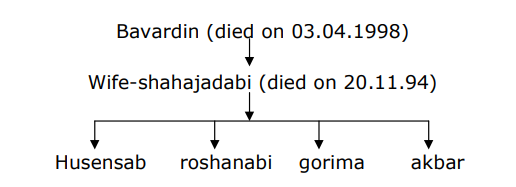
6. The propositus Bavardin died on 3rd April 1988, and his wife Shahajada Bi (mother of plaintiffs and defendants) also died on 20th November 1994. The deceased Bavardin was the owner in possession of the property bearing CTS No.208 measuring 76.92 mtrs. at Jamakhandi. After his demise, defendants 1 & 2 applied to the City Survey Office, Jamakhandi on 19 January 2001 for entering their names alone stating that they are the only legal heirs of the deceased parents and thereby the defendants 1 & 2. Accordingly, the names of defendants 1 & 2 alone have been entered by the City Survey Officer to the suit property. The Survey officer has not given public notice and has also not enquired as to other legal heirs to the deceased. Therefore, the entry made by the Taluk Surveyor/City Survey Officer, Jamakhandi, is without knowledge and behind the back of the plaintiffs. Now, the suit property standing in the names of the defendants. The plaintiffs have got the right of partition in the suit property as per the Mohammedan law to the extent of one-third share therein. The plaintiffs approached defendants 1 & 2 for effecting the partition in the Suit property, but the efforts went in vain. Now, the defendants are trying to sell the suit property by taking advantage of the appearance of their names in the record. The entries in the records of the suit property are not binding on the plaintiffs. Hence prayed for decreeing in the suit.
7. In response to summons, the Power of Attorney Holder of only the defendant No.1 has filed written statement, denying all the averments of the plaint including the relationship of plaintiffs and defendants. Plaintiffs have no right of whatsoever nature in the suit property as sought for. Defendant No.2 has got filed the instant suit through the plaintiffs colluding with them as they are the sisters of defendants, only with a malafide intention to harass defendant No.1. Even otherwise, without admitting the relationship of the plaintiffs, the defendant No.1 has got every right to enjoy suit property at his wish, and the plaintiffs are excluded from the suit property. It is also contended that the suit is barred by law of limitation and further, the suit is not properly valued and the trial Court has no pecuniary jurisdiction, so also, the court fee paid is not correct. It is further stated that the suit, without claiming the relief of declaration of the right of plaintiffs, is not maintainable. The plaintiffs are not in possession of the suit properties and hence the ad-valorem Court fee is required to be paid on the market value of the suit property. Contending thus, it was prayed fo












