


 Back
Back





2025 Supreme(Kar) 1721
IN THE HIGH COURT OF KARNATAKA, DHARWAD BENCH
SACHIN SHANKAR MAGADUM, G. BASAVARAJA, JJ.
Sri. Umesh N., S/o. Pampanna - Appellant
Versus
The State Of Karnataka, Through Sandur Police Station, Now Represented By State Public Prosecutor, High Court Of Karnataka Dharwad, Bench At Dharwad – Respondent
Criminal Appeal No.100607 of 2022 (C)
Decided On : 01-04-2025
For the Appellant :Sri. Srinand A. Pachhapure, Advocate
For the Respondent: Sri. M.B. Gundawade, Addl. SPP.
The prosecution failed to establish guilt beyond a reasonable doubt due to inconsistencies, lack of corroborative evidence, and procedural irregularities impacting the reliability of witness testimonies and dying declarations.
Headnote:(A) Indian Penal Code, 1860 - Sections 498A and 302 - Conviction challenged for causing death of wife by burning and subjecting her to cruelty - Court acquitted the accused due to lack of corroborative evidence and inconsistency in the prosecution's case, stating, 'the prosecution has failed to prove the guilt of the accused beyond all reasonable doubts' and 'the entire case of prosecution will create reasonable doubt.' (Paras 53, 57, 58)
(B) Dying declaration - Importance and reliability - The court emphasized the need for consistency in dying declarations and the necessity of corroborative evidence. The absence of support from key witnesses led to doubt regarding the authenticity of the dying declaration. (Paras 12-14, 46)
(C) Default in procedural law - Violations regarding FIR presentation and testimony by material witnesses compromised the prosecutorial case further, particularly regarding the failure to examine the scribe of the FIR document. (Paras 40, 56)
Facts of the case:
The appellant was convicted by the trial court for the murder of his wife, following allegations of physical and mental harassment for money, culminating in an incident where the wife was set ablaze. The trial involved a significant number of witnesses, but many turned hostile or denied pivotal details.
Findings of Court:
The court found that the prosecution's evidence was insufficient, lacking corroboration from significant witnesses and failing to adequately explain procedural delays and inconsistencies, particularly concerning the FIR and dying declaration.
Issues: Key inquiries included the credibility of the dying declaration and the procedural irregularities affecting the prosecution's case.
Ratio Decidendi: The court determined that the accused is entitled to the benefit of the doubt due to substantial procedural and evidential shortcomings, affirming that 'the prosecution has failed to prove the guilt of the accused.'
Result: Appeal allowed; accused acquitted.
| Table of Content |
|---|
| 1. background of the case detailing the marriage and incidents leading to the trial. (Para 1 , 2) |
| 2. arguments and evidence sufficiency raised by the defense counsel. (Para 6 , 8 , 10) |
| 3. importance of dying declaration as evidence. (Para 34 , 38 , 39) |
| 4. court's analysis on conviction criteria and evidence evaluation. (Para 35 , 36 , 57) |
| 5. conclusion and order regarding the appeal and acquittal. (Para 59) |
JUDGMENT :
G. BASAVARAJA, J.
The appellant/accused has preferred this appeal against the judgment of conviction and order on sentence dated 30th September 2022 passed in SC No.30 of 2017 by the II Additional District and Sessions Judge, Ballari (for short hereinafter referred to as the “trial Court”) whereby, the accused was convicted for the offence punishable and Sections 498A and 302 of the INDIAN PENAL CODE .
2. The factual matrix of the prosecution case is that, the marriage of the deceased-Lakshmi with accused was solemnized about eight years back. After marriage, the accused used to always pick up quarrel with his wife and used to demand money from her for consuming alcohol and when she refused to give him money, the accused used to assault her and used to harass her mentally and physically. That on 15th February 2017 at about 8:30 am in Kitchen accused demanded money for consuming alcohol and when the deceased refused to give money, he kicked her and when she fell he poured kerosene on her and lit fire with a matchstick. When Lakshmi made hue and cry, the neighbours came, extinguished fire and shifted Lakshmi to Jindal Sanjeevini Hospital, Tornagal. On 21st February 2017 at about 9.00 am, she succumbed to the injuries. Thus, the accused committed offences punishable and Sections 498A and 302 of INDIAN PENAL CODE .
3. After filing the charge-sheet, case was registered in CC No.217 of 2017. After committal to the Sessions Court, case was registered as SC No.30 of 2017. Having heard the arguments on charges, the trial Court has framed charges and the same were read over and explained to the accused in the language known to him. Having understood the same, accused pleaded not guilty and claimed to be tried.
4. To prove the case of prosecution, 25 witnesses were examined as PWs1 to 25 and marked 36 documents as Exhibits P1 to P36 and six material objects were marked as MOs 1 to 6. On closure of prosecution side evidence, the statement of the accused under Section 313 of Code of Criminal Procedure was recorded. Accused has totally denied the evidence of prosecution witnesses. Accused also submitted his written statement, in which he has stated as under:
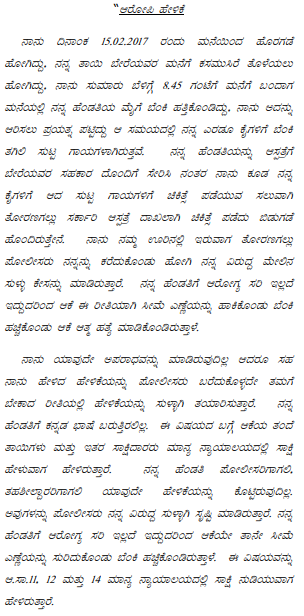
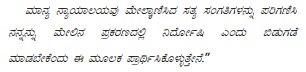
5. Having heard the arguments on both sides, the trial Court has convicted the accused for commission of offence under Sections 498A and 302, INDIAN PENAL CODE and sentenced the accused to undergo rigorous imprisonment for a period of three years and pay a fine of ₹5,000/- and in default of payment of fine, the accused shall undergo simple in imprisonment for a period of three months for the offence punishable under intersection 498A of IPC. Further, the accused was sentenced to undergo imprisonment for life and shall pay a fine of ₹20,000/- and in default of payment of fine, he shall undergo simple imprisonment for a period of six months for the offence punishable and Section 302 INDIAN PENAL CODE . Being aggrieved by the judgment of conviction and order on sentence, the accused has preferred this appeal.
Contentions of learned counsel for the appellant:
6. Learned Counsel Sri Srinand A. Pachhapure, appearing for the appellant/accused submits that the judgment of conviction and order on sentence passed by the trial Court is opposed to facts and probabilities of the case. He would submit that the trial Court has erred in believing the uncorroborated version of prosecution witnesses and has wrongly come to the conclusion. He submits that PWs1 and 2 who are witnesses for spot panchanama as per Exhibit P1, have not supported the case of the prosecution. PWs3 and 4, who a












