Back
Back





2025 Supreme(Kar) 2055
IN THE HIGH COURT OF KARNATAKA AT BENGALURU
ANU SIVARAMAN, VIJAYKUMAR A. PATIL, JJ.
Indian Institute Of Astrophysics – Appellant
Versus
K. Dhananjay, S/o Late K. Krishnappa – Respondent
CRIMINAL CONTEMPT PETITION NO.7 OF 2018
Decided On : 11-12-2025
For the Appellant :Sri. Syed Kashif, Advocate For Sri. Pradeep S. Sawkar, Sri. B. Ravindrananth, Amicus Curiae
For the Respondent: Sri. K. Dhananjay- (Party In Person)
The court found that making unfounded allegations against judges and judicial officers constitutes criminal contempt, undermining public confidence in the justice system.
Headnote:(A) Contempt of Courts Act, 1971 - Section 2(c), 15(1)(b), and 12(1) - Criminal contempt proceedings initiated against accused for making baseless allegations against judicial officers, undermining judicial authority, and scandalizing the court - Consent for contempt taken by Advocate General - Allegations proved through evidence and cross-examination - Accused was found to have engaged in continued contemptuous conduct, displaying no remorse. (Paras 1-20)
(B) Legal standard for contempt - Allegations must not be motivated by malice or an intention to undermine the justice system; fair criticisms protected unless scandalous. (Paras 17-18)
Facts of the case:
The accused made derogatory statements against judges and members of the Central Administrative Tribunal alleging corruption and conspiracies. The complainant institution brought forth these allegations in a criminal contempt petition. The accused did not deny the charges during proceedings, instead, attempted to justify actions with unfounded claims.
Findings of Court:
The charges of criminal contempt were substantiated through the accused's own statements and evidence gathered during the proceedings. The accused's conduct was characterized as willful and continuing contempt.
Issues: Whether the alleged statements by the accused constituted criminal contempt and whether the court should impose a punishment.
Ratio Decidendi: The court reasoned that the accused’s allegations severely undermined public confidence in the judiciary, constituting clear criminal contempt. The court emphasized the importance of upholding judicial authority against baseless and malicious attacks.
Result: Accused held guilty and sentenced to four months of simple imprisonment and fined Rs. 2,000/-.
JUDGMENT :
ANU SIVARAMAN, J.
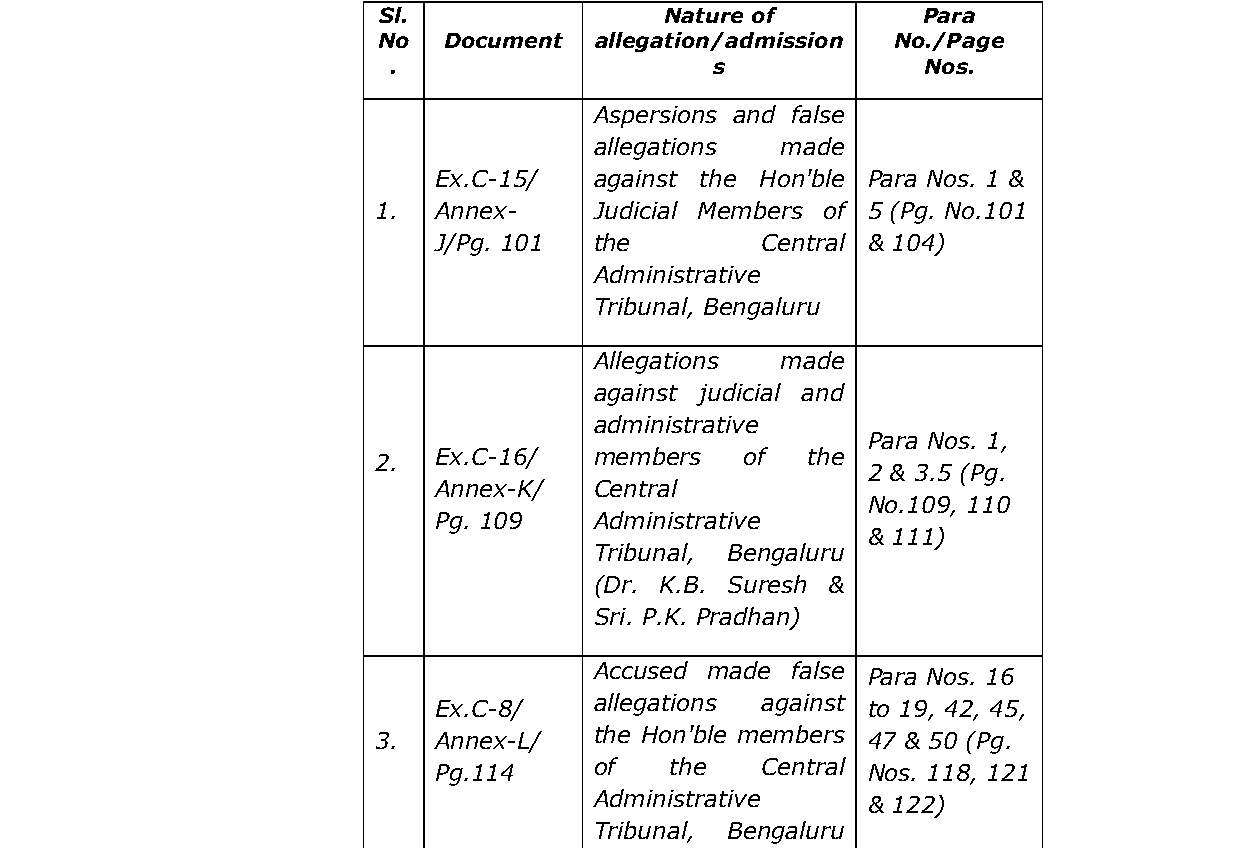
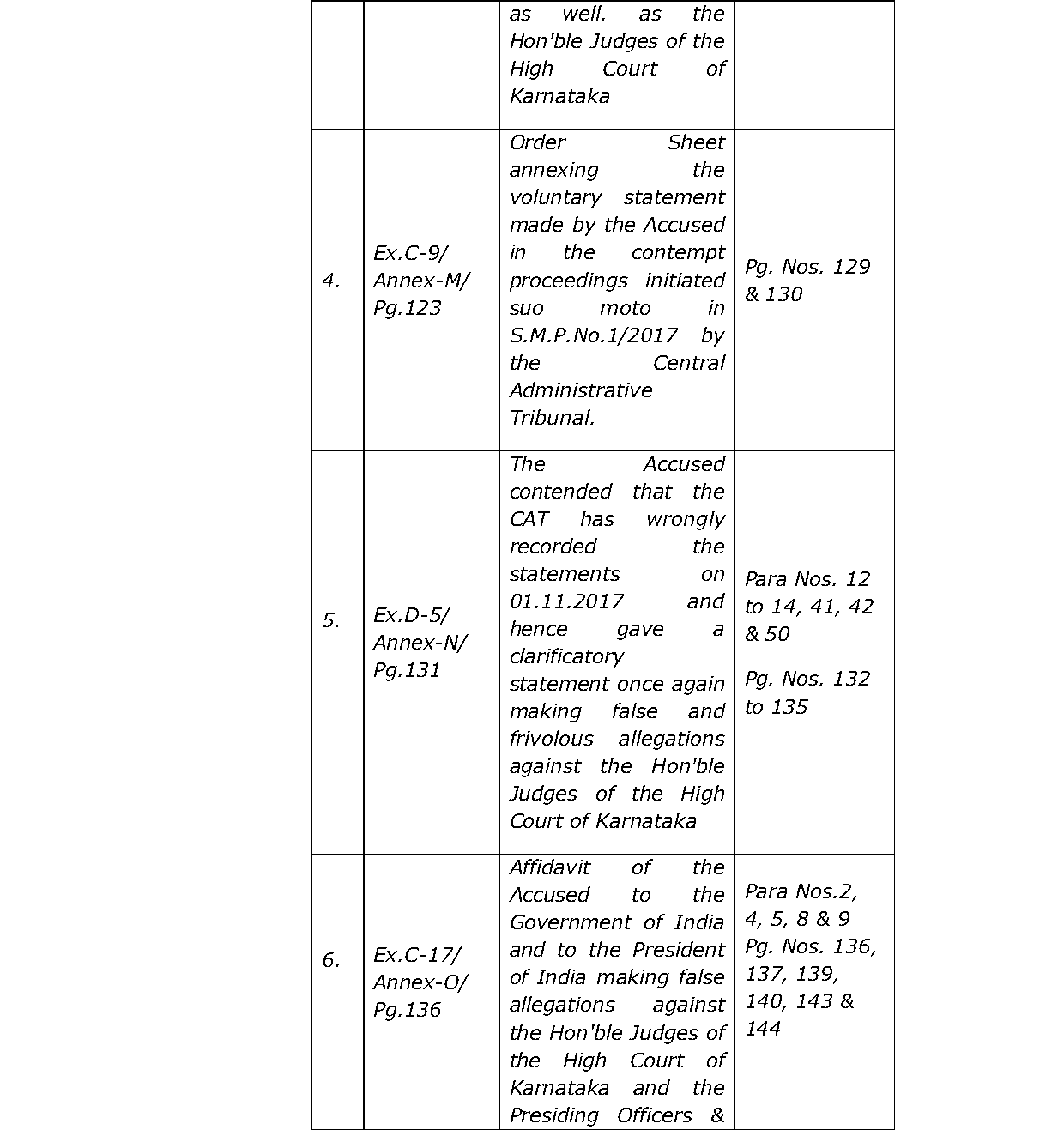
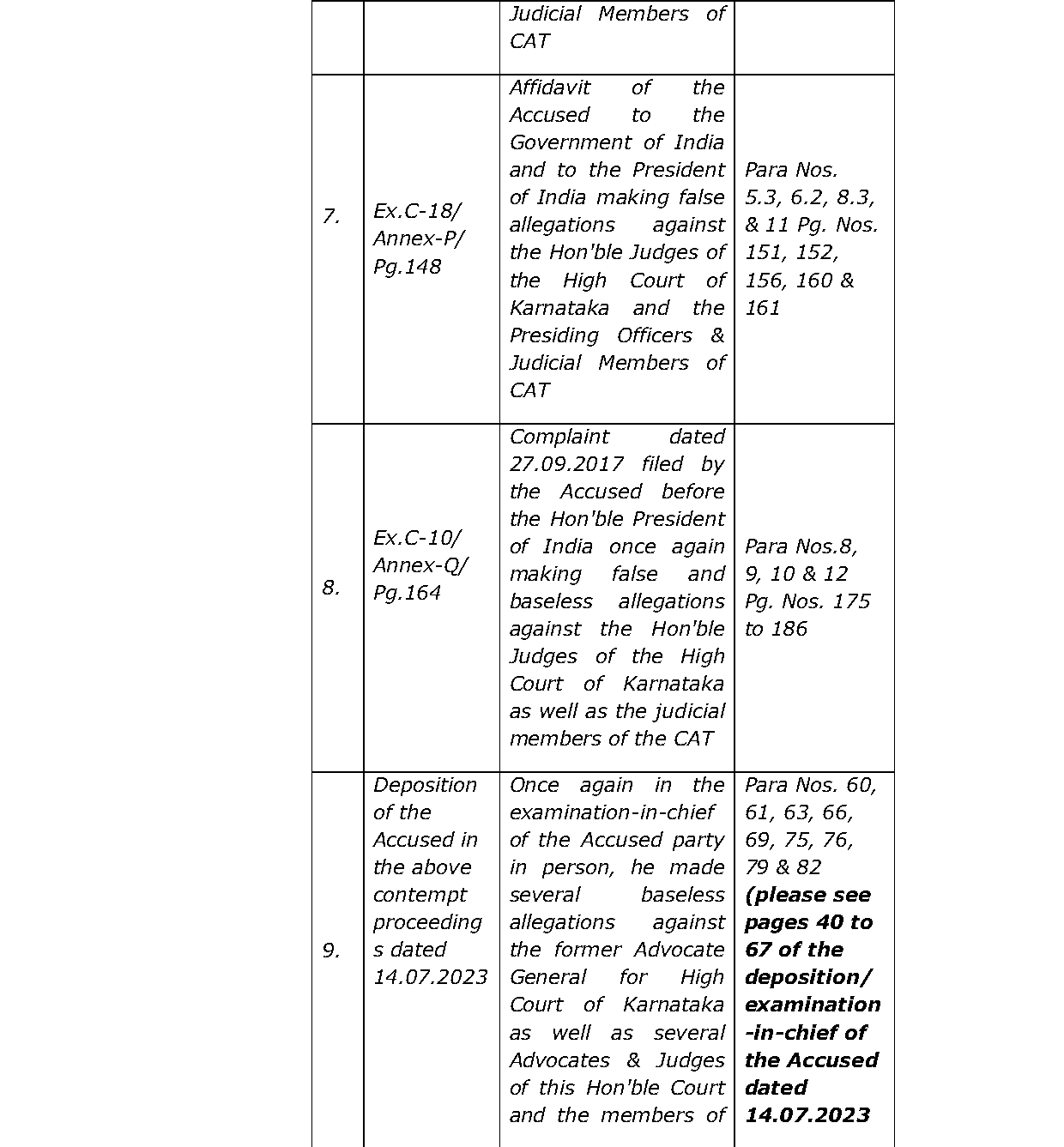
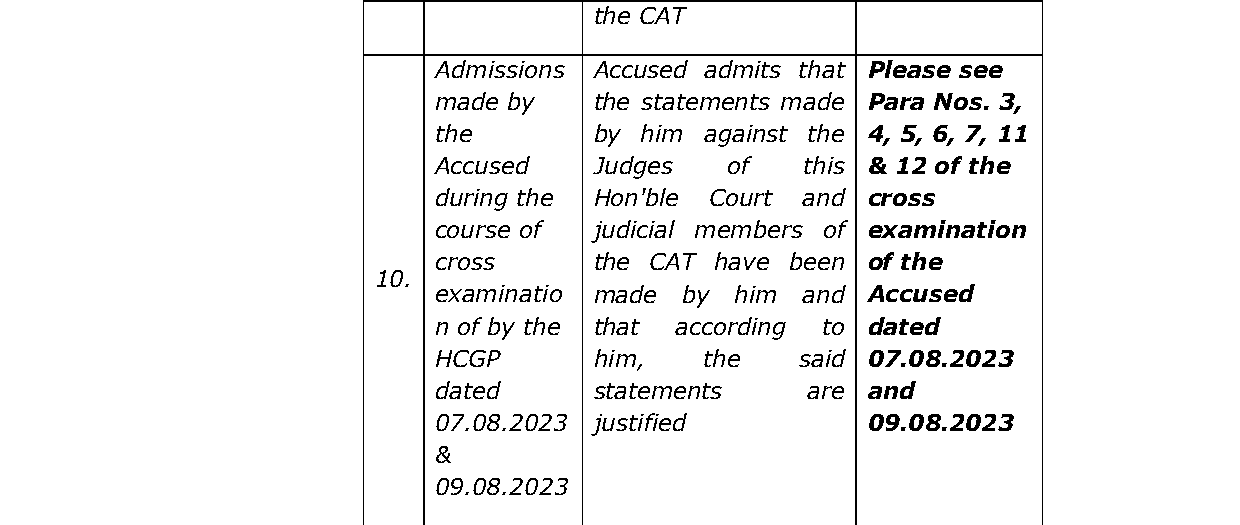
The Criminal Contempt Case No.7/2018 has been filed pursuant to a complaint and Consent Application No.9/2018 filed by the Complainant. The learned Advocate General by order dated 16.07.2023, granted consent to initiate criminal contempt proceedings against the accused on the ground that he had repeatedly made false, reckless, scurrilous, and unsubstantiated allegations against Members of the Central Administrative Tribunal ('CAT' for short) and Judges of the Karnataka High Court in multiple proceedings and representations. The allegations made by the accused, which had also been noticed by the CAT in earlier suo motu contempt proceedings, were found to be baseless and intended to cast aspersions on judicial officers, thereby amounting to gross contempt and undermining the authority of the courts.
2. The consent granted by the Advocate General for Karnataka, Bengaluru was challenged in Writ Petition No.60/2020 and connected matters, which was dismissed as withdrawn by the learned Single Judge on 29.11.2021. Thereafter, notice was issued to the accused in the Criminal Contempt and his pleadings were placed on record.
3. In the memorandum of objections filed by the accused, he alleged that judges of the Court were involved in "case fixing deal crime" and other "grave and heinous criminal acts." He stated that the judges influenced other judges to pass orders which were "colourful and deceptive influences." Consequently, making him a victim of "dictatorial punishment." He further accused judicial officers, CAT members, police and the Complainant of criminal conspiracy. He claimed that he was a "whistle- blower" under target. Serious allegations leveled in the memo are extracted below:
"2. x x x x In obligation to Article 51A(i) of Constitution, Respondent discharged his fundamental duty of protecting public property (Rs. 2,000/- Crores loss to public-funds) by way of blowing his whistle on service matter scam in a case O.A.No.170/021/2011, committed by Management of Indian Institute of Astrophysics. Thus Management of Institute has hatched a criminal conspiracy to eliminate whistleblower Respondent from the Institute to find an escape route from prosecution for scams. The escape route is via committing CASE_FIXING_DEAL_CRIME with sitting Judge Hon’ble Dr. K.B. Suresh, Central Administrative Tribunal, Bangalore Bench. The negotiations made in stated CASE_DEAL was to pass CASE_FIXED_JUDICIAL_ORDER (in case O.A.No.170/0982/2015) for defaming, condemning and punishing and destroying the official and public life of Respondent initially, then, consequently to hatch more complex criminal conspiracy to co-operatively to implicate Respondent. x x x x
Thus, all CASE_FIXING_DEALERS have successfully accomplished their criminal activities as stated herewith for peaceful enjoyment of scams eternally in the Indian Institute of Astrophysics. Under such life endangered circumstances, in pursuant with the statutory provisions, Respondent exercised his legal and constitutional rights for filing several sworn complaints and Affidavits from time to time on CASE_FIXING_DEAL_CRIME to Hon’ble Chief Justices of High Court of Karnataka and Apex Court and Hon’ble President of India and concerned Central Government Ministries. In all his complaints, he prayed for urgent inquiry on CASE_FIXING_DEAL such that he shall be given an opportunity to produce all available evidences with him to inquiry committee and prayed inquiry committee for ascertaining/acquiring certain evidences through the assistance of the Police/CBI available from custodians of Mobile Phone Service providers and CASE_FIXING_DEALERS. Accordingly, inquiry to be logically completed to submit an inquiry report for actions on CASE_FIXING_DEALERS. x x x x
8. Respondent always believed in Court as Temple for Justice and Judges as Priests of Court. He never committed any kind of contempt of any Court. It is the Petitioner (Ex-Director Dr.P. Sreekumar) and his henchmen who hav