
 Back
Back





IN THE HIGH COURT OF KARNATAKA AT BENGALURU
G.BASAVARAJA, J.
N. Hanumanthappa S/o Nagabovi - Appellant
Vs.
State Of Karnataka - Respondent
Criminal Appeal No.917 of 2013
Decided On : 03-12-2025
| Table of Content |
|---|
| 1. factual background of the incident (Para 1 , 3 , 16) |
| 2. arguments challenging trial court's conviction (Para 8 , 9 , 10 , 11 , 12 , 13) |
| 3. court's observations on evidence inconsistencies (Para 17 , 19 , 22 , 27 , 28 , 30 , 31) |
| 4. prosecution's failure to prove guilt (Para 18 , 32) |
| 5. order allowing appeal and acquitting the accused (Para 33) |
JUDGMENT :
G.BASAVARAJA, J.
This appeal is against the judgment of conviction dated 29th August, 2013 and order on sentence dated 30th August, 2013 passed in S.C. No.157/2011 by the Addl. District and Sessions Judge, Chitradurga (for short "trial Court").
2. For the sake of convenience, the parties herein are referred to as per their status before the trial Court.
3. The brief facts leading to this appeal are as follows:
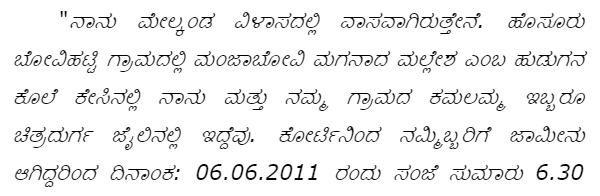
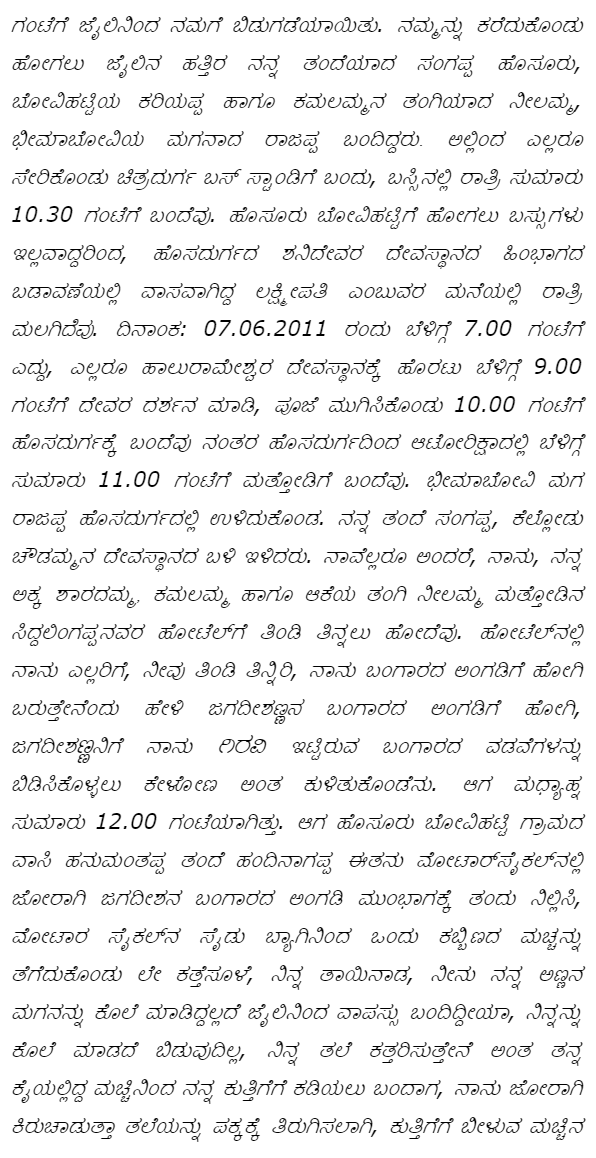
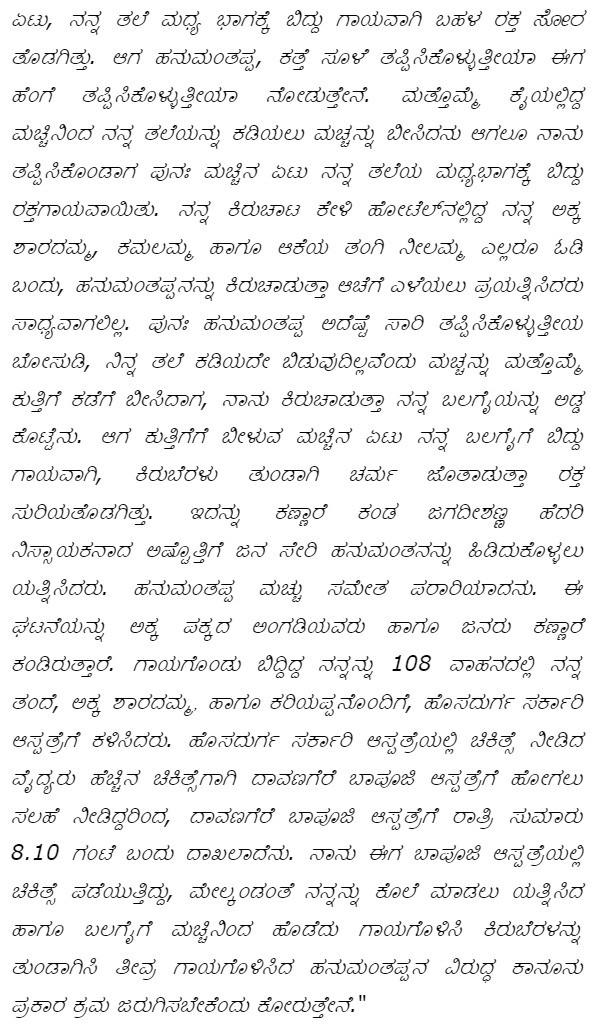
It is alleged by the prosecution that on 07.06.2011, at around 12:00 noon, the complainant had visited Jagadish Jewellery. The individuals accompanying the complainant were having lunch at Siddalingappa’s Hotel. At that juncture, the appellant arrived at the jewellery shop on a motorcycle, took out a chopper from the vehicle, and began abusing the complainant in filthy language, simultaneously threatening to endanger her life. Thereafter, the appellant assaulted the complainant with the said chopper. Though the chopper was aimed twice at the complainant’s neck, it struck her head when she bent forward. On hearing her cries of pain, the persons accompanying the complainant rushed to her rescue and attempted to apprehend the accused; however, the accused managed to escape. Subsequently, upon completion of the investigation, the Investigating Officer submitted the charge sheet against the accused for offences punishable under Sections 504, 326, and 307 of the Indian Penal Code.
4. The accused was arrested and produced before the learned Magistrate and was enlarged on bail. After filing the charge sheet, case was registered in CC No.501/2011. After committal to the Court of Sessions, case was registered in SC No.157/2011.
5. Upon hearing charges, the trial Court has framed the charges for offences punishable under Section 504, 307 and 326 of Indian Penal Code . Same were read over and explained to the accused. Having understood the same, accused pleaded not guilty and claimed to be tried.
6. To prove the case of the prosecution, a total of 22 witnesses were examined as PWs 1 to 22, and eleven documents were marked as Exhibits P1 to P11. Eight material objects were marked as MOs 1 to 8. Upon closure of the prosecution evidence, the statement of the accused was recorded under Section 313 of the Code of Criminal Procedure. The accused stated that a false case has been foisted against him.
7. After the full-fledged trial, having heard the arguments on both sides, the trial Court convicted the accused for offences punishable under Sections 326 , 504, and 307 of the Indian Penal Code and sentenced him to undergo rigorous imprisonment for a period of 7 years and to pay a fine of Rs.5,000/- for the offence under Section 326 of Indian Penal Code. The accused was also sentenced to undergo rigorous imprisonment for 2 years and to pay a fine of Rs.3,000/- for the offence under Section 504 . Further, he was sentenced to undergo rigorous imprisonment for 7 years and to pay a fine of Rs.5,000/- for the offence punishable under Section 307 of the Indian Penal Code. All the substantive sentences are ordered to run concurrently. Being aggrieved by this judgment of conviction and order on sentence, the appellant has preferred this appeal.
8. The learned counsel appearing for the appellant would submit that the judgment of conviction and the order on sentence passed by the trial Court is are highly illegal and erroneous. The trial Court has erred in believing relying on the evidence of PW1, though her evidence testimony is quite contrary to the earlier statement given by her. The trial Court has failed to take notice of the fact that, according to the statement given by the complainant and o
The court emphasized the prosecution's burden to prove guilt beyond a reasonable doubt, ruling that inconsistencies and lack of credible evidence required acquittal.

Point of Law : When once the doubt arise in the mind of the court, the benefit of such doubt should always accrue on the part of the accused and it is the doctrine of criminal justice delivery system....

The prosecution must prove guilt beyond reasonable doubt, and failure to do so, due to contradictions and lack of corroboration, cannot sustain a conviction.
The appellate court modified the conviction from attempted murder to lesser charges due to insufficient evidence of intent, thus reflecting on the critical importance of establishing motive and eyewi....

The prosecution must prove the accused's guilt beyond reasonable doubt, and contradictions in the evidence can raise doubts about the case.


The duty of the court to assess the evidence, the principles of circumstantial evidence, and the application of relevant sections of the Indian Penal Code were the central legal points established in....

The prosecution must establish charges beyond reasonable doubt, and the failure to seal samples and examine the investigating officer can impact the credibility of the evidence.


Point of Law : Evidence let in by the prosecution has to be assessed carefully and cautiously and it should not be brushed aside. [Para 30]



An indispensable Tool for Legal Professionals, Endorsed by Various High Court and Judicial Officers
Please visit our Training & Support
Center or Contact Us for assistance

Scan Me!
India’s Legal research and Law Firm App, Download now!


For Daily Legal Updates, Join us on :



 Back to top


