
 Back
Back





IN THE HIGH COURT OF KARNATAKA AT BENGALURU
UMESH M.ADIGA, J.
Smt. Sharadamma W/o Late Basavarajappa - Appellant
Vs.
Ranjith S/o Ramesh - Respondent
Miscellaneous First Appeal No. 2961 of 2021 (MV-I) C/W Miscellaneous First Appeal No. 6286 of 2022 (MV-I)
Decided On : 06-11-2025
| Table of Content |
|---|
| 1. parties involved and appeal context. (Para 2 , 3 , 5 , 6) |
| 2. accident details and injuries sustained. (Para 4 , 15 , 16) |
| 3. evidence and tribunal assessment. (Para 8 , 9) |
| 4. liability and driving license issues. (Para 10 , 12 , 14 , 19 , 20 , 22) |
| 5. enhancement of compensation awarded. (Para 23 , 24 , 26) |
JUDGMENT :
UMESH M.ADIGA, J.
Both these appeals arise out of the judgment and award dated 23.03.2021 passed in MVC No.1124/2018 by the V Additional District and Sessions Judge, Tiptur, (for short, 'Tribunal').
2. MFA No.2961/2021 is filed by the legal representatives of the owner of the offending vehicle and MFA No.6286/2022 is filed by the claimant seeking enhancement of compensation.
3. For the sake of convenience, the parties are referred to as per their ranking before the Tribunal.
4. The brief facts of the case of the claimant that, on 25.04.2018, at around 09.30 a.m, when the claimant was riding a motorcycle bearing Reg.No.KA-13-EM-0636 on Tiptur - Huliyur road, he met with an accident at Halenahalli, due to rash and negligent driving of Hero Honda Splendor motorbike bearing Reg.No.KA-06-R-3394 (offending vehicle). As a result, claimant sustained fractured injuries and other injuries. He has taken treatment by spending substantial amount and has suffered permanent disability. With these reasons, claimant prayed to award compensation of Rs.15,00,000/-.
5. Respondent No.1 (A to C) are the legal representatives of owner of the offending vehicle i.e., original Respondent No.1. Respondent No.2 was the insurer of the offending vehicle.
6. Before the Tribunal, both the respondents have filed their respective written statements denying the petition averments and Respondent No.2-insurer denied its liability to pay the compensation, and prayed to dismiss the claim petition.
7. From the rival contentions of the parties, the Tribunal framed necessary issues.
8. It recorded the evidence of claimant, as well as respondents. Claimant to prove his case examined two witnesses PW1 and CW1 and marked 89 documents as per Exs.P1 to P89. Respondent examined one witness-RW1 and marked Exs.R1 to R5.
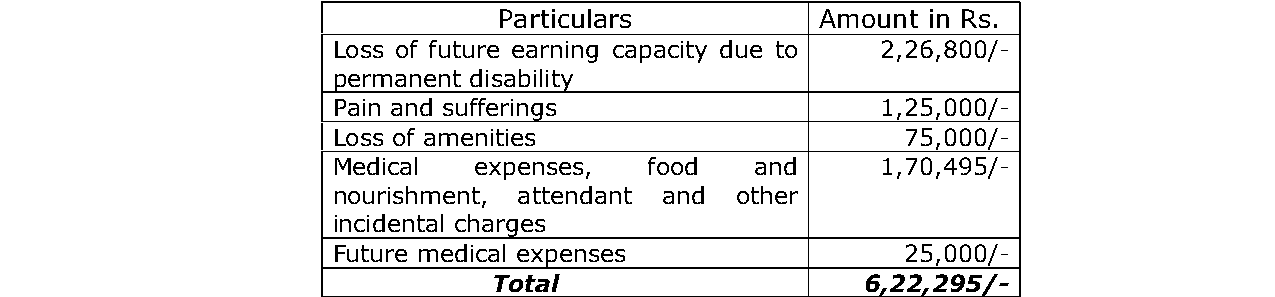
9. After hearing both the parties and appreciating the materials on records, Tribunal held that accident occurred due to negligence of rider of the offending vehicle. Tribunal assessed the age of the claimant as 18 years, earning as Rs.7,000/- p.m., the disability at 15%, applied the multiplier '18' and awarded the following amount of compensation:-
10. Heard the arguments of learned counsel for both the parties.
11. Learned counsel for the claimant contended that, the Tribunal has awarded a meagre amount of compensation on all the heads. The Tribunal has not assessed the income and disability of the claimant properly. The Tribunal directed the owner of the vehicle to pay the compensation on the ground that, driver of the offending vehicle had no valid and effective driving license to drive the said class of vehicle. The Tribunal observed that the period of driving licence was from 17.04.2013 to 16.04.2018, accident occurred on 25.04.2018 i.e., within a period of 8 days from the date of expiry of licence. As per the proviso to the unamended Section 14 of the Motor Vehicles Act, 1988, the date of expiry of a driving licence shall be deemed to be extended by 30 days from the date of its expiry, and renewal may be made within that period. of the Act, reads as under:
"14. Currency of licences to drive motor vehicles.— (1) A learner’s licence issued under this Act shall, subject to the other provisions of this Act, be effective for a period of six months from the date of issue of the licence.
(2) A driving licence issued or renewed under this Act shall,—
(a) in the case of a licence to drive a transport vehicle, be effective for a period of three years:
[Provided that in the case of licence to drive a transport vehicle carrying goods of dangerous or hazardous nature be effective for a period of one year and renewal thereof shall be subject to the con
AI
The grace period for driving license validity under Section 14 legitimizes liability of insurers, impacting judgments on compensation and negligence in vehicular accidents.

The insurer is liable to pay third-party compensation despite driver non-compliance with licensing, as established in prior rulings.

The court ruled on the enhancement of compensation in a personal injury case, establishing liability principles under contributory negligence and the limitations of insurance coverage for pillion rid....

Under the Motor Vehicles Act, non-compliance with license conditions does not absolve insurers of third-party liability; pay and recovery principle applies to recover claims from vehicle owners.


Compensation for personal injury must adequately reflect the severity of injuries and associated suffering, with the finding of primary negligence resting on the lorry driver.

Insurance companies are obligated to pay compensation despite the absence of a valid driving license of the driver, as per Section 149(2) of the Motor Vehicles Act.



An indispensable Tool for Legal Professionals, Endorsed by Various High Court and Judicial Officers
Please visit our Training & Support
Center or Contact Us for assistance

Scan Me!
India’s Legal research and Law Firm App, Download now!


For Daily Legal Updates, Join us on :



 Back to top


