
 Back
Back





IN THE HIGH COURT OF KARNATAKA AT BENGALURU
ASHOK S.KINAGI, J.
T.G. Manjunath - Appellant
Vs.
Sri J.T. Gnanamurthy S/o G. Thippaiah - Respondent
Regular Second Appeal No. 1636 of 2013 (PAR)
Decided On : 06-11-2025
| Table of Content |
|---|
| 1. parties and initial facts of the case. (Para 1 , 2 , 3 , 4 , 5 , 6) |
| 2. defendants' admissions and contestations. (Para 7 , 8) |
| 3. trial and appellate court findings. (Para 11 , 12 , 14) |
| 4. arguments presented by the parties. (Para 17 , 18 , 19 , 20) |
| 5. questions of law framed for consideration. (Para 21 , 22 , 29) |
| 6. appellate court's reasoning and conclusion. (Para 30 , 31) |
| 7. final order and dismissal of appeal. (Para 32) |
JUDGMENT :
ASHOK S.KINAGI, J.
1. This Regular Second Appeal is filed by the appellants challenging the judgment and decree dated 06.07.2013 passed in R.A. No.1 of 2013 by the learned Senior Civil Judge, Challakere and the judgment and preliminary decree dated 13.12.2012 passed in O.S. No.97 of 2011 by the learned Civil Judge and JMFC, Molakalmuru.
2. For convenience, the parties are referred to based on their ranking before the Trial Court. The appellants were the plaintiffs and the respondents were the defendants.
3. Brief facts leading rise to the filing of this appeal are as follows:
4. The plaintiffs filed a suit against the defendants for declaration to declare the registered sale deed dated 19.04.1993 as null and void, and not binding on the share of the plaintiffs, and to cancel the sale deed dated 19.04.1993 executed by defendant Nos.1 and 2 in favour of defendant No.3.
5. It is the case of the plaintiffs that plaintiff Nos.1 and 2 are the sons, and plaintiff No.3 is the daughter of defendant Nos.1 and 2. The suit schedule properties are the ancestral properties of the plaintiffs and defendant Nos.1 and 2. The plaintiffs and defendant Nos.1 and 2 are the members of a Hindu Undivided Family and no partition is effected between the plaintiffs and defendant Nos.1 and 2.
6. It is contended that defendant Nos.1 and 2 had no right to sell the suit schedule property in favour of defendant No.3. The sale deed executed by defendant Nos.1 and 2 in favour of defendant No.3 is not binding on the share of the plaintiffs. Hence, this suit.
7. Defendant Nos.1 and 2 filed a written statement admitting the relationship between the plaintiffs and defendant Nos.1 and 2, and also that the suit schedule property is the ancestral property and they are the members of a Hindu Undivided family. It is contended that the suit schedule property was owned and possessed by one Jalimarada Thippaiah i.e., the grandfather of the plaintiffs and the father of defendant No.1 and he acquired the said property in a partition and the khata was changed in the name of defendant Nos.1 and 2. Further, the above said defendants supported the claim of the plaintiffs and prayed to decree the suit.
8. Defendant No.3 filed a written statement denying the averments made in the plaint and contended that the suit filed by the plaintiffs is a collusive suit and defendant Nos.1 and 2, to extract more money from defendant No.3, got filed the present suit through the plaintiffs and it is contended that the suit schedule property fell to the share of defendant No.1 in a partition deed effected on 16.04.1992 and defendant Nos.1 and 2 jointly sold the suit schedule property in favour of defendant No.3 and executed the registered sale deed dated 19.04.1993 after receiving the valid consideration amount and defendant Nos.1 and 2 delivered the possession of the suit schedule property in favour of defendant No.3. Defendant No.3 became the absolute owner of the suit schedule property by virtue of a registered sale deed executed by defendant Nos.1 and 2 in favour of defendant No.3. It is further contended that defendant No.3, by virtue of the sale deed, is in lawful possession and enjoyment of the suit schedule property. Hence, the suit filed by the plaintiffs is not maintainable and it is also contended that the plaintiffs have not included the other ancestral properties. The suit for a partial partition is not maintainable. Hence, prays to dismiss the suit against defendant No.3.
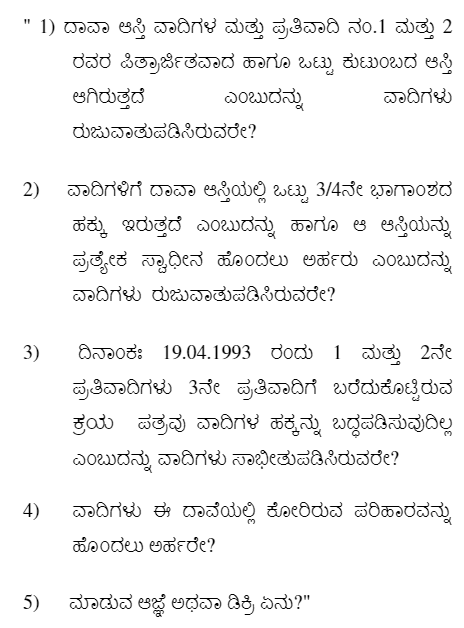
9. The Trial Court, based on the rival pleadings of the parties, framed the foll
AI
The validity of a sale deed executed by a Hindu Undivided Family member is upheld when legal necessity is demonstrated, despite claims of ancestral rights by co-parceners.

The court reaffirmed that a sale deed executed for family and legal necessity by a joint family member is binding, barring challenge by family members after significant delay without sufficient cause....

The legal principle established is that in cases involving the sale of joint family property, the burden of proving legal necessity lies with the purchaser only if the plaintiffs have properly pleade....

The validity of a sale deed in the context of family necessity and the application of limitation periods under the Limitation Act, 1963.

The court reaffirmed that prior sales of property before the 2005 amendment to the Hindu Succession Act are protected and binding, setting aside the trial court’s decree granting shares to plaintiffs....
The court established that a sale of ancestral property requires clear evidence of family necessity to be binding on co-owners, and the limitation period for challenging such sales is twelve years un....
A partition suit must prove ancestral status of properties; claims of prior partition require corroborative evidence, which was insufficient in this case.
The court affirmed that the recitals in registered sale deeds are pivotal evidence, prohibiting oral contradictions under Section 92 of the Indian Evidence Act, thereby establishing the ancestral nat....
Point of law: “Conduct of indifference or Acquiescence and held that, it is settled law that an estoppel may arise as against persons who have not willfully made any misrepresentation, and whose cond....



An indispensable Tool for Legal Professionals, Endorsed by Various High Court and Judicial Officers
Please visit our Training & Support
Center or Contact Us for assistance

Scan Me!
India’s Legal research and Law Firm App, Download now!


For Daily Legal Updates, Join us on :



 Back to top


