
 Back
Back





IN THE HIGH COURT OF KARNATAKA AT BENGALURU
M.I.ARUN, J.
Amulya R. W/o Vaishak K.H.V. – Appellant
Versus
The State of Karnataka – Respondent
Criminal Petition No. 4799, 5231, 5657 of 2024
Decided On : 07-11-2025
| Table of Content |
|---|
| 1. parties involved in business disputes resulting in legal action. (Para 1 , 2 , 3) |
| 2. arguments presented by defense and prosecution. (Para 4 , 5 , 6 , 7) |
| 3. investigation required to ascertain the validity of claims. (Para 8 , 9) |
| 4. differentiation between offences under ipc and n.i. act. (Para 10) |
| 5. conclusion on the dismissal of petitions and continuation of proceedings. (Para 11) |
ORDER :
1. The complainant and the petitioners had certain business transactions which resulted in the complainant lodging a complaint with respondent No.1-Police. Accused No.1 is the father, accused No.2 is his daughter, accused No.3 is the son-in-law and accused No.4 is the assistant of accused No.1. Criminal Petition No.4799/2024 is filed by accused No.2; Criminal Petition No.5231/2024 is filed by accused No.3 and Criminal Petition No.5657/2024 is filed by accused No.1 and accused No.4.
2. The complaint lodged by respondent No.2-complainant reads as under:
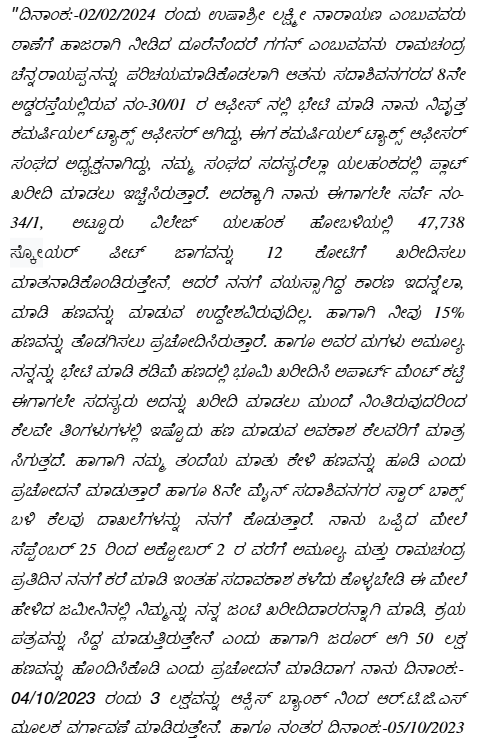
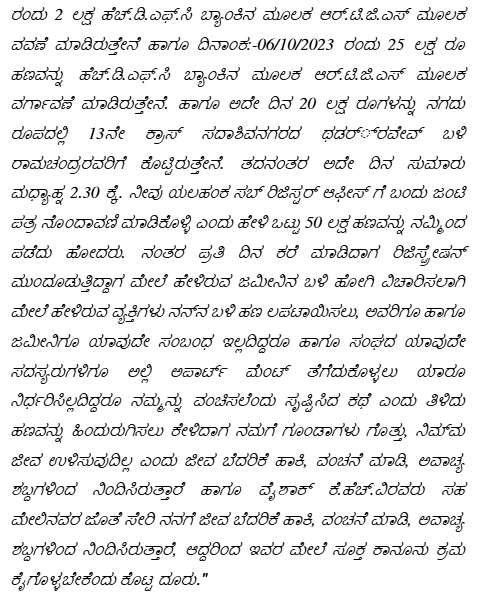
3. Based on the said complaint, the respondent No.1-Police have registered a Crime No.37/2024 on the file of III Additional Chief Metropolitan Magistrate Court, Nrupathunga Road, Bangalore City, for the offences under Sections 420 , 406, 506 and 34 of the Indian Penal Code, 1860 (for short, 'the IPC ').
4. Though several grounds are raised by the petitioners in their petitions, in the course of the arguments, the learned counsel appearing for accused Nos.1 and 4 limits her arguments to the following grounds:
i) Accused No.1 in the course of the transactions has issued post-dated cheques in favour of respondent No.2-complainant and the same have been dishonoured and respondent No.2-complainant has preferred a complaint under Section 138 of the Negotiable Instruments Act, 1881 (for short, 'the N.I. Act') and both the police complaint and the proceedings under of the N.I. Act are not maintainable.
ii) It is further contended that in the present FIR, police have accused, accused Nos.1, 2 and 4 of committing offences under Sections 406 and 420 of the IPC (Punishment for criminal breach of trust; Cheating and dishonestly inducing delivery of property), which are mutually destructive.
5. The learned counsel appearing for accused No.3 apart from adopting the arguments of the learned counsel for the other accused has also contended that the complaint does not disclose the commission of any offence by accused No.3 and prays for allowing the petition as prayed for.
6. Per contra, the learned High Court Government Pleader, upon instructions, submits that accused No.1 is in the habit of collecting money from various persons and not giving them any property nor returning back the money as promised and more than seven(7) criminal cases are pending against him. Further, he contends that the allegations made in the complaint justify the registering of the FIR by the police and prays for dismissal of the petitions.
7. The learned counsel for respondent No.2-complainant adopts the arguments of the learned High Court Government Pleader and prays for dismissal of the petitions.
8. Perusal of the complaint reveals that respondent No.2-complainant has transferred money through RTGS and also by cash. It also reveals that accused No.1 has issued certain cheques to refund the same upon he not being able to get the property registered as promised. There is a direct allegation made against accused Nos.2 and 4 (daughter and assistant of accused No.1) about they being involved in inducing the complainant to pay the money to accused No.1. In respect of accused No.3 the only allegation made is that when she approached accused No.2 for refund of the money, he threatened the complainant with dire consequences and abused her.
9. Whether the aforementioned facts as alleged by the complainant took place or not is a matter to be investigated. It cannot be decided by this Court in exercise of its powers under Section 482 of Code of Criminal Procedure (for short, 'the Cr.P.C). However, there is an allegation of only on
AI
Accused cannot be charged under Sections 420 and 406 of IPC for the same act, as these offences are mutually exclusive; errors in FIR regarding charges are not fatal to proceedings.


Prosecutions under Section 420 IPC and Section 138 N.I. Act are distinct; trial for both based on same facts not permissible due to differing evidentiary requirements.


Point of law : exercise powers under Section 482 CrPC, the complaint in its entirety shall have to be examined on the basis of the allegation made in the complaint/FIR/charge-sheet and the High Court....

A mere breach of contract does not constitute criminal liability under IPC unless fraudulent intent is established at the time of inducement.
The court held that mere breach of contract does not constitute a criminal offence of cheating or criminal breach of trust, emphasizing the necessity of fraudulent intent from inception.



An indispensable Tool for Legal Professionals, Endorsed by Various High Court and Judicial Officers
Please visit our Training & Support
Center or Contact Us for assistance

Scan Me!
India’s Legal research and Law Firm App, Download now!


For Daily Legal Updates, Join us on :



 Back to top


